
|
|
||||
|---|---|---|---|---|
| Volume 42 Number 5, February 25, 2012 | ARCHIVE | HOME | JBCENTRE | SUBSCRIBE |
Workers' Weekly Internet Edition: Article Index :
Parliament Endorses Use of Military Force against Iran
Health and Social Care Bill:
David Cameron Manoeuvres – GP Commissioning “Health Summit” Without GPs
Weekly On Line Newspaper of the
Revolutionary Communist Party of Britain (Marxist-Leninist)
Website:
http://www.rcpbml.org.uk
E-mail:
office@rcpbml.org.uk
170, Wandsworth Road, London, SW8 2LA.
Phone: 020 7627 0599:
Workers'Weekly Internet Edition
Freely available online
Workers' Weekly E-mail Edition
Subscribe
by e-mail daily: Free / Donate
WW
Internet RSS Feed

The Line of March Monthly
Publication of RCPB(ML)Subscribe
In a debate last Monday, February 20, in the House of Commons, members of parliament voted not to renounce the possible use of military force against Iran and to support the Coalition government’s position which is “not to take any options off the table” and continue its warmongering path, with a minority of six MPs opposing. The debate took place as the Iranian Foreign Minister announced his government’s readiness for a new round of talks with Britain, the other UN Security Council members and Germany on a range of issues. The debate and vote in Parliament in regard to Iran were not dissimilar to those on previous occasions prior to the military strikes against Libya and Iraq and graphically illustrated how the Commons is constituted as a pro-war government and the need to constitute an alternative.
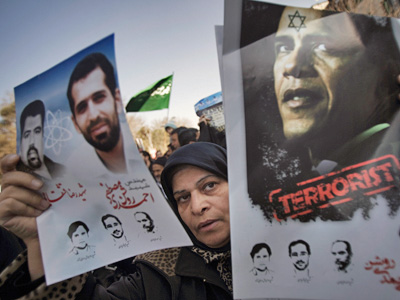

Left -Protest in Iran at the assassination of Iranian scientists.
Right - Syria Damascus Army and Police Casualties Memorial.
The parliamentary debate came in the wake of the deployment of a US-led naval force to the Strait of Hormuz, an escalation of economic sanctions, the recent assassination of Iranian scientists, the continued pressure applied by the International Atomic Energy Agency (IAEA), closely lined to the intelligence agencies of the US, Britain and other countries, and the open threat of a military strike on Iran from Zionist Israel. In reality these actions are themselves acts of war, since the stated aim of economic sanctions is to cripple the Iran’s economy, with the objective of bringing about regime change and reversing the political, economic and strategic reverses suffered by the imperialist system of states as a result of the Iranian Revolution of 1979. At the same time, Britain and its allies are also intensifying efforts to destabilise Syria, one of Iran’s main allies in the region, and to bring about regime change in that country too in order to further their domination of the entire region and create the conditions for further inroads into central Asia and increased contention with Russia and China. As in Libya, Britain has been instigating terrorist acts, inciting civil war, and inserting its special forces.
The statements made by William Hague, the Foreign Secretary, to the effect that the government is mainly concerned to prevent the proliferation of nuclear weapons in the Middle East will not wash. That argument was disputed in Parliament by a small minority of MPs, led by the back-bench Conservative John Baron, who pointed out that there was no concrete evidence that such weapons existed in Iran and that their existence was denied by the Iranian government. Indeed Iran's Supreme Leader Ali Khamenei is reported to have said, “We fundamentally reject nuclear weapons,” a position that was again reiterated this week. It was also pointed out that the government’s accusations in regard to Iran were very similar to those falsely made before the invasion of Iraq. Moreover, the Westminster consensus in opposition to nuclear proliferation is not extended to Zionist Israel, which acquired its nuclear arsenal largely as a result of the clandestine and open support of Britain, France and the US. Indeed the US government not only continues to financially support Israel’s development of nuclear weapons but also opposes any international action that “jeopardises Israel’s national security”. With this support Israel refuses to sign the Non-Proliferation Treaty or allow IAEA inspections.
Other remarks made by the Foreign Secretary highlight the fact that the government’s policy towards Iran is based on its opposition to that country’s role in the region, including its support for the government of Syria and for patriotic organisations in Lebanon and Palestine, as well as the nature of its political system. On this basis, Hague claims that Iran “threatens international peace and security”, as well as arrogantly asserting that “its policies endanger the interests of the Iranian people themselves”. In short, the government’s aim remains one of regime change.
The Coalition government’s belligerent attitude towards Iran is a continuation as well as an escalation of the policy pursued by the previous Labour government and what was most apparent about the debate in the Commons was the consensus that existed regarding the future possible use of military force. The use of force in international relations cannot be sanctioned. Whether the pretexts are the necessity for “regime change”, the “responsibility to protect” a country’s citizens, to deal with “crimes against humanity”, these remain pretexts for intervention and aggression by the big powers, who pick and chose when and where to bring these pretexts into play. They are a smokescreen for actual violations of international law by the big powers, not least by Britain. They attempt to block any coherent opposition to these violations and to hold the government to account.
Closing speech in the Commons debate by John Baron (Basildon and Billericay, Conservative):
I think it can safely be said that I have been in a very small minority in today’s debate, but I thank all right hon. and hon. Members for participating in it. The extent of the interest shown, particularly with a one-line Whip, has proved that it has been worthwhile, and there have been many interesting contributions. I remain of the view, though, that Government and Opposition Members have failed to address various points and have missed opportunities to better relations between Iran and the west.
The current policy of sanctions and sabre-rattling has failed. Iran will not be deterred, and yet the policy has brought us to the brink of military conflict. As most people accept, a military strike by Israel would be a disaster. It would unite Iran in fury behind the hard-liners in the country, it would not work because it would merely delay matters for perhaps a year at most, and it could lead to a regional war. Those who think otherwise are very wrong. Yet the Government and the Opposition keep the option of force on the table despite the fact that it would be disastrous, despite the fact that Iran ignores it, and despite the fact that it increases tensions and makes a peaceful outcome less likely. My contention is that by ruling it out we would reduce the tensions, bring ourselves back from the brink of military conflict, and give diplomacy a greater chance.
There has been no answer to my suggestion that the time has come for a fresh approach that recognises the status of Iran as a regional superpower. We need better to understand and engage with Iran. The precedent for this new relationship is Nixon’s rapprochement with the Chinese during the 1960s and 1970s; after all, China and the west had been at war in Korea just a decade before. The US needs to make it very clear to Israel that military action will not be acceptable. I saw no appetite for that in the House today, and I believe that we are missing a defining moment.
I hope that most of us, if not all, can accept that war should be the measure of last resort to be used only when all other avenues have been exhausted. My belief, in contrast to many of those who have spoken, is that we have not yet reached that point. I shall therefore oppose the amendment to my motion.
(Citation: HC Deb, 20 February 2012, c711)
John Baron is a former soldier and member of the Foreign Affairs Committee, he resigned from the shadow frontbench to vote against the Iraq war, opposed Britain’s intervention in Afghanistan, and was the only Conservative MP to vote against the Libyan intervention.
ShareThis
Health and Social Care Bill:
On Monday, February 20, protests were held outside Downing Street to demand that the Health and Social Care Bill be dropped. Inside Number 10, David Cameron had called his “health summit” in the face of the overwhelming opposition to the bill. According to reports, responding to the charge that his “health summit” excluded the BMA, the Royal College of GPs, the nursing colleges and other opponents of the bill a Downing Street spokesman said that the meeting was for those "constructively engaged in implementing the modernisation" and that the Prime Minister had no plans to meet health groups opposed to the NHS changes. But, he added, he was "listening to health professionals about how we can implement the reforms we have set out". Of course, these only included a few who have been involved in implementing the bill before it has been passed by Parliament.
Whilst nothing was reported on the Prime Minister' official website, on Wednesday David Cameron answered questions in Parliament on the “health summit”. There the Prime Minister tried to manoeuvre by saying what he wanted to do was “safeguard the NHS”. He said that “my summit was about those organisations, including clinical commissioning groups up and down the country – 8,200 GP practices – that want to put the reforms in place”. He went on to say, “We are going ahead with these reforms because we think it is good for patients to have choice, good to have the involvement of the independent and voluntary sectors in the NHS and good to have more emphasis on public health.”
However, one the main planks of the Health and Social Bill is that £80 billion of the NHS budget will be handed over to GP commissioners when the Strategic Health Authorities (SHA) and Primary Care Trusts (PCT) commissioners are abolished. How can the Prime Minister be “constructively engaged in implementing the modernisation” when the GPs’ representatives are not present at his “health summit” and he specifically claims that this health summit was about “those organisations, including clinical commissioning groups up and down the country – 8,200 GP practices”? Does this not reveal the truth that the bill is being implemented to hand commissioning and provision of the NHS over to the private sector under the guise of “GP commissioning”?
David Cameron's reference to having “more emphasis on public health” is also revealing of the aims of this bill. On answering to the fact that the Health and Social Care Bill would further fragment the NHS, he said, “Let me explain to him (Ed Miliband), because I do not suppose he has read the Bill, that clauses 22 and 25 place a specific duty on key organisations to integrate health and social care.”
Margaret Thatcher it was who in 1990 legislated for the first time to institute the “purchaser/provider” split into the NHS after the internal market model, which was embraced by New Labour under Tony Blair. As regards health and social care, it was in 1995 that John Major's government adopted a strategy of privatising NHS provision for elderly care. This led to the closure of all NHS elderly care hospitals and most elderly care wards and opened up a huge a lucrative market in private nursing homes. Not only was this because, like the present bill, the measures were aimed at privatising NHS elderly care enabling the big health monopolies to make huge profits for themselves and shareholders. It was also because elderly care was no longer designated as NHS health care but as “social care” and it came under public health local authority care and it became chargeable to the patients. In defining this, the John Major government redefined the meaning of the words health care and social care. “Health care” was to be confined to those elderly who required specialist intervention on a regular basis and “social care” was for elderly people requiring nursing and residential care and was means tested, forcing many to sell all their homes and assets to pay for their care.
The reference of the Prime Minister to put “more emphasis on public health” and to clauses in the present bill that put the “duty as to promoting integration” between “health care” and “social care” on the National Commissioning Board and local Commissioning Groups is therefore great cause for the concern. It indicates that this bill is not about unifying services but will place more NHS services not only in the private sector but will lead to charging for further NHS services.
In a separate move on Wednesday, the government also blocked the call by the opposition for the publication of the Department of Health’s risk register – the internal document listing the problems foreseen by officials with the government's proposals to reshape the NHS in England. The health secretary has been refusing to publish it, despite a ruling that he should from the information commissioner.
Whilst the massive opposition continues to the government's Health and Social Care Bill, David Cameron tries to manoeuvre. But his GP commissioning “health summit” without GPs has convinced no one about the aims of this bill but has underlined that it must be defeated.
ShareThis
 The political situation in
Greece has been developing quickly over the past month as moneylenders, with
the collaboration of the Greek government, have stepped up their
nation-wrecking offensive, while the people have responded with determined
resistance. Illusions about the establishment political parties have been swept
aside as these parties have come together to impose their illegitimate
authority over the country and force through further anti-social measures
demanded by the financiers.
The political situation in
Greece has been developing quickly over the past month as moneylenders, with
the collaboration of the Greek government, have stepped up their
nation-wrecking offensive, while the people have responded with determined
resistance. Illusions about the establishment political parties have been swept
aside as these parties have come together to impose their illegitimate
authority over the country and force through further anti-social measures
demanded by the financiers.
Just this week, protests have been taking place around the country, and in particular in Athens, outside parliament in Syntagma (Constitution) Square. These protests were held as Greek MPs passed the legislation demanded of them by the EU and IMF to receive a €130bn loan, coming just four months after a previous deal. Though private holders of Greek debt are to accept a loss of 53.5% on their bonds, new sweeping cuts are being made, such as a reduction of 22% in the minimum wage, down to just €580 per month, and less for those under 25 years old.
Furthermore, a permanent foreign monitoring team will be established in Greece to oversee economic policymaking, while debt repayments will be given priority over social programmes via a change to the Greek constitution.
The protests followed weeks of action while the government and the “troika” (the European Commission, European Central Bank and IMF) hammered out the latest nation-wrecking measures.
 A one-day general strike was held on
February 7 as the troika was beginning to make its new demands. Ports and
public transport were halted and schools and hospitals closed after the three
largest unions called the widely supported strike. Police used tear gas on
protesters in Syntagma Square, who had formed a human barrier around the
parliament building.
A one-day general strike was held on
February 7 as the troika was beginning to make its new demands. Ports and
public transport were halted and schools and hospitals closed after the three
largest unions called the widely supported strike. Police used tear gas on
protesters in Syntagma Square, who had formed a human barrier around the
parliament building.
A second general strike was staged beginning on February 10, this time for two days. When Greece’s ruling coalition finally reached agreement on February 11, Greek workers in their tens of thousands held two mass demonstrations outside Parliament, despite the efforts of the police, provocateurs and fascist groups to stir up violence. Communists adorned the Acropolis with banners calling for the cancellation of the debt, Greece’s withdrawal from the EU and an end to the dictate of the European monopolies.
A hated “austerity” bill was passed in the Greek parliament the following day, February 12, amid a growing political crisis in which the parties making up the government expelled over forty who failed to back the bill. More than 120 people were injured in protests across the country. In Athens alone organisers claimed a quarter of a million people assembled. Police repeatedly charged into the masses of peaceful protesters, firing stun grenades and tear gas.
These events began a week that saw workers at the Athens Steelworks mark 100 days on strike, as well as composer and politician Mikis Theodorakis together with hero of the Greek resistance during the Second World War Manolis Glezos call for an “uprising” after suffering a teargas attack in Syntagma Square. “United as one fist, one day we will oust unworthy governments, troikas and Merkel-Sarkozy,” said Theodorakis in an interview for Athens News.
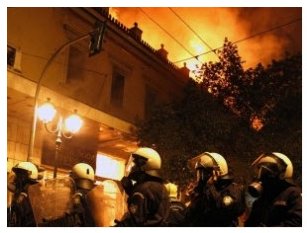 During that week, the demand also began to emerge from
the EU for much greater, more direct supervision of Greece’s economy. On
February 17, protesters pelted the German embassy with eggs, shouting,
“No to the betrayal of Greece in the name of Germany!” and
“Shouldn’t you first pay your debts from the Nazi period?”.
Members of the opposition party Syriza were arrested and later freed. Police
also attacked high school students who were demonstrating outside parliament.
During that week, the demand also began to emerge from
the EU for much greater, more direct supervision of Greece’s economy. On
February 17, protesters pelted the German embassy with eggs, shouting,
“No to the betrayal of Greece in the name of Germany!” and
“Shouldn’t you first pay your debts from the Nazi period?”.
Members of the opposition party Syriza were arrested and later freed. Police
also attacked high school students who were demonstrating outside parliament.
Thousands of Greeks protested on the streets again on February 19 “against the measures and unacceptable demands of the troika”.
The Greek people are only too aware of the growing dangers coming from their ruling circles, the big powers and the financial oligarchy they represent. Voices both within and outside Greece are calling for April’s elections to be postponed, while German Finance Minister, Wolfgang Schäuble, openly called for a technocratic junta. The popular demands that “no means no” and “enough is enough” are taking on an even greater significance at this time.
ShareThis