
|
|
||||
|---|---|---|---|---|
| Volume 42 Number 26, September 1, 2012 | ARCHIVE | HOME | JBCENTRE | SUBSCRIBE |
Workers' Weekly Internet Edition: Article Index :
The Workers’ Movement and the Necessity for an Anti-War Government
Libor Scandal:
The Need is to Break the Stranglehold of the Financial OligarchyLetter to the Editor:
The Olympics and Militarisation
Weekly On Line Newspaper of the
Revolutionary Communist Party of Britain (Marxist-Leninist)
Website:
http://www.rcpbml.org.uk
E-mail:
office@rcpbml.org.uk
170, Wandsworth Road, London, SW8 2LA.
Phone: 020 7627 0599:
Workers'Weekly Internet Edition
Freely available online
Workers' Weekly E-mail Edition
Subscribe
by e-mail daily: Free / Donate
WW
Internet RSS Feed

The Line of March Monthly
Publication of RCPB(ML)Subscribe

2 million march through London against
invasion of Iraq, February 15, 2003.The
government’s actions and statements in regard to Syria, not to mention
the well publicised bullying of the government of Ecuador, show that it is
continuing to flout even the most basic norms of international relations
established after the Second World War. It operates on the basis that might
makes right, with an arrogant contempt for those it does not consider its
equals. It openly interferes in the internal affairs of sovereign nations, is a
barrier to progress abroad as well as at home, and a major contributor to
global militarism and instability, as its intervention in Afghanistan, Iraq and
Libya have demonstrated.
The current British government is a close ally of US imperialism, a contender with the other big powers for geo-political advantage in Africa, Asia and elsewhere. In this context, it has demonstrated that it is ready to intervene militarily and by other means to effect and maintain regime change. It remains one of the main props of many of the most reactionary regimes in the world, and an enthusiastic agent of the major arms manufacturers, big monopolies and big banks. It is prepared to sanction assassination, to carry out criminal acts in concert with its allies, to ignore international law and the UN Charter, to intervene wherever the interests of capital dictate and to create misery and instability throughout the world in the name of “humanitarianism” or “the right to protect”, or on the basis of allegedly upholding certain values, which it now describes as “enlightened self-interest”.
In these circumstances, it is the duty and responsibility of the organised workers’ movement to discuss how to stay the bloody hands of this government and how the working class can break with and settle scores with the chauvinism and imperialism of the ruling elite. There is the need to consider how to further develop the movement against the warmongering and interventionist policies of successive British governments that has been much in evidence in recent years. Millions have opposed military intervention in Iraq, demanded that British troops are withdrawn from Afghanistan and elsewhere and that Britain withdraw from NATO, which in Libya and elsewhere has clearly shown itself to be a warmongering alliance of the big powers, a weapon in the hands of US imperialism and its allies to be used for the most reactionary aims. The anti-war movement has not yet succeeded in terminating the British government’s interference and intervention throughout the world, but history shows that such a movement with the workers playing a leading role is the only force that is able to do so.
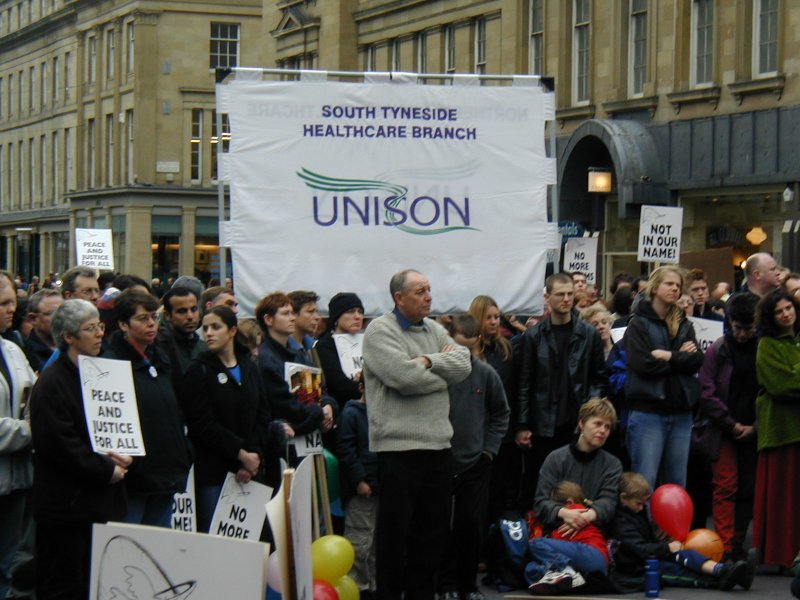
Workers in Newcastle oppose the "war on terror"
and the invasion of Afghanistan, 2001. The workers’
movement and the working class of England, Scotland and Wales must take up this
responsibility not only in their own interests, since the economic crisis and
austerity measures faced at home are also reflected in the warmongering and
interventionist actions of British governments abroad, but also on the basis of
proletarian internationalism, fighting as one with the workers and oppressed
people of all countries. The struggles of the British working class are an
integral part of the struggle of all workers to liberate humanity from the
imperialist system of states and the agenda of neo-liberal globalisation. The
working class of Britain must take a conscious stand as a contingent of an
international working class engaged in one struggle. It is a struggle to put
paid to the capital-centred world, to settle scores with the rich and their
system and usher in a new society in which the needs of working people will
take centre stage and in which the workers themselves will be the
decision-makers.
The workers’ movement must take up the issue of how the rich and their governments intervene to the detriment of the working people of other countries and how conditions can be created to establish an anti-war government in Britain which is guided by a principled stand against all pretexts which seek to deprive the peoples of their sovereign decision-making power. This would be a government in which the interests of the working people would take first place. It would be a government constituted by the working class and people that bases itself on the principle of respect for other states and non-interference in their internal affairs, which withdraws from the warmongering NATO alliance and removes all British troops from foreign soil.
Fight for an Anti-War Government!
For the Unity of the Working Class and Oppressed People of All Countries!
Yes to Sovereignty – No to Aggression!
ShareThis
Libor Scandal:

London G20 Demonstration April 1, 2009.
The past few months have seen the breaking of two major scandals
surrounding interest rates, the most widely publicised being the Libor scandal
resulting in the resignations of a number of senior managers of Barclays.
Currently lower down the news headlines is a further scandal over the
mis-selling of interest rate swaps. These two scandals underline the need to
break the stranglehold of the financial oligarchy and for an alternative to its
system of international usury.
Loosely speaking, Libor is the interest rate at which major global banks supposedly lend to each other. These banks, such as JP Morgan Chase, HSBC, The Royal Bank of Scotland Group and others, have high credit ratings (AA or more) and are considered very unlikely to default on their debts, at least until the onset of the present crisis. Since its introduction in the mid 1980s, Libor has come to play a central role in financial markets and lending at all levels of the economy. For example, due to the high ratings of the banks involved, Libor is considered an estimate of the “risk-free” rate of interest, and is used as such in the pricing of derivatives*. Due to its importance, manipulation of Libor to make big scores and other purposes exacerbates the disequilibrium in these markets. Though such activity is presented as particular in nature, due to a number of individual banks, in actuality it is part of the general criminal activity of the whole financial oligarchy.

London G20 Demonstration April 1, 2009.
An initiative of the British Bankers’ Association** (BBA) in
collaboration with other parties such as the Bank of England, Libor was
officially introduced in 1986. This was an era in which the markets were
undergoing transformation and trading in derivatives was beginning to take off
in a big way. It coincided with the Thatcher-Regan period of liberalisation and
the unleashing of the anti-social offensive. Banks in this period had begun
trading in interest rate derivates such as forward rate agreements, and sought
uniformity in pricing these instruments, which were relatively new at the time.
Libor now forms a cornerstone of contemporary financial arrangements. According to the New York Times, over $350tn in derivatives and other products are priced according to Libor, while the BBC reports that Libor is used to set a total range of financial transactions worth in the region of $800tn, twelve times world GDP. In particular, £6.4tn in loans are indexed to Libor. As well as interbank lending, this includes mortgages and credit card lending. Along with the similar Euribor, Libor is the main standard for short term interest rates around the world.
Libor is calculated by the BBA. Each day, a panel of large banks operating in London submit their answer to the question “At what rate could you borrow funds, were you to do so by asking for and then accepting inter-bank offers in a reasonable market size just prior to 11 am?” The four highest rates and the four lowest responses are ignored and an average is taken of the remaining rates. This average, reported at 11:30 am, is the Libor rate.
It is clear that this methodology is inherently subjective and open to collusion and manipulation from the outset. Indeed, the entire form and content of Libor – the history out of which it arose, its method of estimation and the role it plays in the financial system – reflects the domination of the world economy by a powerful financial oligarchy, represented in this case by a handful of big financial monopolies, who effectively decide this key quantity between themselves. The fact that an interest rate takes on such importance is itself indicative of a parasitic financial system based on usury.
As Bank of England Governor Mervyn King back in 2008, Libor “is in many ways the rate at which banks do not lend to each other, ... it is not a rate at which anyone is actually borrowing.”

Earlier that year, a Wall Street Journal study implied that the
financial monopolies may have reported lower rates for the calculation of Libor
during the credit crunch, to both give the impression that individual banks and
the banking system as a whole were in better shape than they in fact were at
that time. The rate each bank reports is effectively a statement on how
creditworthy it appears to its competitors.
This study was followed up by a report last year in the same newspaper that the actions of the Bank of America, Citigroup and UBS were being looked at by regulators.
In February of this year, the US Department of Justice revealed that it was conducting a criminal investigation into how Libor was being manipulated for big scores. For example, it has been exposed how traders were given prior knowledge of daily Libor quotations by banks in order to give them a trading advantage resulting in profits running into the millions.
On June 27, 2012, Barclays Bank was fined a total of nearly £300m by various authorities for Libor and Euribor manipulation, in a scandal which resulted in the resignations of chairman Marcus Agius, chief executive officer Bob Diamond and chief operating officer Jerry del Missier.
As the evidence has mounted, it has become clear that this is not the act of any single institution. According to reports, each of the 16 banking giants involved in the setting of Libor are under investigation over the issue or have had lawsuits filed against them. The sheer size of the funds controlled by these banks illustrates the scale of the activity. It has been exposed how banks have colluded with each other, as well acting individually, over a period of time stretching back years.
In a related issue, it has been revealed how interest rate swaps were fraudulently sold by financial monopolies as insurance against rising interest rates, when lending to particularly small businesses and local authorities, with devastating effects. The driving down of interest rates by central banks such as the Bank of England on the one hand, and the artificial suppression of Libor rates on the other, left those supposedly “protected” with huge sums to pay annually to these monopolies.

The Libor and
interest rate swap scandals are an exposure of the parasitic nature of the
financial oligarchy as a whole and its banking system based on usury. From the
criminal behaviour of various individuals and organisations, to the institution
of Libor itself and all of the arrangements of the markets, all are features of
the financial oligarchy acting with impunity.
Corrupt practices, extraction of tribute via interest on loans and market speculation are all ways that the financial oligarchs drain wealth from the socialised economy. These huge private claims and practices block the development of the socialised economy by, on the one hand, taking away what should be available for investing in social programmes, and on the other, leading to an enormous accumulation of wealth, privilege, influence and power over all aspects of the economy, society and the state.
These practices have no place in a modern economy, and their corruption is a sign of decay, reflecting their outdated character. The government’s current Financial Services Bill, to be supplemented by the recommendations of the forthcoming Wheatley Review in the wake of the Libor scandal, will propose additional regulation of these practices. Such reforms are aimed at keeping the defunct system going, strengthening the financial oligarchy and diverting the working class from developing its opposition. The Workers’ Opposition is aimed at actually restricting monopoly right, challenging the banks’ power to plunder and manipulate the economy for private profit; it takes the lead in fighting for the alternative.
Criminal activity such as the present Libor scandal originate in the banks’ use of the massive pooled social funds they control for private profit, both legally and illegally. The working class must fight for an alternative, public and not-for-profit system of financial services that puts more back into the economy than is taken out by pooling social funds for investment in social programmes, not for paying the rich. Workers should discuss a new direction for the economy where the charging of interest is no longer permitted and the dependency on interest rates is eliminated.
___
* Derivatives (known by names such as futures, forwards, options and swaps) are contracts that specify conditions under which payments or purchases of underlying assets are to be made and are the means by which financial institutions and traders mitigate or transfer their risks, speculate and attempt to find so-called arbitrage opportunities (riskless trading occurrences, which are only profitable for big players, particularly hedge funds). These ever-more-exotic trading instruments have played a key role in all crises since the 1980s, most notoriously the present.
** The BBA is the world’s largest financial association, representing more than 250 institutions based in 50 countries and operating in almost every country.
ShareThis
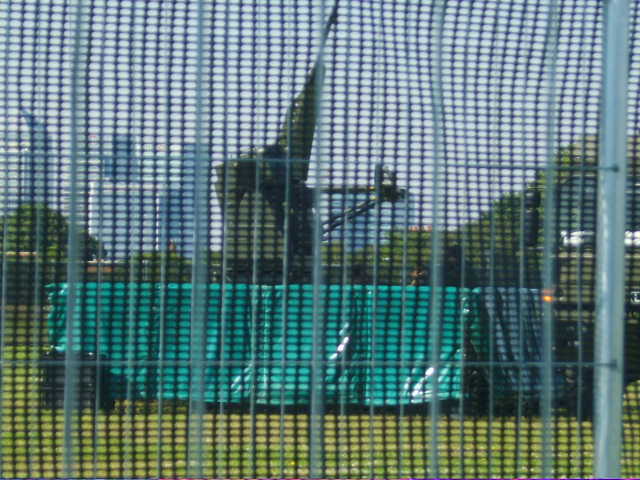
Missiles on Blackheath
I thought the WWIE articles on the Olympic Games were excellent.
“No to the Hysteria Generated over the Olympic Games” clearly
explained how the Olympics have been used to further the militarisation of
society.
Last Saturday I went over Blackheath and a corner of Greenwich Park. The main entrance to the park has been closed off and behind the high metal fences there are security guards and soldiers patrolling up and down; there were also soldiers patrolling on Blackheath itself. The whole area is like a war zone – it is not as if there were even any games going on at the time! The article on the opening ceremony very successfully put this very highly praised event in perspective, “sanitising the reality” – i.e. the harsh times in which we live.
ShareThis