
|
|
||||
|---|---|---|---|---|
| Volume 42 Number 31,October 13, 2012 | ARCHIVE | HOME | JBCENTRE | SUBSCRIBE |
Workers' Weekly Internet Edition: Article Index :
Victory for Chávez in Defence of the Bolivarian Revolution
Weekly On Line Newspaper of the
Revolutionary Communist Party of Britain (Marxist-Leninist)
Website:
http://www.rcpbml.org.uk
E-mail:
office@rcpbml.org.uk
170, Wandsworth Road, London, SW8 2LA.
Phone: 020 7627 0599:
Workers'Weekly Internet Edition
Freely available online
Workers' Weekly E-mail Edition
Subscribe
by e-mail daily: Free / Donate
WW
Internet RSS Feed

The Line of March Monthly
Publication of RCPB(ML)Subscribe

March in London on October 6th Naming
the DeadOctober 7 marked the 11th anniversary of the
Anglo-US invasion and occupation of Afghanistan. On this anniversary, to ensure
the end of the continuing carnage and to oppose the new threats of the NATO
powers to intervene in Syria and attack Iran, RCPB(ML) calls for the immediate
withdrawal of all the remaining British troops from Afghanistan, and for
Britain to get out of the warmongering NATO alliance forthwith.
The anti-war forces have stood on principle to oppose any conciliation with the warmongers’ pretexts and justifications for imperialist war, aggression and intervention. Neither have the people of Afghanistan submitted to the brutal onslaught of the past 11 years at the hands of the occupying forces which has caused such untold death and destruction.
The ruling circles in this country have continued to attempt to draw a line under Britain’s colonial and imperialist past and claim that they are for justice and even for “revolution”. The Coalition claims that it is for the end of tyrannical regimes, while attempting to throw dust in the eyes of the anti-war forces and working class movement to blind them to the heinous crimes of their own ruling elite.
The British government’s interference in the current conflict in Syria, its support for violent regime change, assassination and subversion, have demonstrated that it retains its reactionary role as a major interventionist power in the world. The carnage of human beings using highly sophisticated weapons against a barely armed resistance and civilians in Afghanistan, one of the poorest countries of the world, beggars belief.
The Coalition government boasts about the role is has taken in the UN Security Council and the EU, where it has been the most zealous advocate of sanctions and a hostile stand to the Assad regime. Similarly, it has openly and brazenly supported the armed opposition to the Syrian government, even though such support breaches the norms of international law and the UN Charter. Together with its allies, principally the US and the other major NATO powers, as well as the most reactionary states in western Asia, it has played a leading role in the so-called Friends of Syria organisation, instigated civil war and armed rebellion against another member of the UN.
The boast of the British government is that it is the most zealous supporter of what it refers to as the “Arab Spring”, the popular movement that swept through parts of North Africa and beyond in 2011. The British government seized on this movement as a “great opportunity” to strengthen its own position in the region, to extend NATO’s influence and to eliminate regimes that were not to its liking, first in Libya and now Syria. In so doing, Britain and its allies also sought to weaken the influence of Iran, strengthen the position of Zionist Israel and further extend NATO’s position in central Asia, where it is in contention with Russia and China.
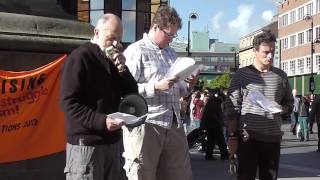
Naming the Dead, Newcastle, October 6th
It was Blair and his governments that developed the
notions of “humanitarian intervention”, and “failed
states” and “the doctrine of international community”, to
provide justifications for military and other external intervention. The aim
was to subvert the UN Charter, especially Article 2 that upholds the rights of
states to political independence and territorial sovereignty and the principle
of non-intervention unless there is a specific threat to international peace,
and to strengthen the feudal notion of Britain and the other big powers that
might is right. In a similar fashion the “right to protect”
civilian populations has been invoked and elaborated as a justification for
military intervention in Libya and the basis for interference elsewhere,
including in Syria.
Under the Labour government of Blair, Britain emerged not only as the major ally of US imperialism throughout the world but the major theoretician of the so-called “war on terror” and policy of global intervention. The present government has proceeded along the same reactionary course but has distinguished itself by appearing even more bellicose first in instigating rebellion and regime change by military means in Libya and now attempting to implement the Libyan model in Syria. At the same time, it continues to issue threats against Iran.
Whereas the Labour governments spoke of their aim to “make Britain great again” and the promotion of so-called “universal values”, the current Coalition states that it is guided by “enlightened national interest” but continues to defend the values of the financial oligarchy and neo-liberal globalisation and to brazenly support all those who adhere to such values. The government still wishes Britain to “punch above its weight” in international affairs and boasts that although the country is only the sixth largest economy it has the fourth largest military budget in the world. It aims to take advantage of global economic and political instability to assert itself particularly in Asia but also in other parts of the world. For this end, it is rapidly modernising the armed forces and playing a leading role in encouraging an expansion in NATO’s interventionist role in the world. However, its stated aim is to intervene by other means wherever possible, including the use of “special forces” rather than by outright military might. The Coalition government seems determined to continue to play a reactionary interventionist role in the world, closely allied to US imperialism, and the other big powers of NATO and the EU.
For the working class, “A Future that Works” must also be a future without war. To bring this about, the working class and people must fight for an anti-war government in Britain.
This means that te working class and people must stand shoulder to shoulder with the working class and people of all lands as a single whole against imperialist domination. Through their own efforts, they must establish an anti-war government, rejecting with hatred and contempt the unbridled chauvinism that comes from an outdated and reactionary social system which is lauded in such obscene terms by those who hold political power or who refuse to settle scores with Britain’s imperialist past and present. When the working class and people are able to take such a stand, they will be well on the way to establishing a future without war, based on the internationalism of the working class and the unity and friendship of all the peoples of the world.
ShareThis

Crowd greets Chavez following his victory
On October 7, Venezuelans once again went to the polls to elect their
president. Hugo Chávez won an outstanding victory against Henrique
Capriles, the candidate of the right-wing neo-liberal Coalition for Democratic
Unity (MUD).
The National Electoral Council announced on October 7 that with most of the ballots counted, the president had secured 54.42% of the votes, while his rival Capriles was behind with 44.9%. This gives Chávez another six-year mandate until 2019.
As the result was announced, his supporters burst into cheers and songs of "Viva Le Patria" and shouted slogans in praise of Chávez.
Underlining the intense interest in the campaign, the turnout among the 19 million registered voters was a record 80.4%. The result signals the deepening of the Bolilvarian revolution, despite all the attempts of the neo-liberals to sabotage it, including an attempted coup.
This election had presented Venezuelans with two alternative visions for the country. Would the social progress of the past decade, based on growing and sharing the wealth, continue? Or would there be a return of the types of neo-liberal policies that failed Venezuela and Latin America and which are today causing so much harm in Europe?
The election of Hugo Chávez in 1998 marked the end of a forty-year period known pejoratively in Venezuela as puntofijismo. This describes the pact signed by the two major parties – AD and COPEI – to keep other parties and the voice of millions of people side-lined in order to share the spoils of Venezuela’s oil wealth amongst a small minority.

Against this
backdrop, Hugo Chávez – coming from outside the established and
corrupt two main parties – was swept to office in 1998 with 57% of the
vote and with a mission to transform the country.
In this election, President Chávez called on Venezuelans to not permit a return to the situation of the 1980s, underscoring that a vote for his continued leadership of the Bolivarian revolution "is a vote for the youth, the future, security, stability and development".
The achievements Venezuela have made have shown the fundamental importance of increasing investments in social programmes. In an official report made by Venezuela to the UN Human Rights Council on October 7, 2011, it was highlighted that Venezuela has spent around US$400 billion on a vast range of such investments since the Chávez government came to office.
It is also worth noting that even during the financial crisis, which had a very negative impact on the Venezuela economy, spending on social services was maintained as the government sought to protect the living standards of the majority. The government now believes that spending on social programmes should not only be maintained but increased to help stimulate economic growth and jobs.
The inclusion of the people in the political and cultural life of the country has also been notable. One of the most famous examples is that of Venezuela’s widespread system of community youth orchestras, El Sistema, which has been internationally recognised as one of the best music programmes in the world. Sir Simon Rattle has said, "There is no more important work being done in music than what is being done in Venezuela."
WWIE hails the victory of Hugo Chávez, which represents the alternative prevailing over the neo-liberal agenda, and a victory for the programme of defending the gains of the Bolivarian socialist revolution.
ShareThis
“Celebrating the Outstanding Achievements of the DPRK” was the title of a friendship and solidarity meeting held on Saturday, October 13. It was organised at the John Buckle Centre by the Friends of Korea (FoK), and marked the 67th anniversary of the Workers’ Party of Korea, which fell on October 10. The FoK has the aim of combating the disinformation peddled by those who wish the DPRK ill, and accuse it of all the crimes that imperialism is itself responsible for. To this end it seeks to unite all friends of Korea in Britain in taking a stand in favour of the DPRK, and to encourage all to investigate the truth about the DPRK, its achievements and social system, and to defend the right of the DPRK to its independence and sovereignty and the right of its people to chart their own destiny.
In the DPRK today, the people fully benefit from universal free medical care, guaranteed under the Socialist Constitution and the Public Health Law. The system of taxation was abolished 38 years ago, with the national economy on a firm footing being the source of the state income.
Of note recently has been the care of the rising generation. This is not only evident in the guaranteed right to education, but the organisation of children into the Korean Children’s Union representing the hope and future of the DPRK. In the DPRK there is universal 11-year compulsory education. There are also a huge number of large and small colleges.
The government of the DPRK is a genuine people’s government with local organ’s of power, as well as the Supreme People’s Assembly.
The Korean people receive such social benefits as free housing, and to constantly improve the people’s living standards is the central aim of the organisation of the economy. As an example, spectacular new tower blocks of flats have been erected in the past year in Changjon Street in Pyongyang, changing this area of the capital beyond recognition, including public service amenities and parks, in addition to modern dwellings.
At the meeting, Michael Chant, as Secretary of the FoK, welcomed all the participants who filled the hall. He especially welcomed Mun Myongsin as guest from the Embassy of the Democratic People’s Republic of Korea in London. The meeting opened with the showing of a film on Kim Jong Il and the significance of his Songun politics, following which a talk was given by Dr Hugh Goodacre on the history of the Workers’ Party of Korea. A period of discussion followed, and extracts from messages to the meeting from Andy Brooks, Chair of FoK, and Dermot Hudson, Vice-chair, were read out.
In conclusion, it was pointed out the importance of the DPRK’s finding a place in the hearts of working people in Britain, in the spirit of friendship and proletarian internationalism.
For your information, documents from the DPRK on the Workers' Party of Korea and on Kim Jong Il may be read by clicking on the links.
ShareThis
October 13, 2012 (Juche 101)
To the Supreme Leader of the Korean People,
Respected Comrade Kim Jong Un
Dear Comrade Kim Jong Un
This friendship and solidarity meeting convened to celebrate the 67th anniversary of the foundation of the Workers’ Party of Korea conveys to you its warmest greetings. The meeting also marks the important 15th anniversary of the election of Comrade Kim Jong Il as the General Secretary of the Party and on this occasion we also pay tribute to Comrade Kim Jong Il as Eternal General Secretary of the WPK.
The Workers’ Party of Korea is imbued with a humanity and concern for the whole of society. It serves to unite the people around the cause of independence and socialism, in contrast to the aggression and brutality of imperialism which stands for war and outright reaction.
The progressive forces in Britain are duty bound to combat the disinformation of the enemies of the DPRK. We are fighting together against the imperialist forces that would turn back the world to medievalism in pursuit of their neo-liberal agenda. But the common cause of the people is that of the defence of independence and sovereignty of peoples and nations, and our common conviction is that humanity will achieve a world where the people are the masters of their own destiny.
May we wish you on this occasion good health and long life, and assure you that we stand shoulder to shoulder with you in our common cause of building a new world, the world of peace, independence and socialism.
ShareThis