
|
|
||||
|---|---|---|---|---|
| Volume 42 Number 35, November 18, 2012 | ARCHIVE | HOME | JBCENTRE | SUBSCRIBE |
Weekly On Line Newspaper of the
Revolutionary Communist Party of Britain (Marxist-Leninist)
Website:
http://www.rcpbml.org.uk
E-mail:
office@rcpbml.org.uk
170, Wandsworth Road, London, SW8 2LA.
Phone: 020 7627 0599:
Workers'Weekly Internet Edition
Freely available online
Workers' Weekly E-mail Edition
Subscribe
by e-mail daily: Free / Donate
WW
Internet RSS Feed

The Line of March Monthly
Publication of RCPB(ML)Subscribe

Demonstration at the Israeli Embassy,
London.Emergency demonstrations have been held
internationally since Israel began its latest aerial and ground assault on Gaza
with “Operation Pillar of Cloud”. The Israeli-Zionists have
launched murderous attacks on Gaza after assassinating the military commander
of Hamas. The Israeli army is widening its assault on the people of Gaza,
caring nothing whether unarmed civilians are tragically killed in this assault,
and bombarding the Palestinian’s homes and lands.
Unjustified killings of
civilians under the Israeli siege of Gaza are said to have provoked rocket
attacks from within the Gaza Strip. The Zionists in their propaganda have used
these rocket attacks as their pretext to wage a broader assault on Gaza. They
go

The Israeli Embassy, London.so far
as to use the Hitlerite policy of "collective punishment" against the
Palestinians trying to survive in the Gaza Strip.
The Coalition government joined
the Zionists' disinformation campaign. Far from condemning Israel’s
aggression, it has tried to heap blame on Hamas. Foreign Secretary William
Hague said, "Hamas bears principal responsibility for the current crisis.
I utterly condemn rocket attacks from Gaza into southern Israel by Hamas and
other armed groups. This creates an intolerable situation for Israeli civilians
in southern Israel, who have the right to live without fear of attack from
Gaza.” The Foreign 
Monument, Newcastle.
Secretary’s statement is the latest example of the
government’s decision to ignore international law with respect to
Israel's crimes against the Palestinian people, trying to construe the
Zionists’ aggression and war crimes as self-defence.
Thousands of Palestinians have held protests in different parts of the occupied West Bank against the ongoing Israeli military aggression against Gaza. The Palestinians in the Gaza Strip and the West Bank are escalating the resistance against the Israeli occupation in response to the aggression against the Palestinian people in the Strip.
RCPB(ML) denounces the war crimes of the Israeli-Zionists against the Palestinians. It vigorously condemns the ConDem government's support for these crimes. The crimes of Israel against the Palestinian people must be ended, and the right of the Palestinian people to justice, freedom and to exist as a people must be respected. Israel must end its violation of international law and basic human rights, and Britain and the other big powers must end their military, financial and diplomatic backing for the Israeli regime. All out to demand an immediate end to the aggression against Gaza!
ShareThis
On November 12, the Prime Minister delivered the customary annual speech on government foreign policy at the Lord’s Mayor’s banquet held at the Mansion House in London.
On this occasion, although David Cameron boasted of his government’s criminal actions in Libya, its warmongering policy towards Iran and Syria and its interventionist approach in general, he was even keener to boast about the government’s “new commercial focus” in foreign policy.
David Cameron told his audience of financial oligarchs and speculators, “there is a global race out there to win jobs for Britain and I believe in leading from the front. So I make no apology for linking Britain to the fastest growing parts of the world.” This to assure the City of London, and the rich in general, that the government and its diplomatic service are completely focused on serving their interests. The Prime Minister not only justified his recent trip to the UAE on behalf of the armaments monopolies but even boasted of the number of trade missions he had led since his election to that office, citing trips throughout Africa, Asia, and the Gulf region as well as to the BRICS countries. According to Cameron, the result was significantly increased exports to Brazil, China and Russia. Nevertheless, the Prime Minister claimed that some of Britain’s economic rivals were doing even better and that therefore the government would introduce additional measures of support, including appointing “senior parliamentarians as Trade Envoys” in order to “lead a transformation that will change the face of British trade overseas across the globe”. In this endeavour, the Prime Minister stressed in particular the importance of capturing new and emerging markets in Africa and Asia, including Vietnam, Algeria, Morocco, South Africa, Kazakhstan, and Indonesia.
As Cameron pointed out, the government’s foreign policy is focused not just on making Britain competitive in the global market but in outstripping its rivals. As he stressed time and again, “Right now Britain is in a global race. It is a moment of reckoning for every country. Sink or swim. Do or decline. The critical question is this. How does Britain compete and win in a world where all around us new countries are on the rise?”
The Prime Minister argued that what is required to make Britain “great” again is not just a concern with an aggressive and interventionist foreign policy, although it is clear that in some respects he considered it was not aggressive enough. What is also required, he claimed, is even more firmly gearing the entire economy, including social programmes, to the needs of the big monopolies and financial institutions to win the “global race”. There was, said Cameron, a need to “rebalance the economy” in order to “expand the private sector”. A need to cut corporation tax and provide other tax breaks for big business and a need to link education and the NHS more closely to the needs of capital, a need for government to support and subsidise business including creating the necessary infrastructure. In short, Cameron called for “a modern industrial strategy” to provide maximum support for those sectors of the economy where Britain has “a competitive edge”, such as the pharmaceutical, defence, agritech and energy industries, as well as the financial sector. In this regard, Cameron was particularly enthusiastic about the armaments industry which, he claimed, was “supporting British jobs and British allies”.
Nowhere did Cameron’s speech exhibit any concern for the needs of the people of Britain. Nowhere did he base himself on the needs of the people for a free, modern and enlightened education, for example, or a health service geared to catering for the needs and expectations of patients. He expressed no interest in a national economy centred around the needs of the population at all. The government’s concern is only for an economy and foreign policy that satisfies the needs of the financial institutions and big monopolies to win the “global race” against their rivals and realise maximum profits. It was in this context, for example, that Foreign Secretary William Hague visited India earlier this month as a salesman for the monopolies in order to further consolidate what is already the largest market for British goods outside the European Union.
The working class and democratic people demand an alternative path, one based not on the interests of the financial oligarchy and the values of neo-liberal globalisation, a path leading to war and destruction, but on the interests of the people’s well-being, developing trade on the basis of mutual benefit and co-operation.
ShareThis
Following on from the swamping of the Olympic stadia with army soldiers, the increasingly regular appearance of the military at public events, the Remembrance Day ceremonies and their coverage in the media bears witness to the increasing militarisation of society.
It is one thing to solemnly remember the dreadful slaughter of the First World War, when the Great Powers sought to redivide the world with callous disregard for the cost in human life, or to pay tribute to the sacrifices made in the heroic struggles against fascism of the Second World War, in which the Soviet Union bore the brunt of the losses. But it is another to glorify Britain's barbarous colonial wars, the military interventions in the devastating partition of India, the Korean War, the Malaya, Kenya, Suez, Cyprus and Aden "emergencies" amongst others, right up to the Malvinas campaign and the more recent criminal interventions in Afghanistan, Iraq and Libya. And such glorification only bolsters the threat of war which increases month by month against Syria and Iran.
What we are witnessing is the increasing militarisation of society at home, not to speak of the militarisation of the economy, and the increasing use of war abroad as the main instrument of foreign policy, the main means to settle international disputes. In other words, a policy of fascism at home and war abroad.
What the governing parties have in store and their justifications could be seen in an article by David Cameron in the Telegraph of November 10, on his plans to commemorate in 2014 the 100th anniversary of the outbreak of the First World War. He asserts that the commemorations will "capture the British spirit" and will "unite the country in national pride". He speaks also of the "huge geopolitical impact to remember – the unleashing of Nazism and Bolshevism that caused immeasurable suffering for decades afterwards". It is hard to believe that repugnant jingoism and outright falsification of history can descend to such crude depths! Yet Cameron is certainly not alone; week after week the media spew out such equally banal and sinister disinformation, dressed up as serious journalism or history.
As regards Cameron's remarks, any objective historical analysis would show irrefutably that it was the Bolshevik October Revolution which in fact brought the First World War to a swift end, that it was the West who financed and supported the rise of Nazism, and egged Hitler on to Go East and destroy the new workers' state, the Soviet Union. It would show that it was the proposals of the Soviet Union for collective security against fascism which could have prevented or, at least, made less devastating the Second World War, proposals spurned by the Western Powers, who instead signed the traitorous Munich Accord with Hitler which sealed the fate of Europe. It would show too that it was, in the end, the Soviet Union which would play the main role in the defeat of Nazism, while not belittling the vital contribution of others.
The increasing militarisation at home, the glorification of criminal war abroad, make clear the vital necessity to build the Workers’ Opposition, to change the direction of the economy and of society itself, to bring into being an anti-war government.
ShareThis

The biggest Europe-wide day of action so far in resistance to austerity was held on Wednesday, November 15. General and smaller strikes and mass demonstrations took place across the continent, particularly in Spain, Italy, Portugal, Greece, France and Belgium. Rallies and other actions were also held in Britain, Germany, Denmark, the Netherlands and elsewhere.
The day of “action and solidarity” was called by the European Trade Union Confederation, which represents nearly 90 organisations across Europe and came just a week after a two-day general strike in Greece. It is the first time such generalised strikes have been simultaneously held in a number of different European countries.
For the first time since the fall of the Franco dictatorship, two general strikes have been held in same year, with more than 9 million Spanish workers participating according to union figures. Power consumption was down 16% due to closed factories and other workplaces, while over 600 flights were cancelled.
Defying public opinion, Economy Minister Luis de Guindos said that the Spanish government would stick to the spending cuts. To back up his words, tear gas was used on protesters and police fired rubber bullets at demonstrators in Madrid.
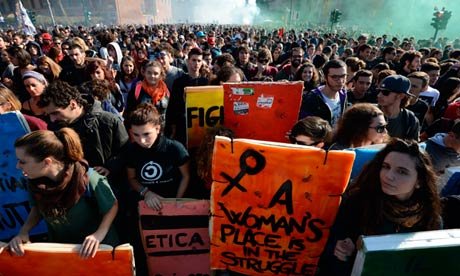
Rome, Italy.Tear gas was also used
in Italy, while many arrests were made in Italy and Spain as well as Portugal.
Portuguese strikers grounded 45% of national airline TAP and in Lisbon, many
thousands demonstrated in front of parliament demanding “Out IMF, out
troika”, and asserting “This debt is not ours!”.
Protesters occupied Italy’s iconic Leaning Tower of Pisa, raising the banner: “Rise up. We are not paying for your crisis.”
At a rally in central Athens, Greek demonstrators shouted, “Enough is enough!”
In France, marches were organised in more than 100 cities by the five main unions.
Strikes in Belgium severely disrupted the important Eurostar and Thalys rail links connecting Brussels with Paris and London.
In Britain, a rally was held outside the European Commission offices in Westminster.
“Today we stand in solidarity rejecting austerity and demanding a future that gets people back to work and that protects our public services,” said TUC General Secretary Designate Frances O’Grady at the rally. The people of Europe “will fight for an alternative based on social and economic justice”.
ShareThis
Since the imposition of the Health and Social Care Act 2012 on March 27, it as if the government has declared war on the social well-being of society, its health workers and its health system that has served society over decades since 1947. The situation shows that the government is determined to drive society down a path to disaster in terms of being able to meet the basic needs of people for health care as long as the finance capitalists and health monopolies get paid. Shockingly this week the Royal College of Nursing (RCN) revealed that “despite the Coalition's promise to protect front-line staff from cuts the NHS workforce has fallen by almost 21,000 since the Coalition Government came to power. This includes a loss of more than 6,000 qualified nursing posts – from a total of 312,000 nursing posts in the NHS.”
These days when health workers and their union organisations are faced with ever spiralling attacks on the health services they provide and on their jobs, terms and conditions, it is a struggle in itself not to become overwhelmed by the sheer weight of these attacks on every front. The constant drive to privatise particularly preventative and facility services at this stage but also whole acute and community services as well causes huge concerns and worry to health workers for their future and the future of their patients. Add to this the constant drive to reduce services and even whole hospitals, to reduce staffing levels to dangerous levels, to transfer staff from one “provider” to another, to attack terms and conditions in a myriad of ways, to freeze pay, to try and “regionalise” pay, seems relentless and unstoppable.
What has made and is making a difference is when health workers discuss what is what and what things mean within the conditions in which they are working. Analysing what the concerns are and what the solutions are and making sure that people at all levels are involved is crucial. So, for example, the Chief Executives of some NHS Foundation Trusts in the north-east have attempted to form a wages and conditions cartel to challenge the Agenda for Change terms and conditions, as has also been attempted in the south-west of the country. Opposition to this at all levels has meant that such a plan has broadly failed so far. Such thinking has been isolated in a recognition that a modern health service requires a national standard for the claim of health workers in regard to the role which they perform. As can be seen where the health service has been privatised, such as with the closure of elderly care hospitals and the creation of private nursing homes, not only do most residents now pay for their care but also the majority of the nurses are paid only the minimum wage and not even a “living wage”.
Responding on a daily basis to this whole government-driven anti-social offensive in the sphere of health is a crucial if workers are to maintain their resistance and organisation and defend their rights as well as the right to health care of their patients. One of the most important questions for health workers is also to develop their own thinking in the fight for the future of the NHS and to build their resistance and organisation on this basis. This means to start building that future in the here and now by first of all demanding that the Health and Social Care Act 2012 be repealed.
ShareThis
On October 17, UCATT (the Union of Construction, Allied Trades and Technicians) released a report showing that there was a large increase in construction fatalities involving self-employed workers last year.
The report stated: “In total there were 49 construction deaths in 2011/12 of which the Health and Safety Executive have recorded that 22 involved self-employed workers, 45% of all construction fatalities.” It continued: “In 2010/11 36% of construction deaths involved self-employed workers and in the last seven years the previous highest number of construction deaths involving self-employed workers was in 2008/09 when 38% of fatalities were self-employed workers. The highest number of deaths was in the Midlands where 8 workers were killed, an increase of 2 on the previous year. The number of deaths in the West Midlands doubled from 3 to 6.” The report also pointed out: “There were also 7 fatalities in the North West and the South East, in both cases an increase on the previous year. There was also a major increase in deaths in the South West where fatalities doubled from 3 to 6, in 2011/12.”
UCATT general secretary Steve Murphy said: “This rise in deaths among self-employed workers is very worrying. Self-employed workers frequently work on sites where safety levels are lower and are therefore more vulnerable to suffering an accident or injury.”
The UCATT report pointed out that, under the government’s direction, the Health and Safety Executive (HSE) is currently consulting about removing some self-employed workers from health and safety regulation. The report further explained: “While these proposals do not currently include construction there are concerns that the policy will be extended in the future, as part of the government’s desire to ‘cut red tape’.”
Steve Murphy said: “Every one of these deaths was an individual tragedy and many could easily have been prevented. Rather than cutting safety, the government should be ensuring that existing laws are properly enforced.”
“It is vital to remember that each of these deaths was an individual tragedy. Construction deaths remain far too high and many of these deaths could have been prevented.”
He added: “Sadly construction deaths are likely to rise in future. After every previous recession as the construction industry has recovered there has been a large increase in deaths. These dangers will be increased due to the cutbacks to the Health and Safety Executive and the Government’s attacks on safety laws.”
On November 13, UCATT pointed out that Mayor of London Boris Johnson had refused to answer whether he would support the direct employment of construction workers in order to reduce deaths and injuries. Jerry Swain, UCATT Regional Secretary for London and the South East, said: “Sites where workers are directly employed are safer. Direct employment and proper engagement with trade unions about safety was the primary reason why London delivered a safe Olympics. Boris Johnson should not try to ignore those lessons through misdirection and weasel words.”
UCATT are now seeking a meeting with Boris Johnson to get his support to ensure that future public sector contracts in London specify direct employment and that private sector contracts be strongly encouraged to follow the same safety models.
ShareThis