
|
|
||||
|---|---|---|---|---|
| Volume 43 Number 32, October 19, 2013 | ARCHIVE | HOME | JBCENTRE | SUBSCRIBE |
Save Lewisham Hospital Campaign Sets Out Its Strategy:
Workers' Weekly Internet Edition: Article Index :
Defence of Lewisham Hospital Is Defence of the Whole NHS!
NUT and NASUWT Teachers’ Strike Actions
Commentary:
Teachers Taking a Stand Together to Protect Teachers and Defend Education
Weekly On Line Newspaper of the
Revolutionary Communist Party of Britain (Marxist-Leninist)
Website:
http://www.rcpbml.org.uk
E-mail:
office@rcpbml.org.uk
170, Wandsworth Road, London, SW8 2LA.
Phone: 020 7627 0599:
Workers'Weekly Internet Edition
Freely available online
Workers' Weekly E-mail Edition
Subscribe
by e-mail daily: Free / Donate
WW
Internet RSS Feed

The Line of March Monthly
Publication of RCPB(ML)Subscribe
Save Lewisham Hospital Campaign Sets Out Its Strategy:

The Save
Lewisham Hospital Campaign (SLHC) at its mass meeting earlier this month
approved its campaign strategy for the next six months. This was an important
development for the campaign, and shows it consolidating the factors of
consciousness and organisation which had contributed to its successes to date
and setting out a plan of campaign to build on them.
As the SLHC website rightly suggests, the campaign has been and continues to be a source of inspiration to many others. Health workers, professionals and the communities which they serve are fighting similar battles on different fronts in the overall struggle to emerge victorious in safeguarding the future of the NHS as a health service dedicated to providing health care for all members of society of the highest quality as of right.
One of the most important features of the SLHC is that its struggle has been carried out on the basis of self-reliance, basing itself on the strength of the people themselves mobilised to participate around the aim of defending Lewisham Hospital and its core acute and maternity services. Not to fight was not considered an option, as the government’s plans would have led to the closure of Lewisham as a district general hospital. The campaign continues to demonstrate the absolutely crucial importance of unity in action of the people’s forces to achieve their goals, irrespective of the political opinions of the individuals and collectives involved.
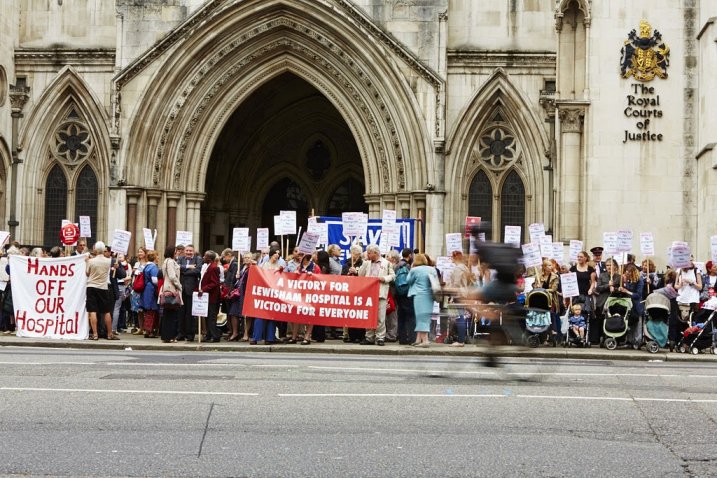
Historic victory at the High Court in taking
on the government in a judicial reviewAs readers may
know, the SLHC won an historic victory at the High Court in taking on the
government in a judicial review of its plans to embroil Lewisham Healthcare in
financial issues of sustainability which did not pertain to it. As the strategy
document says, “At this point we have the upper hand. Everything we have
done so far, big or small, has been a positive contribution to our overall
success. Our high court victory was historic as it challenged the first use of
legislation that if left on the statute books could be used to close and
downgrade hospitals all over England.”
The document emphasises, however, “Our message is that this was a victory in just one battle in a long war not only to protect our local services but the whole NHS.” This could be said of every step the campaign has taken moving from one successful step to another. This outlook also emphasises that the SLHC campaign provides an example in its perspective to fight the battles as they actually present themselves concretely. As the SLHC website points out, by successfully defending the local services, the working class and people are actually engaged in defending the whole NHS.

The People's Commission The
government is appealing against the judicial review decision, and the appeal is
being heard in the High Court on October 28 and 29. The Campaign emphasises
that regardless of the outcome of the appeal, the fight to save our hospitals
goes on. “Even if we win the appeal,” the SLHC says, “we know
there are huge threats facing Lewisham Hospital in the future. These threats
come from massive funding cuts to all hospitals and healthcare facilities;
toxic Private Finance Initiative payments and privatisation of NHS
services.” There are also signs that the government intends to widen the
powers of Trust Special Administrators, the issue at the heart of the legal
argument in the judicial review.
This emphasises the importance of adopting a political outlook in each battle the people are undertaking to defend the health service. The SLHC outlines some of the wider threats involved. The strategy document says, “We recognise that Lewisham Hospital cannot be safe unless the NHS is safe; that the threats to Lewisham Hospital are part of a wider attack on the NHS (cuts, privatisation, and Private Finance Initiatives (PFI)); that a victory in one area is a victory for all; that solidarity with campaigners in other areas is vital; and that we have to take up and campaign on the wider issues that threaten Lewisham as part of the NHS.”

Lewisham Victory Parade - The Fight Goes
On! At the same time, as the strategy document
emphasises, “Our strength is our focus on Lewisham: success in
Lewisham will inspire campaigns elsewhere to fight on to defend their hospitals
and services. The Save Lewisham Hospital Campaign will be a catalyst to other
campaigns.”
On the significance of the battle against privatisation in the context of the merger which has taken place between Lewisham and Queen Elizabeth, Woolwich (QEH) hospitals to create a new NHS Trust, the strategy document has this to say:
“Looking at recent changes in healthcare policy, accelerated since the coming into force of the Health and Social Care Act, where private companies have been invited to wield the axe, it would send a mixed message to oppose an NHS organisation running two local hospitals along with community services.
“Alternative unaccountable
providers of healthcare are more likely to decimate local services, cut jobs
and conditions and erode workforce unity, as has been happening in the drug and
alcohol sector locally. The drive for marketisation and cuts does not come from
a merged Lewisham and Greenwich NHS Trust it comes from the 
On Saturday January 26, 25,000 people march
through Lewisham to save Lewisham hospitalGovernment via
the Department of Health and the TSA. Adopting a stance on a trust or its
merger is not the best way to save the NHS or to save services in Lewisham
Hospital, when our biggest threats are governments and their policies, and
private health care. The merger will bring together two NHS trusts and
community health services in Lewisham to create a bigger NHS trust. Many staff
at QEH feel this is a better alternative than the fate that could have awaiting
them, namely a Hitchingbrooke style takeover by Circle Health. Reconfiguration
pressures exist regardless.”
The working class and people have to take up the aim of fighting to block the government’s strategy of paying the rich. Rather, the government should recognise its obligation to ensure that the right of the monopolies is subordinated to the right of social well-being, and that they must recognise the benefit the monopolies reap from having a healthy workforce at their disposal for which they must pay.

The people have to fight against
the arrangements which the government is putting in place to cut the necessary
social spending on the health service. It is also the people’s right and
duty to elaborate their own solutions in the course of this struggle, doing so
with the aim of developing the broadest possible fighting unity. WWIE
will continue to report on the campaign and to highlight the issues that it is
elaborating in its battles.
The full text of the strategy document can be downloaded [here]
If you would like to get involved
in any campaign activities in the coming period, please sign up for the
newsletter on any page of the
SLHC website
(http://www.savelewishamhospital.com),
or click this link:
http://eepurl.com/wM2qT
Defence of Lewisham
Hospital Is Defence of the Whole NHS!
Fight to Safeguard the Future of the NHS! Healthcare Is A Right!
ShareThis

LondonOctober 17 saw the third
regional strike organised by the NUT and NASUWT, in which tens of thousands of
teachers took action in the North East and Cumbria, the South West, South East
and London and London regions. There were an estimated 15,000 who marched in
London, over 2,500 in Bristol, 2,000 in Brighton, 400 in Portsmouth, 200 in
Southampton and 100 in Oxford. Rallies took place in Bristol, Brighton and
Durham, as well as at Whitehall. The issue was not simply that the teachers are
fighting for the right to a decent pension and for pay and conditions
appropriate to their profession, but was also one of upholding the vision of
the teachers’ profession for the highest standard of education for all
pupils as of right.
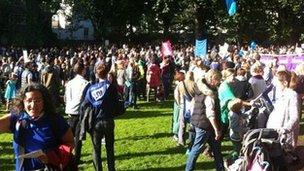
Brighton Condemning the attacks on
education and teachers by the government, NASUWT general secretary Chris
Keates, speaking to cheers and applause at the rally in Durham, said: “Mr
Gove will seek to denigrate you, but let’s be clear, NASUWT and NUT
members are not the ones damaging children’s education … No
teacher has any wish to inconvenience parents or disrupt pupils’
education, but this action is not the failure or due to the unreasonableness of
teachers. It is the failure and unreasonableness of the Secretary of State, who
day-in, day-out, is disrupting the education of children and young people
through his attacks on the teaching profession.” She further pointed out:
“Attacks on your pay and working conditions are part of a deliberate
strategy to present our education service as broken and failing because its
part of the masterplan to privatise our public education service.”
The centre of Brighton was filled with over 2,000 teachers and their supporters from across the city and elsewhere in Sussex, waving placards and shouting slogans. Rachel Henocq, who teaches at Peacehaven Community School near Brighton, said: “I think it’s unfair what the government is doing to education. It’s ruining children’s lives at the moment. Someone has got to take a stand. No one wants to go on strike. I love teaching and I love children.”

SouthamptonFurther reports show
that popular support for the strike was shown across the country. In east
London, teachers at Barking Abbey School have been leafleting outside since the
start of term to explain to parents why they are striking, accusing the
government of putting children’s education and future at risk and
collecting hundreds of signatures supporting them. The east London teachers
joined thousands of others from all over the South East for the march past
Downing Street to a protest rally at Westminster’s Emmanuel Centre,
assembling at Malet Street at 10.30am. Approximately 445 schools in London
boroughs were reported to have been completely closed with 450 partially
closed.
Over 471 schools came out on strike in Tyne and Wear, plus more than 200 schools in Hampshire and the Isle of Wight. Roberta Kirby from Fernhurst Junior School in Portsmouth said political attacks were contributing to a "very difficult working environment". About 120 teachers and union members took part in a march in Southampton. They gathered in Hoglands Park for speeches before walking up Above Bar Street, along London Road to Friends Meeting House. Among those taking part was Gerry Connor, a teacher at Barton Peveril College in Eastleigh. He said education secretary Michael Gove's plans amounted to an "attack on education". He said, "Performance related pay will lead to a system in which the starting pay is £22,000 and you'll have to crawl for the other £14,000. It may work when you first start, but not when you move on. Teachers in their 30s will not be able to live on that.”

DurhamCommenting on the regional
strike action in England by the two largest teachers’ unions, Christine
Blower, General Secretary of the National Union of Teachers, said:
“Today’s strike action has been a great success and is an indication of the anger and concern that teachers share about the changes this Government is making to the profession. Strike action does of course always come at a price and we are very well aware of the disruption this causes to parents’ working lives as well as their children’s education. Unfortunately, with a Government that will not negotiate on the issues of our dispute over pay, pensions and workload, we have been left with little choice.

Bristol “Make no mistake
Michael Gove’s reforms to teachers’ pay are about paying teachers
less, not more. A YouGov poll commissioned by the NUT showed that only a
quarter of parents (25%) thought schools should set their own pay system with
60% supporting the continuation of a national pay system for teachers.
“We do not want to be on strike but if we do not make teaching attractive there will be huge problems for recruiting and retaining good teachers. Michael Gove has demoralised an entire profession and today’s action is a direct result of his and the Government’s steadfast refusal to accept there are problems that need to be resolved. We urge the Government to set aside their prejudices and talk to the profession for the sake of everyone.”
(BBC, East London Advertiser, Northern Echo, NUT, NASUWT)
ShareThis

On October 17,
tens of thousands of teachers held the latest in their series of one-day
strikes with 3,492 schools shut or partially closed across much of England in
London, Cumbria, the South East, North East and the South West. Previously, the
first regional walkout took place in the North West on June 27. Then on October
1 the first wave of the present strike actions was launched at schools in the
East Midlands, West Midlands, Yorkshire and Humberside and the east of England.
In a protracted struggle which was described as an historic agreement the NUT and the NASUWT are planning further joint strike actions later. In describing their actions as “Taking a Stand Together” to “protect teachers and defend education”, teachers are saying no to the dismantling of their national pay system, longer school days and years and working longer, paying more and getting less for their pensions, and no to the attack on the education system.
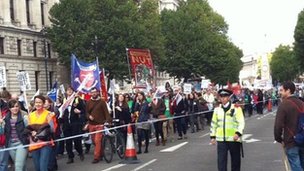
Marching past ParliamentA statement
of the Department of Education spokesman underlined the anti-teacher hysteria
of the media opposing the strike: “All strikes will do is disrupt
parents’ lives, hold back children’s education and damage the
reputation of the profession.” But it is clear that it is not the
teachers but the government, with Michael Gove’s attacks on
teachers’ pay, pensions and conditions in conjunction with his archaic
notion of what constitutes education that is in reality “holding back
children’s education”.
It is this growing unity of teachers which is a block to the government’s dismantling and privatisation of the education system and the attack on the right to education. The unity of the teachers is not only because teachers have had enough of the attacks on their pay, on their pensions and on their working conditions, but also because they enter the profession to teach and they oppose attacks on education. The government’s anti-social policy on education, as exemplified by Michael Gove, is much hated and despised in the teaching profession as well as with parents and with all who care about the quality of education and children’s future.

Plymouth RallyTeachers are against
the imposition of Gove’s so-called core knowledge curriculum in ten
subjects at secondary level. Its backward-looking, highly structured content
and method of fact learning by rote is aimed at blocking the youth from
questioning this imposed consciousness and taking control of their future on
their own account. This shows that defence of the teachers’ rights is
defence not only of education but also of the right to education and of
education in rights! The government’s actions against the teachers is
part and parcel of the attempt to dismantle and privatise the education system
and attack the right to education which is against the general interests of
society and the public good.
WWIE hails the stand of the teachers in taking a stand together in defence of their interests and the right to education. The challenge facing the teachers is to continue to strengthen their unity and their organisation and make their struggle part of a Workers’ Opposition and the fight for the alternative direction for society opening up the path to guarantee the right to education for all.
ShareThis