
|
|
||||
|---|---|---|---|---|
| Volume 44 Number 14, May 24, 2014 | ARCHIVE | HOME | JBCENTRE | SUBSCRIBE |
Hail African Liberation Day!
Workers' Weekly Internet Edition: Article Index :
Hail African Liberation Day!
No to Foreign Intervention in Africa
Weekly On Line Newspaper of the
Revolutionary Communist Party of Britain (Marxist-Leninist)
Website:
http://www.rcpbml.org.uk
E-mail:
office@rcpbml.org.uk
170, Wandsworth Road, London, SW8 2LA.
Phone: 020 7627 0599:
Workers' Weekly Internet Edition
Freely available online
Workers' Weekly E-mail Edition
Subscribe
by e-mail daily: Free / Donate
WW
Internet RSS Feed

The Line of March Monthly
Publication of RCPB(ML) Subscribe

May 25,
Africa Liberation Day, is celebrated, as it has been since its inception in
1958, by the peoples of Africa, the African diaspora and all progressive people
to mark the victories achieved in, as well as the continuing struggles for, the
complete liberation and independence of the African continent. The African
continent and its peoples have made many advances in the past half a century
and recent years have seen the mighty struggles of the people of Egypt,
Tunisia, South Africa, Nigeria and elsewhere for their empowerment. But the
imperialist system of states, headed by the governments of Britain and the
other big powers, continue to thwart the aspirations of the peoples of Africa
for total liberation.
This year Africa Liberation Day
is being held in the wake of the abduction of over 200 young women in northern
Nigeria, as well as the recent indiscriminate bombings in that country in which
hundreds have lost their lives. These criminal acts have led to an
international campaign demanding that action should be taken to free those
abducted. However, this has been used by the big powers to justify their
intervention in Nigeria and the deployment of special forces and other military
personnel from
the US, Britain, France and even Zionist Israel. Indeed security and
“anti-terrorism” measures against Boko Haram, the organisation
which has claimed responsibility for the abductions and recent bombings in
Nigeria, have been co-ordinated by the government of France, which recently
convened the “Paris Summit for Security in Nigeria”. This summit,
attended by the heads of state of Nigeria, Niger, Benin, Cameroon and Chad, as
well as representatives from the governments of Britain, the US and the EU, has
created the conditions for further external intervention throughout West Africa
in the future.
The government of France still
has its army deployed in Mali, where it intervened in 2013, supported by
Britain and the US, allegedly to combat the threat of terrorism and instability
in an area in which the US army had formerly based its
“anti-terrorism” operations. The French forces have done nothing to
resolve the deep-seated problems in Mali, many of which stem from the period of
colonial rule by France. Moreover, the government of France recently announced
that it 
would not only
increase the numbers of troops in Mali but also deploy hundreds more in the
neighbouring countries of Niger, Burkina Faso and Chad. The threat of
“terrorism” has increased throughout the region, a spokesperson
stressed, as a result of instability created by the NATO bombing of Libya and
regime change in that country organised by the governments of France, Britain
and the US. It may well be the case that those who were trained and financed by
NATO to effect regime change in Libya are closely connected with those who have
subsequently created instability in Mali and those responsible for recent
crimes in Nigeria.
By these and other means, the big powers have created the militarisation of large parts of the African continent. The US Africa Command (AFRICOM) continues to play a major role in this. Established in 2007, allegedly as part of the “war against terror” and to bring “peace and security” to Africa, AFRICOM is widely recognised as the means to safeguard US economic interests in Africa, to place the armies of African countries under US control and as a weapon to be used against the growing power of China in Africa. It was AFRICOM that co-ordinated military intervention in Libya and that only last month staged its fourth annual naval exercises off the coast of Nigeria with the participation of over twenty of its allies from Europe, South America and Africa.
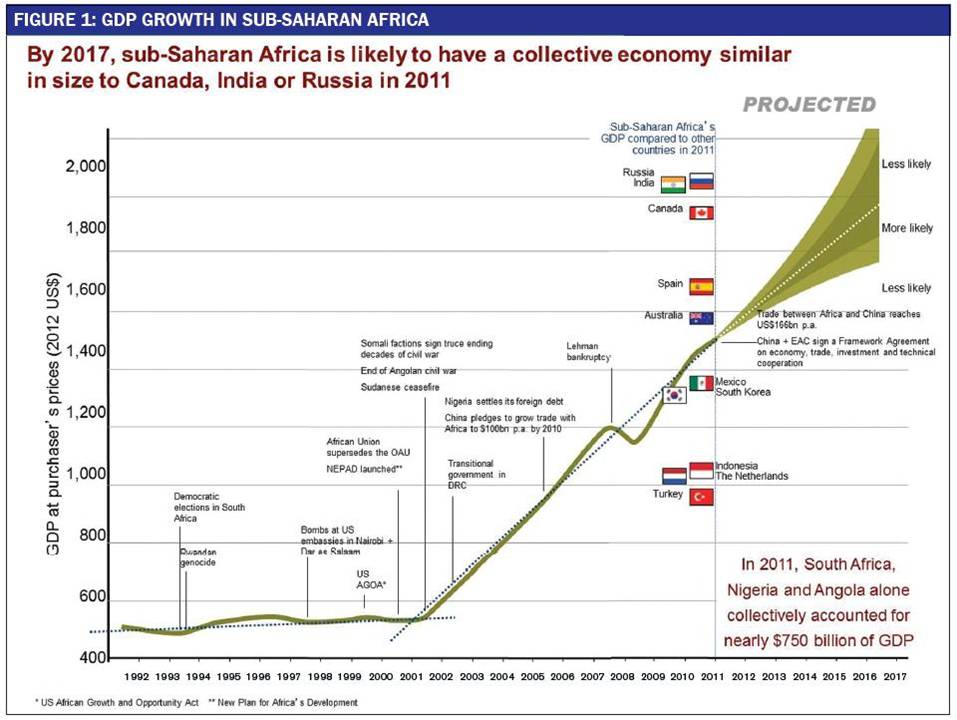
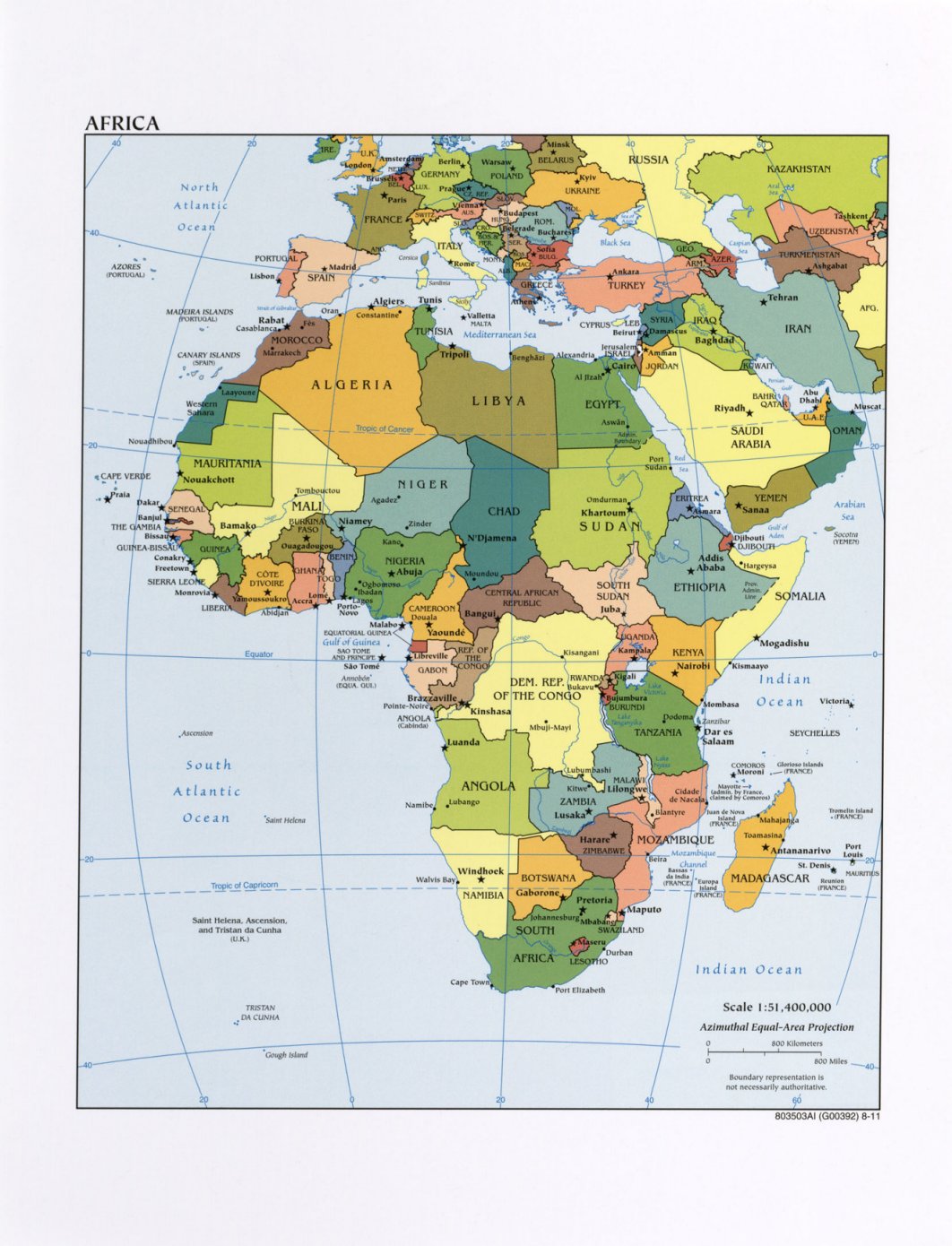
It is not coincidental that at the same time as the militarisation of the African continent and increasing instability caused by the activities of the big powers, there are reports that Africa is on the brink of an economic take-off. It is the continent with most of the world’s fastest growing economies, and is becoming an increasingly important market and area of investment, as well as a supplier of raw materials such as oil, gas and uranium. It is therefore an area where contention between the big powers and especially between the NATO powers and the BRICS is intense. China is now the dominant economic power in Africa, in terms of both trade and investment and a major rival to the US, Britain and their allies. In Nigeria, which is now Africa’s largest economy, China is not only taking the lead in inland oil exploration throughout the north of the country but is also providing oil refineries and is becoming a key player in many sectors of Nigeria’s economy.
There is therefore evidence that a new scramble for Africa is taking place, both for economic and geo-political advantage, in which all the big powers are engaged. The contention between the big powers and their increasing intervention in the continent is justified under the guise of “humanitarian intervention” or “responsibility to protect” or “anti-terrorism”. Nevertheless, the problems the big powers claim they are intervening to solve they have themselves created. At the same time, they wish to ensure that the impoverished peoples of Africa are not able to empower themselves and take full control of their own destinies.
Recent events in Nigeria, Mali, Kenya and other parts of Africa have created the conditions for further interference and military intervention by the governments of the US, France, Britain and their allies. A situation of instability and insecurity has been created in such a way as to present African governments as incapable of managing their own internal affairs and safeguarding their citizens. Such criminal activities cannot be permitted to continue.
As we mark African Liberation Day 2014, it is with the certainty that the peoples of the African continent will indeed find the means to become their own liberators. At the same time, there is an urgent need for all progressive people to step up their struggles to prevent the continued interference in the African continent by Britain and the other big powers.
ShareThis
Hakim Adi, Pan-Africanism and Communism: The Communist International, Africa and Diaspora, 1919-1939 (Africa World Press, 2013)
by Workers’ Weekly reviewer

This
ground-breaking book, based on research undertaken in the archives of the
Comintern in Moscow as well as archives in France, Britain, the US and West
Africa, documents the activities of the Communist International in relation to
Africa and the African diaspora. It focuses on a period when the world was in
flux, with inter-imperialist rivalry at its height, when African and Caribbean
countries, amongst others, were under colonial domination. Black people in
Africa, the Caribbean and other western countries were officially considered
inferior, had few rights and racism was at the level of open state policy from
so-called “Jim Crow” laws and lynching in the US, to pass laws and
segregation in South Africa and the colour bar in Britain.
In these circumstances many were inspired by the creation of the Soviet Union, following the October Revolution Russia in 1917, and the creation of the Communist International in 1919. From its founding under Lenin’s leadership, the Comintern sought to inspire and support the oppressed black people throughout the world to organise and empower themselves and break the shackles of imperialism. The book points out that it was the Communists who were at the forefront of the struggle against colonial rule in this period.
The book plays an important role in chronicling the many African, Caribbean and African American Communists who took up the struggle at that time, in particular those connected with the International Trade Union Committee of Negro Workers (ITUCNW), established in 1928 under the auspices of the Comintern. The ITUCNW acted to strengthen the work of the Communist Parties to take up for solution the question of how the liberation of Africa and the African diaspora might be achieved. The book points out that in that period many key activists gravitated towards or organised in unity with the international communist movement, including Lamine Senghor in France, Isaac Wallace-Johnson in West Africa, Elma Francois in Trinidad and Jacques Romain in Haiti. In this period the Communists were often in the forefront of major international struggles, for example, to oppose fascist Italy’s invasion of Ethiopia in 1935 or to demand the release of the nine African American youth arrested in Scottsboro, Alabama in 1931.
The book also examines several areas of controversy and disinformation about the role of the international communist movement in relation to African liberation. Significantly the information outlined in Dr Adi’s book highlights that disinformation has often become accepted wisdom and part of continuing efforts to undermine the crucial role of Communists of African descent and of the Soviet Union itself in this period. Using his extensively researched material the writer outlines the facts about the activity and demise of the ITUCNW, as well as the changing tactics and analysis of the Comintern in the period leading to the outbreak of World War II, and leaves the reader to make an independent judgement.
This book makes an important contribution to an area of African and Caribbean, as well as Communist history that has long been neglected and which many people are unaware of. Its focus on the activities of African, African American and Caribbean Communists in the period 1919-1939 is to be welcomed. It is an area about which there remains a great deal of confusion not only with regard to the facts but also concerning the lessons to be drawn from this experience.
Dr Adi focuses his attention on the efforts of ordinary African and Caribbean people who decided to take a stand and address the many problems that confronted them in their time. Problems such as Jim Crow in the USA, and racism and violation of human rights all over colonial Africa and the Caribbean disfigured the lives of millions of people. The Communists took up this struggle with the idea of finding a revolutionary solution to it and with an understanding that solving it would be bound up with the struggle of all oppressed people for their freedom. At great personal sacrifice, these activists made a significant contribution to the mass movements for African liberation which were to burst out in the 1950s and 1960s, such as the Civil Rights movement, the Black Power movement and the independence struggles in Africa and the Caribbean. The progress that has been achieved in the struggle for African liberation to date is due in no small part to the efforts of those individuals featured in this book. It shows what a significant impact we can have on changing the world in which we live when we take up the challenges facing us and try to find solutions to them.
This book has great significance for those who are today involved in trying to find a solution to the many problems that continue to confront Africans both on the continent and in the diaspora. The point is not that we should simply repeat what was done in 1919 – 39 when people were grappling with the problems of the world as it was then. Rather, it is that we should be inspired by their example to courageously take up the challenge of changing the world today and using the scientific approach which modern communism offers us.
ShareThis
Home secretary Theresa May is to introduce a package of measures relating to the stop-and-search powers of the police, it is reported.
The main focus of these reforms is said to be to introduce “best practice” and various “checks” and “accountability” on the powers. For example:
• A voluntary scheme for the “Best Use of Stop and Search”;
• “Lay observation policies”, through which members of the public will be able to accompany police officers on patrol;
• By means of a “community trigger” based on numbers of complaints, the police must explain to community groups how the powers are being used;
• Revising the definition of “reasonable grounds for suspicion” for a search;
•The Inspectorate of Constabulary will carry out a yearly review of the powers;
• A review of stop and search training will be conducted.
It seems then that the aim is to further institutionalise the use of stop and search, bringing it out of its current grey area of legality/illegality so as to give it the semblance of transparency and due process. May recently stated that up to a quarter of a million searches might have been conducted illegally in 2013. If true, the obvious conclusion is that the “illegal” is standard practice. It could be said that they are now codifying this practice, specifying what can be considered the norm. And if such “illegality” is so rife, what could possibly change? What is legal and illegal are revealed as two sides of the same coin.
The other aspect of the new measures is “fairness”. May launched the consultation on the powers last July with the stated aim of introducing proposals, now in the form of the newly-announced package, to reduce the use of police stop-and-search powers and ensure their “fair and effective use”. As part of this, May is proposing to limit the use of the notorious Section 60 “no suspicion” stop-and-search powers to 15 hours. These powers are not to be removed, but kept it in reserve and scaled back. The conception of “fairness” looks very hollow when all powers like with the police.
Further, does this indicate a move to a different way of doing things? May has said that the aim of reducing the use of stop and search is part of moving towards a “more intelligence-led” approach of “targeted” operations. There is an issue of efficiency here, where May points to the need to improve the ratio of searches that lead to arrests. But there is also the issue of the damage to the image of police following the killing of Mark Duggan and the subsequent spontaneous reaction to police killing, particularly amongst the youth. The recent finding by an inquest that Mark Duggan had been killed “lawfully” by police has further brought the use of stop-and-search to crisis point.
Since the post-Thatcher Conservative government introduced Section 60 in 1994, successive governments have been taking reactionary measures all along the line. The Blair-Brown government, after the launching of the so-called war on terror, introduced a series of pieces of legislation criminalising dissent, conscience and national origin. In particular, it introduced the Terrorism Act 2000 containing the widely-condemned Section 44 sweeping power of stop and search without suspicion. In that period, unsurprisingly, arbitrary and racist actions by the police increased. Now, with the stepping-up of the anti-social offensive against all sections of society, things have moved on, particularly with youth and student protests and the developing movements against austerity and war and for democratic renewal.
People need therefore to view this talk of intelligence-led policing with caution. The Metropolitan and West Midlands police forces have already been reducing their use of stop and search as part of piloting a scheme to move towards this new approach. It needs to be viewed as a political question with the perspective that the rights of all are defended.
____________________
For Your Information: Stop and Search
Section 60
Section 60 of the Criminal Justice and Public Order Act 1994 allows a police officer to stop and search a person without suspicion. Section 60 stops and searches can take place in an area which has been authorised by a senior police officer on the basis of their reasonable belief that violence has or is about to occur, and where it is expedient to prevent it or search people for a weapon if one was involved in the incident.
Section 60 is a broadly framed and indiscriminate policing tool. Following the finding that section 44 of the Terrorism Act was unlawful by the European Court of Human Rights (see below), it was suspended, and the use of section 60 dramatically increased... Statistics clearly showed you were far more likely to be stopped and searched under section 60 if you were Black or Asian... In December 2011 the Home Secretary announced that stop and search powers would be reviewed in light of findings that disproportionate use of the power contributed to the riots earlier that year. And in January 2012 the Metropolitan Police announced it would significantly scale back its section 60 stops and searches.
Changes to section 44 of the Terrorism Act
Section 44 was a stop and search without suspicion power which was even broader than section 60. It allowed for a wide geographical area to be designated - by authorisation by an assistant chief constable - as one where people and vehicles could be stopped and searched at any time. The legislation was so broadly drawn that authorisations were made on a rolling basis since their introduction in 2001. For ten years all of Greater London was designated as an area in which anyone could be stopped and searched without suspicion.
Just like section 60, section 44 was used predominantly against young Black and Asian men. It was also captured peaceful protesters. In early 2010, Liberty won a landmark legal case before the European Court of Human Rights, which ruled that section 44 was unlawful. In Gillan and Quinton v UK, the Court ruled that section 44 violated the right to respect for private life because the power was so broad it failed to provide safeguards against abuse.
In 2010 the Home Office Counter-Terrorism Review concluded that section 44 should be repealed. In May 2012, the provision was repealed and replaced in the Protection of Freedoms Act. The replacement power is a significant improvement. It allows a senior police officer to authorise an area for stop and search without suspicion in a specified area where she or he reasonably suspects an act of terrorism is about to occur. With tougher time limits and other safeguards aiming to ensure the power is only used in genuine emergencies, Liberty welcomed these changes.
Liberty, 2012
ShareThis