
|
|
||||
|---|---|---|---|---|
| Volume 45 Number 6, March 21, 2015 | ARCHIVE | HOME | JBCENTRE | SUBSCRIBE |
Budget 2015:
Workers' Weekly Internet Edition: Article Index :
Budget 2015:
The Need for a Pro-Social Direction for the Economy Is an Election IssueWorkers' Forum Commentary:
The Question of Economic Recovery Poses Itself in Terms of Whose Interests are ServedThe Anti-Social Direction of the Economy and the Crisis of Government Revenue
Weekly On Line Newspaper of the
Revolutionary Communist Party of Britain (Marxist-Leninist)
Website:
http://www.rcpbml.org.uk
E-mail:
office@rcpbml.org.uk
170, Wandsworth Road, London, SW8 2LA.
Phone: 020 7627 0599:
Workers' Weekly Internet Edition
Freely available online
Workers' Weekly E-mail Edition
Subscribe
by e-mail daily: Free / Donate
WW
Internet RSS Feed

The Line of March Monthly
Publication of RCPB(ML) Subscribe
Budget 2015:

Chancellor
George Osborne presented the government’s final budget before the general
election on Wednesday, March 18. This was a political act of disinformation
aimed at manipulating the electorate, and represented a firm commitment to
further austerity.
It was, as described by Newsnight’s Evan Davis, an exercise in “expectation management”. The fact is that the planned deep cuts are an open secret and have been widely exposed, and this has been doing the Conservatives damage in the pre-election polls. The Chancellor therefore announced that £30bn of cuts would be made, and it was supposed to be some relief that £12bn of this would come from a reduction in spending on welfare, notwithstanding that this is itself an anti-social cut and part of the austerity agenda.
The attempt to mislead has been widely commented upon, including by the Institute of Fiscal Studies, who called on Osborne to specify what exactly will be cut from welfare and pointed out that the poorest had been worst affected by the cuts. This budget announcement was an attempt to give the impression that things are improving, that the “sun was starting to shine again”, thanks to austerity (though even in this, the Chancellor had to resort to trickery, such as the inclusion of one-off asset sales such as that of Northern Rock in meeting their targets).
Also widely condemned was the lack of any mention of the NHS, a silence which speaks for itself.
In overall terms, the budget thoroughly represents the continuing austerity agenda, and as such reflects the sharpening contradictions over how the government should raise its revenue, in the context of an election being fought over the issue of austerity and the rights of all. It hardly merits consideration as a serious attempt at managing and setting an aim for the economy.
A breakdown of the sources of government revenue according to the budget is illustrated below 1:

At this level, the budget contains no significant deviations at all from the austerity programme. The Whole of Government Accounts for 2012-13, for example, closely match the above figures. 2
Total revenue comes to £670bn. (For comparison, the gross domestic product is approximately £2tn, or three times total government revenue). Corporate taxes form less than 7% of this total. The figures reveal the major role played by personal income tax, national insurance and sales taxes in raising revenue.
An important issue posed for the developing Workers’ Opposition by the current budget is to examine the sources of government revenue. An alternative to the focus on personal income tax, national insurance and sales taxes in raising revenue is a key component of changing the direction of the economy in favour of the working people and small businesses.
Two issues that are urgently required to be taken up in elaborating this alternative are:
That the government must claim revenue directly from the economy.
That the monopolies must pay for the value they receive from public services and infrastructure.
Budget revenue figures
We present a more detailed summary of the government revenue figures presented in the budget, in order of size. Classifying the figures under headings is made difficult due to the roundabout nature of collecting revenue - ultimately claims on the value added by the working class in the socialised economy - and the methods of accounting in which there is no measure of work-time, value added and transferred, and so on that are essential for organising a modern pro-social economy.
Personal income tax and National Insurance: £284bn
£171bn of this figure is income tax, mainly out of workers’ wages. The remaining £113bn is National Insurance, which is effectively a fee, taken at the point of earnings on certain state benefits such as the state pension.
Sales taxes: £193bn
Sales taxes mainly consist of VAT (£128bn), fuel duties (£27bn) and duties on tobacco and alcoholic drinks (£19bn). We also include stamp duty on property sales (£10bn), air passenger duty (£3bn), insurance premium tax (£3bn) and stamp taxes on shares (£3bn). This is paid indiscriminately by the population as a whole, mainly on paying for the necessities of modern life, including work and leisure.
Property taxes: £56bn
We have included council tax (£28bn) and business rates (£28bn). We have not included inheritance tax and capital gains tax, though a large portion of these relates to property.
Taxes on corporations: £46bn
Corporate taxes consist mainly of corporation tax (£42bn), which, rather than a direct claim on added value, is a tax on equity profit, plus a contribution from the bank levy (£4bn).
Revenue from public enterprises and infrastructure: £46bn
The government quotes a gross operating surplus (£40bn), which includes its revenue from public enterprises in the form of sale of goods and services. We have included vehicle excise duty, or road tax, here (£6bn). Various fees for public services, such as university tuition fees (which alone amount to £13bn for home, EU and non-EU students combined 3 ) are not included in government revenue.
Miscellaneous taxes: £36bn
This includes emission and carbon levies (£8bn), which affects the energy companies, for example, capital gains tax (£7bn), inheritance tax (£4bn), license fee receipts (£3bn) and other taxes (£14bn).
Other revenue: £9bn
This includes revenue from interest, dividends and receipts not covered by the above.
References
2. HM Treasury, Whole of Government Accounts 2012/13
3. Higher Education Statistics Agency, HE Finance Plus 2013/14
ShareThis

Last week with
the imminent General Election and the 2015 Budget there was much hype about
economic “recovery” in the media by the Chancellor of the
Exchequer, George Osborne, and the Coalition government. Like all narratives
these days the commentary that is concentrated on in the media is just between
the three big parties in particular and is aimed at obscuring the whole
question as to whose interests are being served. This “debate” on
the economy is no different and in fact has one aim – that of securing a
vote at the general election for candidates and parties that stand for
austerity and serve the rich and are against the public good and the interests
of all.
In this way all the arguments are being marshalled in the Budget debate as to whether the Coalition “austerity” measures to finance the deficit have led to an economic recovery. This is the level of the fraudulent political thinking that tries to secure a continuation of the Coalition government and stop it being defeated in the General Election. Well hidden in this debate is any voice of the working class movement. Responding to the budget statement, Frances O'Grady, TUC General Secretary, pointed out, “For all the warm words, austerity is set to continue year after year.” This then is the point of view of the organised working class that whether there is recovery, or not is not the main issue, especially when the interests of the working class and people are left out of the equation of the economy and whether their needs and interests are recovering or not. In other words the question of the economy poses itself not in terms of recovery or no recovery, but whose interests are served – that is, “recovery” for whom? The working class, which fights for a change in the direction of the economy so that the impasse is overcome in resolving the problems faced by working people, is not convinced.
The fact is in this equation of the capital-centred terms of the ruling elite there is no let-up in "austerity" and low wage, zero-hours recovery is no recovery at all. What is passed off as economic recovery is that you get all the figures about these increases in jobs that consist of zero hours contracts, part-time hours and women and men in precarious employment. And this weighed against continued massive youth unemployment, cuts to benefits, social programmes and the public sector. Then you get the promises and policy objectives that maybe further down the line this will all get sorted out and “austerity” will end. Not one of these claims for recovery challenges the whole fraudulent direction of “austerity” which is wrecking the economy and serving only the interests of the ruling elite to enrich themselves to unprecedented levels through exploitation of people in Britain and internationally.
Today, only the working class and people are concerned about the fate of the country and its economy and the public good. This is why the people are fighting up and down the country to safeguard the NHS and the future of their public services and social programmes. Defeating the Coalition government at the General Election and supporting genuine anti-austerity candidates that defend the rights of all and stand up for the public services and social programmes is an immediate task. The necessity is to build on the resistance which is ongoing in the struggles and strikes of the working class and people and build the Workers’ Opposition. The only alternative is an anti-austerity direction that places public right above monopoly right and opens a path to a society which is pro-social and anti-war and upholds the rights of all, as well as strengthening the internationalist ties with all who are fighting for genuine progress against imperialist domination and interference.
ShareThis
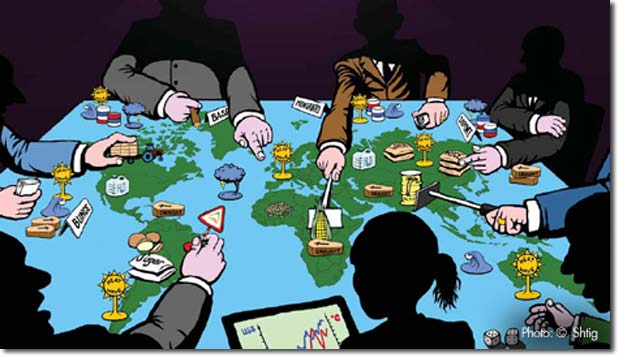
The serious
problem surrounding public expenditures and sources of revenue began early in
the twentieth century with the rise to power of the global monopolies, which
united the industrial and financial sectors into dominant global companies. The
monopolies organised the modern economy and state to suit their pursuit of
worldwide empires. They required the use of an increasingly complex state to
supply educated and healthy workers, public infrastructure, greatly expanded
police security forces, and large standing armies equipped with weapons of mass
destruction to defend and expand their global empires, suppress the working
class and occupied populations, repel competitors and wage increasingly
expensive and destructive wars such as the First World War.
The monopolies faced the problem of raising public funds for state enterprises, public services, infrastructure, police forces and standing armies without directly claiming those funds from the economy, specifically from their own particular operations. They also refused to pay for in a proper exchange the value produced by state enterprises, public services and infrastructure when consumed in their operations.
The problem became even more profound for the monopolies with the consolidation of the Soviet Union, the first nation-building project and state led by the working class. The working class state introduced comprehensive and free public health care, public education and other social programmes to raise the living standard of workers and peasants and defend their rights, in particular the rights of women and girls. In spite of the low level of industrial mass production and agriculture inherited by the workers and peasants in Russia, Ukraine and other members of the Union of Soviet Socialist Republics, the advanced social programmes the communist nation-building project organised for the people stood in stark contrast to the "fend for yourself" imperialist states dominated by the private monopolies.
The victory of the people's forces in the anti-fascist Second World War struck terror into the dark souls of those in control of the imperialist system of states now dominated by the US and British monopolies. To protect their narrow private interests and control from a demanding and rebellious working class flush with victory over fascism, the ruling capitalist elite fashioned a welfare state and social contract with organised workers, which included an expansion of social programmes and trade union legislation bringing class struggle for better wages and working conditions within a controlled legal framework. They formed a cartel system of party politics and governance to keep the working class from organising democratic renewal and the empowerment of the people.
Even while demobilising millions of soldiers after World War II, the US-led imperialist system of states organised NATO and escalated spending on nuclear warfare and other weaponry to threaten the Soviet Union and expand their occupied territories beginning with the war against the Korean people, then into Vietnam, and on and on trampling people's rights throughout the world. All this has required, and continues to demand, huge amounts of public revenue to finance the imperialist state.
The destruction of the first nation-building project of the working class in the Soviet Union quickly accelerated in the 1960s, when the leadership refused to revolutionise the relations of production in keeping with the rapid developments in the forces of production. This led to its disintegration into social-imperialism and ultimate collapse in 1989.
US imperialism has become the sole superpower and engages in continual hot and cold predatory wars with the rest of the world. The internal contradictions of the capitalist economy, especially with productivity and its downward pressure on rates of profit, have continued to deepen with recurring economic crises becoming more severe and long-lasting.
The monopolies and their political representatives are campaigning to destroy much of the welfare state and social contract under the hoax of austerity. They are campaigning to raise revenue for their imperialist state and empire-building with yet more individual taxation on the working class of all incomes, and small businesses.
The methods to claim state revenue have greatly accelerated the accumulation of immense wealth in the hands of those who own and control the global monopolies and dominate economic and political power. Individual taxation puts downward pressure on the living standards of the people. The working class remains dependent on work to survive without any control over the direction of the economy, with a growing section living in poverty and frightening economic insecurity.
In the absence of political power, the working class has been unable to restrict monopoly right and deprive those holding economic and political power from using the state and their private wealth to attack the working class and the rights of all. The working class with its communist leadership is waging a determined battle to open a path forward for democratic renewal to empower the people and to resolve the economy's underlying contradictions and recurring crises and fashion a new pro-social direction.
The global monopolies have organised government claims for revenue in ways that damage the economy and public interest, and serve the narrow private interests of the privileged capitalist elite who own and control vast quantities of social wealth the working class has produced at home and abroad.
A primary political consideration in government Budgets is the concept of social wealth as private property under the control of individuals who are not the actual producers. This private social wealth, which is itself a contradiction, exists in the form of parts of the socialised economy used to expand private accumulation of the value workers produce. The ruling capitalist elite consider this privately controlled social wealth unassailable and refuse to allow it to be mobilised to serve the public interest and good. This leaves long festering social and economic problems unresolved regardless of how many policy objectives are advanced by the cartel political parties or individuals in charge of running governments.
The ruling capitalist elite would never use the crisis to reflect on the incoherence of the present situation and search for a new pro-social direction such as restricting monopoly right over natural resources, their uses and prices, so that a path forward can be opened up to serve the public interest, as that would contradict their basic premise of private ownership and control over social wealth.
The crisis of the methods by which the government claims revenue can only be resolved with a major restructuring and new pro-social direction for the economy, which restricts monopoly right and puts the public interest and actual producers in control of the socialised economy with the well-being of the people as the main aim.
(source: BC Worker, A Supplement to the Marxist-Leninist Daily)
ShareThis
Last week,
William Hague, the Leader of the House of Commons, announced that the weekend
of 8-10 May, 2015, has been officially designated to commemorate the 70th
anniversary of Victory in Europe (VE) Day, which is marked on May 8 in Britain.
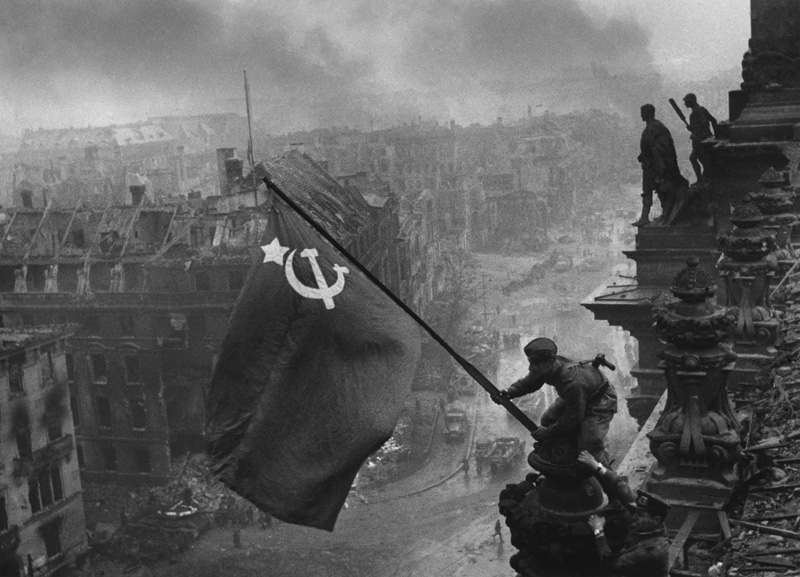
What is noteworthy about the planned celebrations and the statement made by Hague is the fact that the government seems less concerned about commemorating the 70th anniversaries of VE Day, and of VJ Day in August, than it is about the centenary of the First World War which has been marked by four years of planned commemorative events. What is also evident is that the government is intent on marking the end of the Second World War in Europe by obscuring the nature of that war and the important fact that it was concluded by a decisive victory over fascism. The re-writing and falsification of history that followed this victory have also necessarily obscured the vital role of the Soviet Union, which led the defeat of fascism in Europe in the course of which over 20 million of its population gave their lives.

Greek resistance fighters, 1940s It
is perhaps for this reason that there are attempts to present the wartime
Conservative Prime Minister as the embodiment of Britain’s part in this
victory and make much of the speech that he delivered on VE Day in 1945.
However, as history records, less than two months later, the working class and
people of Britain, with their aspirations for a new society, one that was built
on opposition to all that imperialism, fascism and Nazism stood for, threw
Churchill out of power in the July 1945 general election.
Churchill’s government had already indicated its predatory and anti-people nature several months before VE Day with military intervention in Greece in December 1944. That intervention, planned for some time, had the aim not of ridding Greece of the Nazi occupiers but of eliminating the heroic Communist-led resistance movement, the National Liberation Front (EAM), that had led the struggle against Nazi Germany and Fascist Italy in Greece, and which had received arms from Britain during the war. The British government intervened in order to prevent the empowerment of the Greek people following the evacuation of the occupiers and to restore a reactionary government and monarch who were considered best suited to safeguard the route to Britain’s wider imperial interests. The British army created the conditions for a massacre of unarmed patriotic demonstrators including children in Athens and conducted other military actions against the resistance, having been instructed by Churchill not to “hesitate to act as if you were in a conquered city where a local rebellion is in progress”.
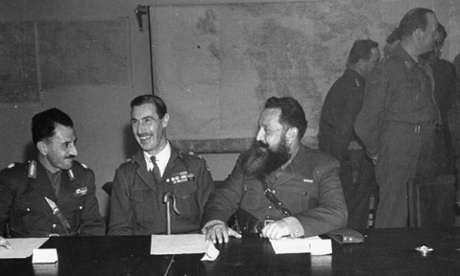
Lt Gen Ronald Scobie (centre) who, on 5 December
1944, imposed martial law and ordered the aerial
bombing of the working-class Metz quarter of Athens The
military intervention in Greece and attacks on anti-fascists during the Second
World War was widely condemned in Britain, even most major newspapers including
The Times joining this condemnation. It was however supported by the
leaders of the Labour Party and the TUC, both before the 1945 General Election
and after when Atlee’s Labour government took office. The TUC first sent
a delegation to Greece at the request of Churchill’s government shortly
after military intervention. Several others followed, all with the intention of
splitting the Greek trade union movement, preventing “free and fair
elections” and imposing leaders who would serve the interests of the
British government. Atlee’s Labour government both supported the
reactionary Greek governments, which attacked the rights of working people in
Greece, and simultaneously attacked the workers’ and patriotic movements
that had led the struggle against fascism during the Second World War.
Intervention in Greece by the British government and trade union leaders created the conditions for the growing political crisis in Greece, and paved the way for US intervention, not just in Greece but elsewhere, justified under the openly anti-Communist “Truman Doctrine” and supported by the so-called Marshall Plan. It culminated in what is referred to as a civil war between the reactionary Greek government, supported by Anglo-American imperialism, and the patriot forces led by the Greek Communist Party. This was a military conflict which the led to the deaths, imprisonment and exile of many thousands who had fought to defeat fascism during the Second World War and that left Greece politically unstable and dependent on the US for many decades.


Left: Bodies of unarmed protesters shot by the police and
the British army in Athens on 3 December 1944
Right: Women protest against the shootings, which led to more than a month of
street fighting in Athens
History shows that the Second World War led to a victory over fascism and created the conditions for the liberation of many nations in Africa and Asia and for the working people to advance their cause for progress and social emancipation. The few years after the victory over Nazi fascism were a time of great momentum, profound changes and the creation of the socialist camp. However, history also shows that these advances were not welcomed by all. They were opposed by those that had nurtured, appeased and financed fascism before the war, in the hope that it would destroy the Soviet Union and the aspirations of the workers of all countries. Once the victory over fascism seemed assured and VE Day beckoned, the struggle against communism and to prevent the peoples empowering themselves recommenced.
ShareThis