
|
|
||||
|---|---|---|---|---|
| Volume 52 Number 17, July 9, 2022 | ARCHIVE | HOME | JBCENTRE | SUBSCRIBE |
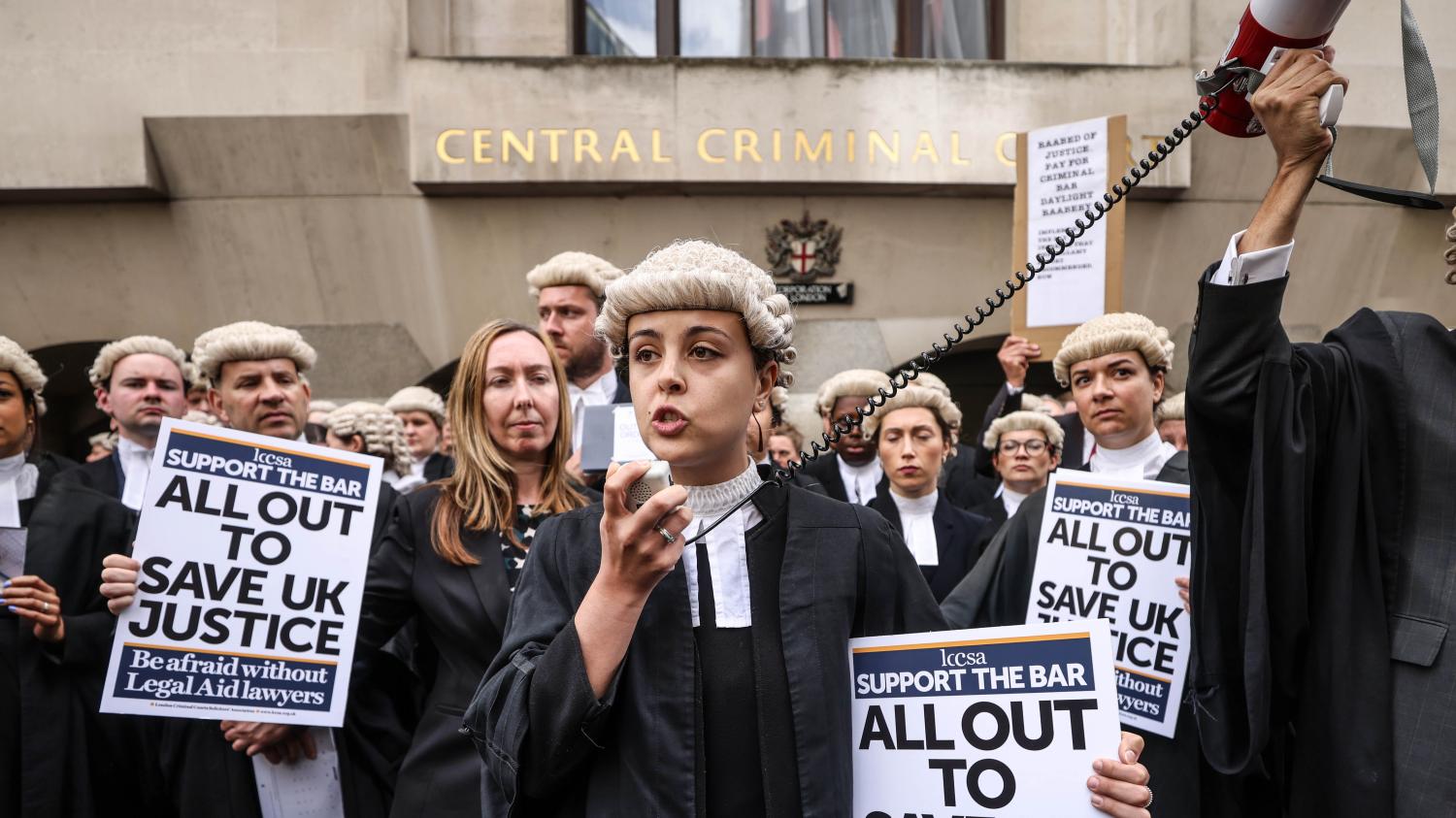
Picket at the Old Bailey in London. Photo: Richard Pohle,
Times
Criminal barristers, members of the Criminal Bar Association (CBA), are currently amid 14 days of strike action centred on their funding and pay. The strikes, which are being held over a period of four weeks, began on June 27 and 28, and are increasing by a day each week, culminating in a full five-day strike from July 18-22. Pickets have been organised at the Old Bailey in London, as well as at Birmingham, Bristol, Cardiff, Leeds and Manchester Crown Courts.
It is difficult for barristers to strike without being found in breach of rules and contractual obligations, to the extent that they have only done so once before, in 2014. Nevertheless, some 81% of ballot votes cast favoured the action.
During strike days, barristers are refusing to accept new cases or take up court appearances of other barristers. Such "return work" is critical to the efficient running of the court system. The action has disrupted hundreds of cases per day, and trials have been delayed. The government has responded by attacking the barristers, accusing them of "delaying justice for victims".
The immediate issue over which the barristers are taking action is government intransigence in properly implementing the minimum recommendation of the Bellamy Review into criminal legal aid funding for an immediate increase of at least 15% [1]. The Ministry of Justice is only offering this minimal figure (the CBA argues that a rise of 25% would be more in the region of what is required) and further, would neither come into effect immediately nor apply to backlogged cases. This is particularly important, points out the CBA, as this rise does not in fact amount to 15% when the extensive court closures at the beginning of the pandemic are taken into account. 83% of criminal barristers took on debt or used savings during this period, according to the CBA.
The situation is serious. While a small minority of barristers operating privately can earn large sums serving the privileged, the reality for most is quite the opposite. A newly qualified barrister is likely to earn as little as £9,000 from legal aid fees after expenses [1]. According to the CBA, barristers' pay has fallen 28% since 2000 in real terms. As a result, some 25% of barristers have left the profession since 2017, with the same fraction again intending to follow.
Barristers, particularly junior barristers, receive much of their income from the state in the form of the fees they are paid for cases covered by legal aid.
Legal aid is central to the functioning of the criminal justice system. Many people who are put on trial for criminal cases are not the sort of people who can afford to pay for private lawyers, and so legal aid is the standard means by which most of the population finds legal representation.
Funding for legal aid has been cut for many years, with the result that junior and many other barristers are receiving extremely poor incomes for most of their work, even effectively below the minimum wage for particular cases. The Bellamy Review expressed the concern that the whole legal system, haemorrhaging both barristers and solicitors, could grind into a halt in the near future. The current backlog of cases stands in the tens of thousands of cases. The system is reaching the point inability to function.
Attacks on legal aid amount to attacks on the right to justice. As Bellamy stated in his review:
"I take the view that the Review is about much more than the remuneration of defence lawyers, it is also about the effectiveness of the CJS [Criminal Justice System] as a whole. The adversarial system of the CJS cannot function without the defence. If the providers of criminal legal aid defence were to fail or be substantially weakened, the CJS as a whole would grind to a halt, with obvious adverse consequences, not least in the context of reducing the backlog. Moreover, criminal legal aid does not merely support the defence: it is the cradle of many barristers who also prosecute, and of solicitors and others who later join the CPS [Crown Prosecution Service], or other authorities who need criminal law expertise. Criminal legal aid also provides the training ground for many who later become judges. The view has been expressed to the Review that, as it is, there are not enough criminal lawyers to go round."
Speaking to the BBC, prominent barrister Susan Meek said: "In every democracy, you have to have a functioning justice system; it's a foundation of society and you have to have it. We are being treated the way we are and there's no-one coming through. I have been doing this job for 25 years, the juniors just aren't there any more, they are just not paid enough money. They have to have it, so we have come out to support them in the days of action, which will go on for weeks and weeks and weeks if necessary".
The barristers' strike exposes the essence of the present arrangements, which are based on privileges and not rights, other than private property rights. The interests of the majority are marginalised. A new alternative set of arrangements need to be brought about aimed at protecting the rights of all, the rights people have by virtue of being human, and of being members of various collectives and society as a whole. Support the struggle of the barristers for improved pay and conditions as part of increased funding for legal aid, which is an important social programme! The wrecking activity of the government must be opposed.
Notes
1. Sir Christopher Bellamy QC, "Independent Review of Criminal Legal
Aid", 29 November, 2021
https://www.gov.uk/government/groups/independent-review-of-criminal-legal-aid