
|
|
||||
|---|---|---|---|---|
| Volume 52 Number 20, September 10, 2022 | ARCHIVE | HOME | JBCENTRE | SUBSCRIBE |
Workers' Weekly Internet Edition: Article Index : ShareThis
The Fight For A Human-Centred Health Care System:
Health Workers Building their Resistance against Below-Inflation Pay IncreasesWorkers Forum:
RCN General Secretary Makes Case for Nurses to StrikeWorkers' Movement:
Enough Is Enough Campaign Rallies Keep the Momentum GoingWorkers' Forum Report:
Protest at Cost-of-Living Crisis in Newport, Isle of Wight
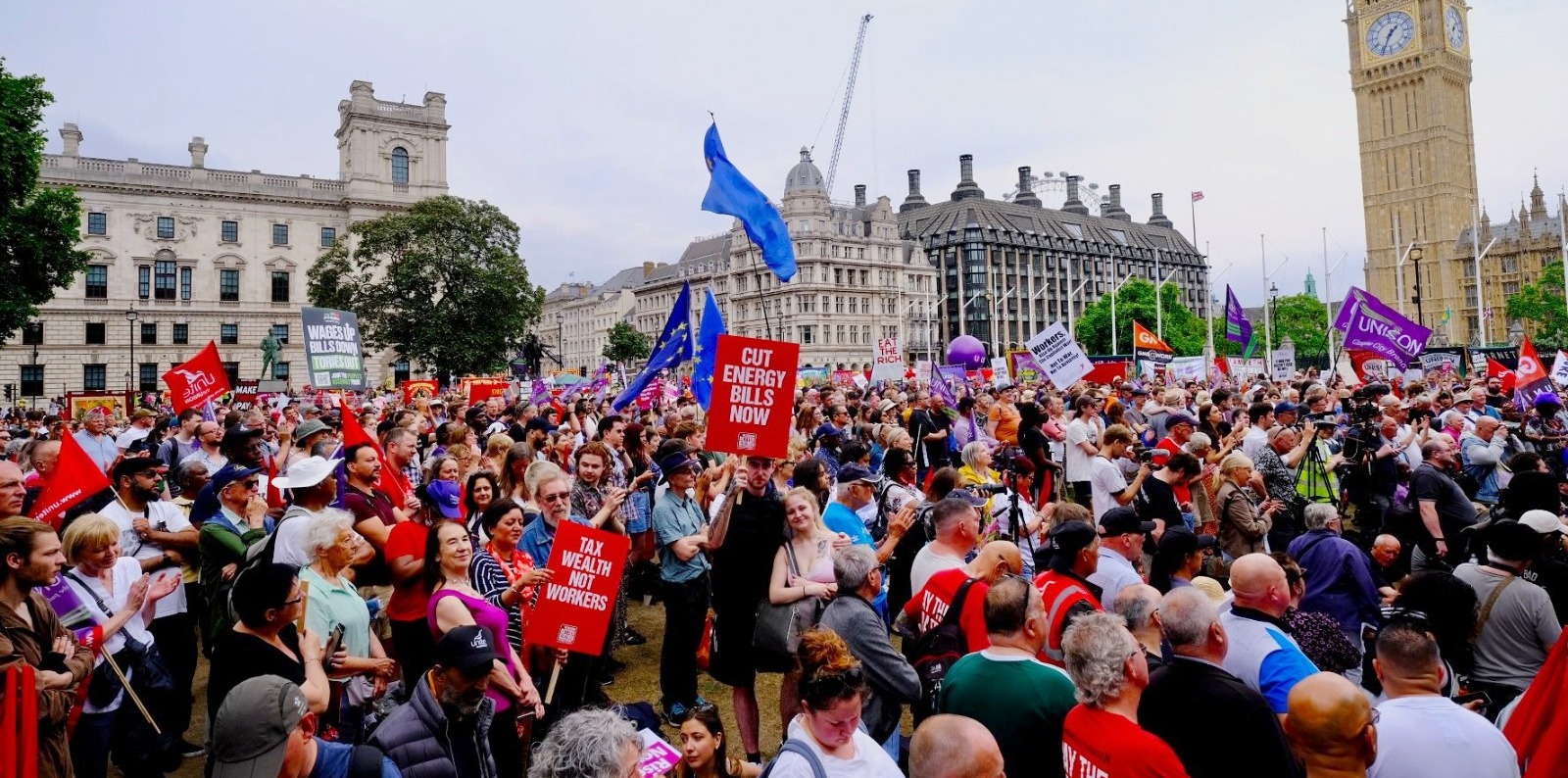
TUC Rally in London - "We Demand Better - Enough Is
Enough!", June 18 2022.
On September 5, Foreign Secretary Liz Truss secured the leadership of the Conservative Party, and hence became Britain's new Prime Minister. On September 6, Boris Johnson tendered his resignation to Queen Elizabeth II at Balmoral Castle in Scotland. Liz Truss kissed the Queen's hand and was invited by her to form a government.
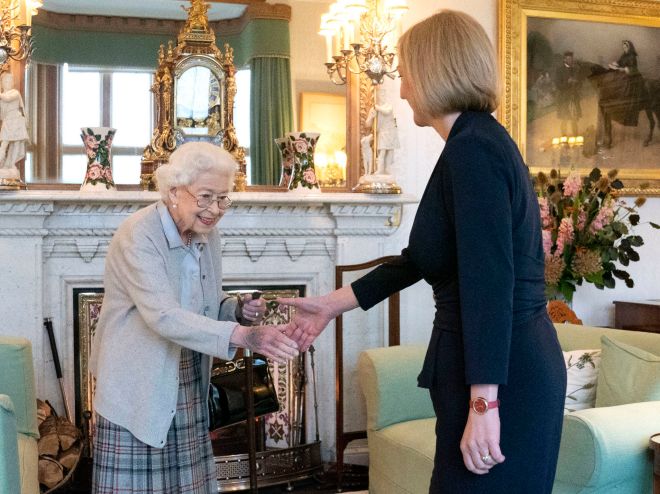
Photo: Press Association
As a student at Oxford University, Liz Truss was President of the Oxford University Liberal Democrats and stood for ending the monarchy. She went out of her way in this election and post-election to say that she campaigned as a Conservative and will rule as a Conservative. This is diversion because the past she is not putting behind her is her yeoman's service as a warmongering Foreign Secretary and that she is staying the course despite the disasters Britain's neo-liberal policy has brought about both at home and abroad.
Truss's win was less than spectacular. She garnered the support of fewer Conservative members than any of her predecessors. Under the party's current leadership rules introduced in 1998, those participating in the election were only the fully paid-up members of the Conservative Party, numbering, it is said, little more than 160,000. In prevailing over contender Rishi Sunak, former Chancellor of the Exchequer, Truss received 81,326 of these votes amounting to 57 percent of the votes cast. This is a smaller percentage than those of her predecessors Iain Duncan Smith, David Cameron and Boris Johnson who won 60.7, 68 and 66 percent respectively, which did not help their claim to speak on behalf of the people of Britain much either.
In the conditions of the on-going crisis of the anachronistic liberal democratic institutions in Britain, to have the decision of who should be Prime Minister made by roughly 0.2% of the electorate of the polity deepens the crisis of legitimacy in which these institutions are mired. That the Prime Minister in no way speaks for the people and is not seen to represent their claims on society is more glaringly apparent than ever. Tory Party chief executive, Darren Mott, went so far as to write a response to the media newsroom Tortoise that the Party "does not carry out public functions". The election was "a private matter for the members of the Party," Mott wrote, adding that the appointment of the Prime Minister is a matter for the sovereign, not the Party!
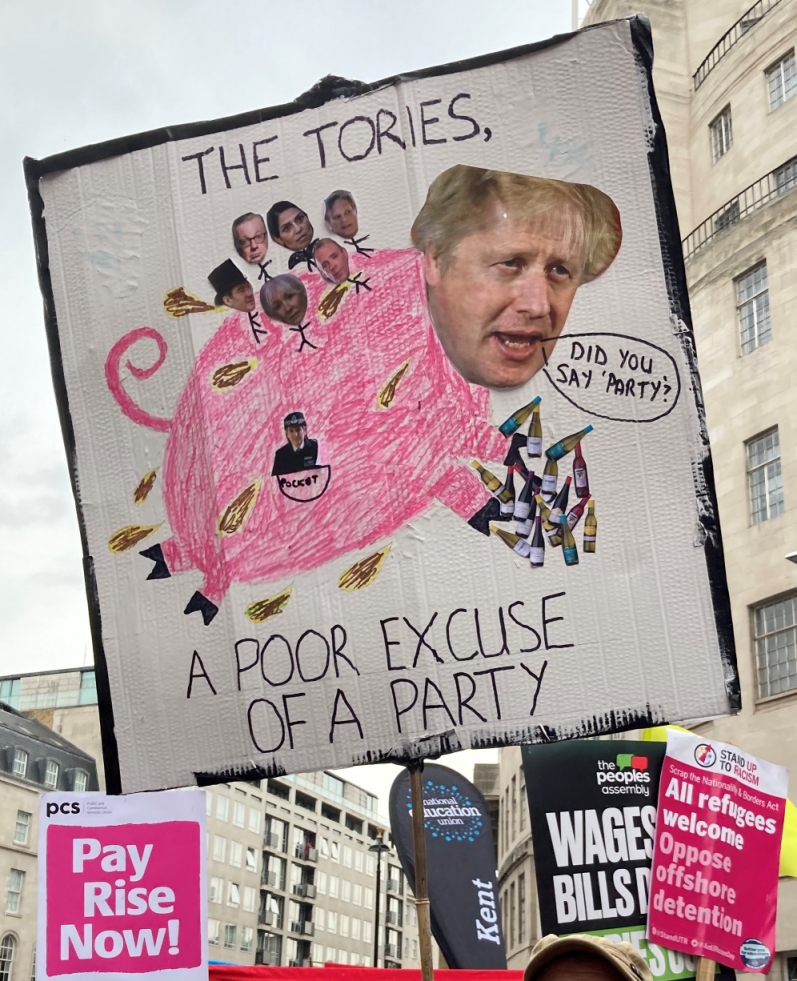
The viciousness of the campaign demonstrated, should demonstration be needed, that the Conservative Party is a sorry excuse for a Party. There is nothing modern about it. It has no defined political line or mechanisms for sorting out differences within its ranks. Character assassination and boorishness marked the campaign and continued in the public exhibition over who should be appointed by Truss to her Cabinet. Former Home Secretary Priti Patel resigned by means of a tweet while Boris Johnson was still Prime Minister. The Conservative Co-Chair, Ben Elliot, also quit just hours after the result was announced. As expected, Truss's new cabinet excludes the main backers of her rival Rishi Sunak.
This government is crisis-ridden because it serves narrow private interests, and the institutions are incapable to dealing with the demands of history at this time which are for peace, freedom and democracy, not governments of police powers which commit crimes against peace, against humanity and to destroy whatever they cannot control. The more power is concentrated in executives which are out of the reach of the people, the more the people feel the absence of their own political power. Already Truss has announced a crackdown on unions in the coming period which will certainly not go over well either. The Communication Workers' Union (CWU) among others, pointed out that Truss becomes Prime Minister with the backing of less than the threshold she plans to require for unions to be able to call a strike.
On the issue of the north of Ireland, in the context of the Irish people's striving for unity and independence, it is clear enough that a political solution will not be entertained and the demands of the people will continue to be treated as law and order problems. History has already condemned the British state for this, many times over.
Underscoring the failure of the sanctions against Russia and the resultant energy crisis - for which the British in lock step with the US/NATO alliance are responsible - Truss vowed she will tackle the energy crisis "once and for all". Households will save £1,000 a year under energy bills price freeze, she said. This has done nothing to mitigate the mass rallies and demonstrations taking place across Britain and all of Europe demanding the energy crisis be resolved by ending the sanctions against Russia.
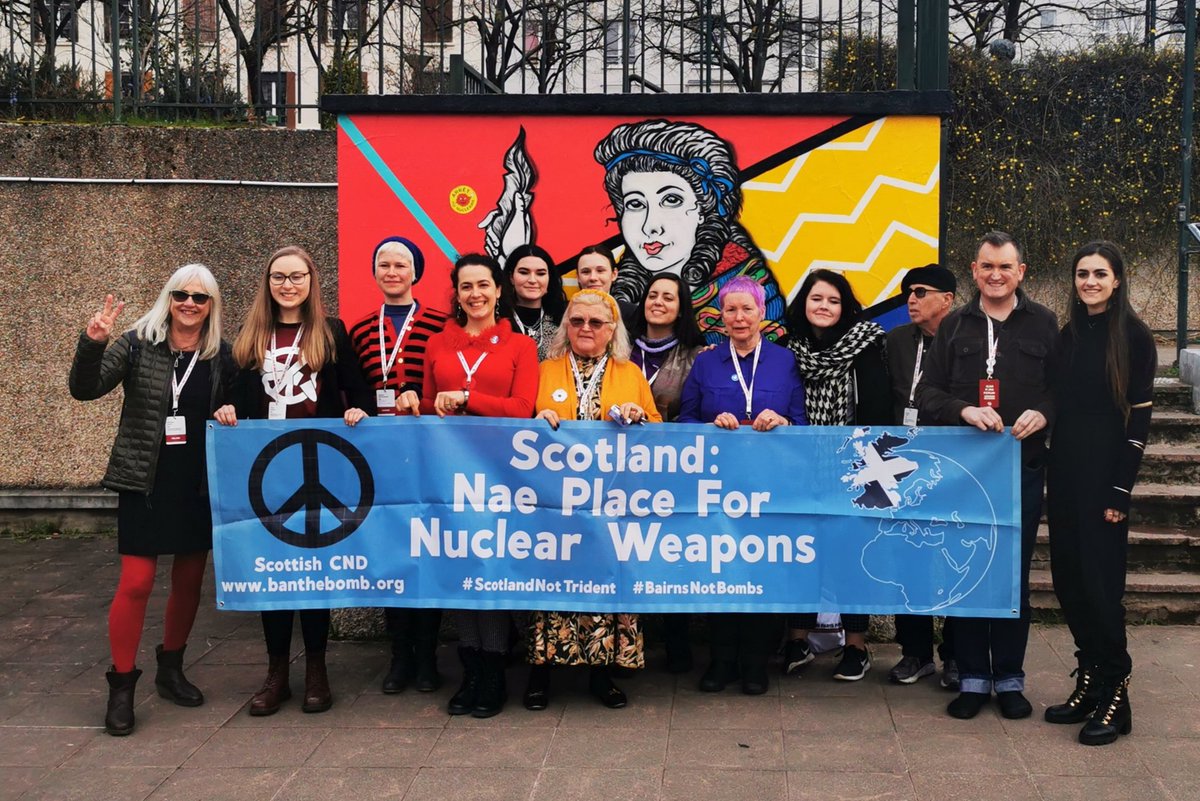
Truss's tenure as Foreign Secretary shows that the narrow private interests she serves will stay the course of fuelling brinkmanship, warmongering and disinformation while attacking the claims of the working class and immigrants at home. Truss pledged her readiness to use nuclear weapons, and according to reports, her first act as Prime Minister will be to write "Letters of Last Resort" for the commanders of Britain's nuclear-weapons-carrying submarines. Truss also committed to keeping Britain's Trident nuclear submarines and to boosting military spending to 3% of GDP by 2030.
These attempts to unite the military in Britain are bound to fail because they are hollow. Cobbling all her pledges together does not make a nation-building project by any stretch of the imagination. They merely underscore the anarchy and violence which are the result of the nation-wrecking agenda of the international financial oligarchy of which various contingents are British, each seeking to make a killing on the basis of expediency.
Truss's exhortations are in vain. They indicate that Britain's crisis is so profound, the ruling class has been incapable of finding a champion who can rally the ruling class itself, let alone the people of Britain.
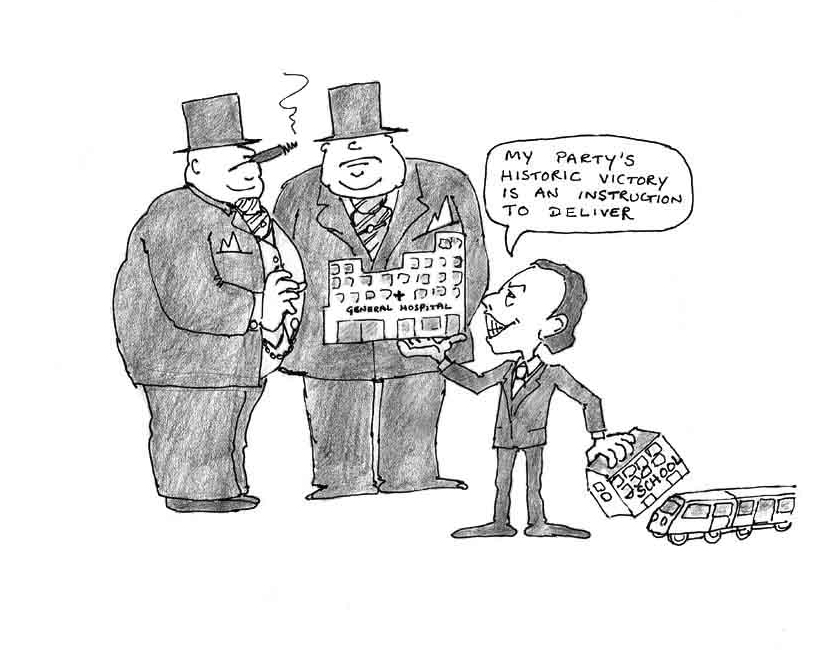
Truss is known for bypassing the old forms of political decision-making and attempting to foster the illusion of a personal connection between those in power and the electorate. The people find out what she is up to through tweets. Furthermore, her declaration that she campaigned as a Conservative and will govern as a Conservative confirms that she will give the problems the people face short shrift. Her repetition of "We will deliver" at the end of her first speech, without saying what it is that the government will deliver, is another ominous sign. Tony Blair when winning the 2001 general election famously said that he regarded the result as an "instruction to deliver". He appointed deliverologist Michael Barber to head his "Delivery Unit". It delivered the privatisation of healthcare and the jobs of the civil service along with the destruction of manufacturing, social programmes and public infrastructure. Former Conservative Prime Minister Margaret Thatcher's dictum that there is no such thing as society prevails as working people experience the rules set by the ruling elites which are stacked against them.
Internationally, Truss has been adept at making enemies, particularly in the EU, prompting the spokesperson of the German ruling party to say: "But anyone who believed that things could not get any worse after Johnson is being proved wrong. Many of Truss's statements are unfortunate or wrong." It was only in August that Truss, in her role as Foreign Secretary, launched legal proceedings against Brussels over the delay in granting the UK associated status in Horizon Europe, the EU's flagship research programme, which Brussels has put on hold until issues related to the Northern Ireland Protocol have been resolved. Legislation to overturn the Northern Ireland Protocol, which the Johnson government had duly signed in negotiations with the EU, is still passing through parliament.
What is certain is that the legitimacy of an outdated political system cannot be salvaged. No matter what actions the Liz Truss government undertakes, its dysfunctionality has become a permanent feature. It is no good whistling in the wind and believing that everything will be business as usual. Failure is bound to be her legacy as it was with Boris Johnson whose sense of entitlement brought the British institutions to their knees. Her election in no way lends the office of Prime Minister credibility, nor indeed will it lend any legitimacy to Westminster cartel party rule.
The response of the working people is ringing out loud and clear: Enough Is Enough! The people's movement for democratic renewal in which people empower themselves is emerging as the necessity. Liz Truss's election may well be one of the spurs that will tip the balance.

Nurses and other health workers in England, Wales, Scotland and northern Ireland are presently engaging in consultative and official ballots on strike action. This is in response to the serious situation facing nurses and health workers, the shortages of staff [1], and the systematic lowering of their pay and conditions by so-called "pay-offers" [2] of around 4 to 5% by the governments of the UK. This is all under the direction of the Westminster government and its Pay Review Body. All of these so-called rises are way lower than inflation, which is currently between 9 to 13% and come on the back of years of below-inflation pay increases for NHS staff. Whilst the "pay offer" claims that low-paid staff will get a higher percentage rise, the offer does not apply to the majority of low-paid staff, who are not covered by the "agenda for change" pay system. These staff are working in hospitals and clinics whilst employed by outsourced private companies, or "arm's length" companies within NHS Trusts.
Pat Cullen, RCN General Secretary, said: "There's never been a more urgent time to fight for fair pay and patient safety. From severe staff shortages to a decade of underpayment, we can't continue like this. Nursing staff will stop at nothing to protect their patients. Staff shortages are putting patient safety at risk and the failure of governments across the UK to listen has left us with no choice but to advocate for strike action." The RCN ballot will run across the UK from September 15 until October 13.
Unison has also launched a Pledge Yes for the NHS campaign in a consultative ballot to "Take the first step towards industrial action", which is running over a number of weeks, before a strike ballot from October 27 to November 25. Explaining the pledge, Unison points on their website: "There are over 100,000 NHS vacancies including one in ten nursing posts vacant. You know the stress of understaffing, and the NHS is in the greatest workforce crisis in its history. Patients are put at risk when overstretched staff are forced to leave so they can feed their family."
Unite has already balloted health workers with a strike action ballot that closes on September 11. Unite general secretary Sharon Graham said: "This offer is nothing other than a massive national pay cut for NHS staff. After everything they have been through with the Covid pandemic and the service this workforce gives this country day in, day out, this is a kick in the teeth from the government and an insult to staff and patients alike. This ballot is a chance for our members to have their say, and whatever they decide, they will have the full backing of their union, Unite."

Also, in July the BMJ reported that hundreds of doctors marched from the Department of Health and Social Care offices to Downing Street to protest about their pay and call for industrial action. The demonstration brought together leaders from the British Medical Association (BMA), the Doctors' Association UK, and the newly formed Doctors Vote campaign, Junior doctors and medical students expressed their anger and frustration at the government's decision to leave juniors out of the 4.5% pay uplift announced for other eligible doctors. The association has calculated that the estimated take-home pay for the average junior doctor in England has declined by 22% in real terms between 2008-09 and 2020-21, and these losses are accelerating now with inflation continuing to rise.
Further, a report from the health select committee in July [3] concluded that the NHS and the social care system are facing their greatest workforce crises in their history, with around 100,000 vacancies being advertised in each at the end of last year. "The Workforce: recruitment, training and retention report outlines the scale of the workforce crisis: new research suggests the NHS in England is short of 12,000 hospital doctors and more than 50,000 nurses and midwives; evidence on workforce projections say an extra 475,000 jobs will be needed in health and an extra 490,000 jobs in social care by the early part of the next decade; hospital waiting lists reached a record high of nearly 6.5 million in April. The report finds the Government to have shown a marked reluctance to act decisively. The refusal to do proper workforce planning risked plans to tackle the Covid backlog - a key target for the NHS."
Over recent times the successive Health Secretaries at most talked about the pandemic causing lack of funding, beds and staff. They refused to recognise that their own and previous governments over many years have caused this crisis in the NHS by ongoing reduction in investment in the comprehensive public health and care system. This they have done in favour of costly investment in fragmenting and contracting out of many services and buildings (PFI) to private companies at huge cost, including the whole elderly care home sector privatised and employing very low paid staff. Added to this, successive governments have driven NHS Trusts and GP services in a corporate direction, encouraging the closure of more and more beds and have refused to meet the actual needs of the NHS for training of clinical and nursing staff and fully providing the most up to date equipment and premises.
This latest pay offer is a further case in point. The then Health Secretary Stephen Barclay directed an offer that does not even recognise the Health Committee's view that "pay is a crucial factor recruitment and retention", but has been deliberately imposing lower than inflation pay increases once again. He claimed when he announced it that "very high inflation-driven settlements would have a worse impact on pay packets in the long run than proportionate and balanced increases now, and it is welcome that the pay review bodies agree with this approach". How is this the case? How is it that meeting the needs of health workers pay in full and redressing the years of downgrading of their pay is an "inflation driven settlement", yet lowering their income once again will not have a "worse impact" and how is this a "balanced increase now"?
This whole conception is that the funding of health care and of staff pay is to be presented as a driver of inflation and a burden on the economy. Nothing could be further from the truth. Even the offer itself is to be funded from existing NHS budgets, which shows that it is a scam that will be used by health authorities to justify further NHS cuts and blame it on health workers' pay. There is no conception that the reality is that health workers contribute to the whole wealth of society so that people who live in it can function as fully as possible and create and produce the human and natural resources for all. Health workers do not cause inflation - that has more to do with the financial oligarchy and the rich who take more out of the economy than they put in. Health workers are the human resources that can implement the right of all to health care if they are given the resources to do it fully in society. Also, if they are given the power to decide along with the people they serve they can work to resolve the crucial questions that are causing the crisis in the NHS, such as the need for more staff and more NHS beds, ending privatisation and so on. Health workers are central to a human-centred health care system and their well-being is crucial to the future of the health care system.
Health workers are yet another section of the working class that have said that enough is enough and are building their resistance to yet another below-inflation pay rise that is an attack on their well-being and the well-being of society.
Notes
1. According to reports, one in 10 NHS jobs lie vacant. The number of unfilled
NHS jobs hit a new high of 132,000 in June according to new data, prompting
health service chiefs to issue serious warnings to ministers of an
"all-engulfing NHS crisis". The vacancy rate now stands at 9.7 per
cent, records show, with 46,828 nursing posts currently unfilled and 10,582
doctor roles remaining empty.
2. The "pay offer", in England and Wales is a complicated and
divisive formula made by the Pay Review Body and accepted by the government
that pits staff pay increases against NHS budgets. NHS staff will get at least
a 4.5% "pay rise", with the lowest earners receiving up to a 9.3%
increase backdated to April. Eligible dentists and doctors will also receive a
4.5% "pay rise". However, the UK government plans to
"re-prioritise" the funding of this pay rise from existing NHS
budgets so any rise will be and excuse to cut investment in services. The Welsh
government accepted these recommendations but, as we publish, the government of
northern Ireland has not decided. The Scottish government offered a 5%
"pay rise" to NHS Scotland.
3. Workforce: recruitment, training and retention in health and social care:
Health and Social Care Committee, July 25 2022
The report goes on to say, "Maternity services are flagged as being under
serious pressure with more than 500 midwives leaving in a single year. A year
ago the Committee's maternity safety inquiry concluded almost 2,000 more
midwives were needed and almost 500 more obstetricians. The Secretary of State
failed to give a deadline by when a shortfall in midwife numbers would be
addressed. Pay is a crucial factor in recruitment and retention in social care.
Government analysis estimated more than 17,000 jobs in care paid below the
minimum wage."
https://publications.parliament.uk/pa/cm5803/cmselect/cmhealth/115/report.html
https://committees.parliament.uk/committee/81/health-and-social-care-committee/news/172310/persistent-understaffing-of-nhs-a-serious-risk-to-patient-safety-warn-mps/
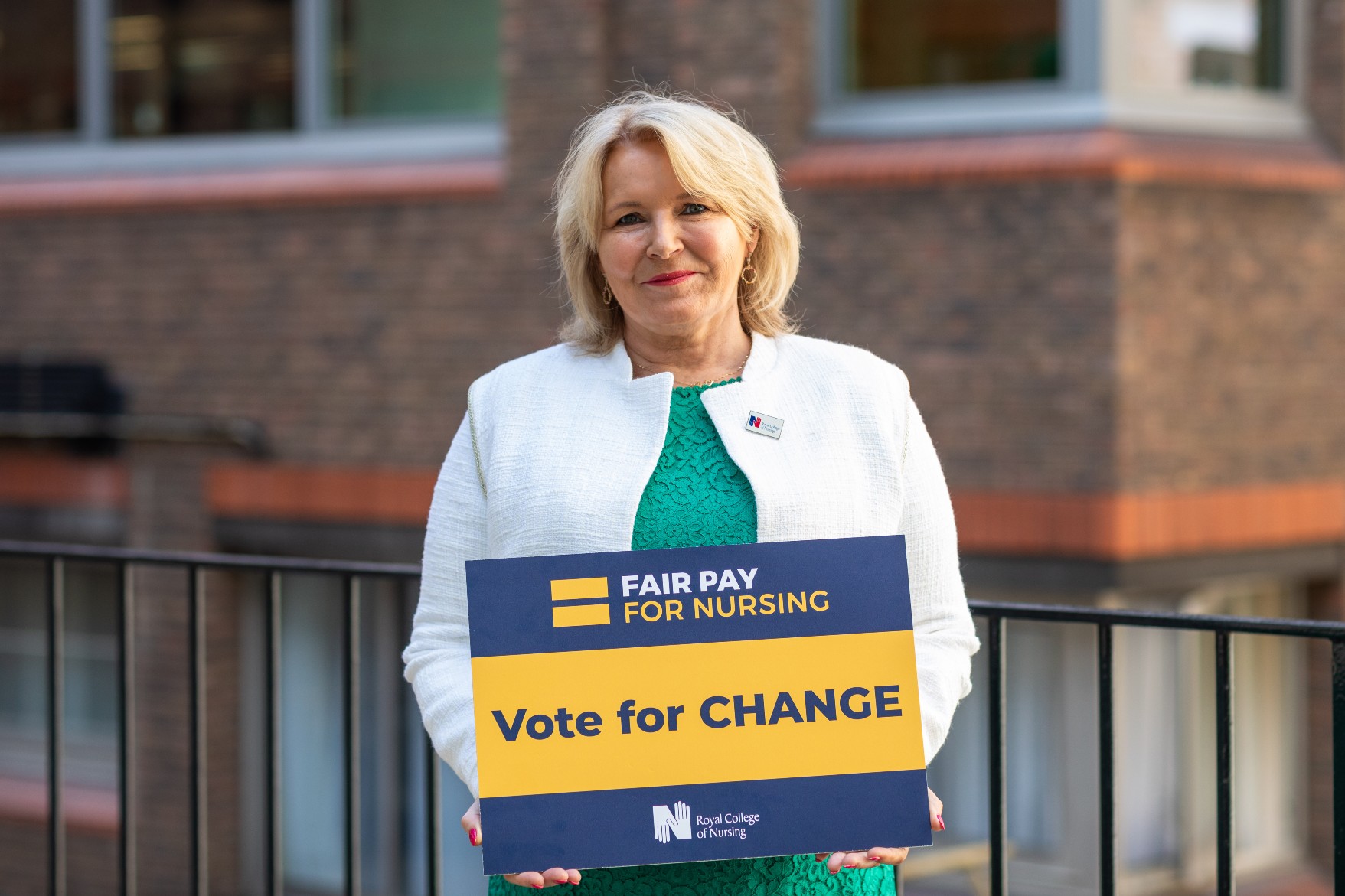
Pat Cullen, Royal College of Nursing General Secretary
and Chief Executive
Royal College of Nursing general secretary and chief executive, Pat Cullen, has warned: "Nurses have been pushed to the brink and beyond, and the only way it appears we are going to get the government to listen is to take action."
After discussing with nurses in England throughout August, the RCN general secretary, whose background is in mental health nursing, said that nurses felt they had no choice but to leave the profession or work every single solitary hour that is available in the day to make ends meet. Nurses from overseas had also said they were now thinking very seriously about returning to their country of origin because they can no longer afford to live here.
Pat Cullen cited examples of nurses being denied rental properties as they did not earn enough, meaning some with young families were being put up in a room in other people's houses. Some were having to live hours outside of the large London hospital areas, meaning their days were starting at 5am and finishing at around 11pm.
"Then they tell me that, when they have finished their shift, they have to 'embarrassingly' go along to the food bank and try and bring some food home to their children," Pat Cullen said. The RCN general secretary said that it was shameful that nurses were being made to live this way and urged government ministers to spend a day walking in the shoes of those nurses to help them realise the importance of, and need for, a decent wage.
"This is a profession where morale is the lowest I have ever seen it in 42 years," Ms Cullen said in an interview with Nursing Times. "Morale is lower now than it even was at the time that we took strike action in Northern Ireland, and I didn't think it could get much lower."
Nurses in the north of Ireland successfully went on strike in 2019 to gain pay parity with nurses in England, Scotland and Wales, and a promise of safe staffing.
As RCN leader, Pat Cullen said that she wanted to see the profession "valued and respected by those in power" and that this should be the top priority for the next prime minster.
The RCN has been campaigning for a fully funded pay rise for nursing staff of 5% above inflation. It branded the below-inflation awards an insult to the profession and subsequently launched a set of four official ballots across Britain and northern Ireland. Members of health unions nationwide are now preparing to cast their votes in upcoming ballots on industrial action, including strikes, following the latest pay awards from the four UK governments. The 2022-23 pay awards for NHS staff on Agenda for Change have fallen well below the level of inflation, despite the campaigning of the unions, including the RCN.
In England and Wales, a pay increase of at least £1,400 was awarded, in line with the NHS Pay Review Body's recommendations. In northern Ireland, the lack of a fully functioning government means that nurses are still waiting for an official pay outcome. Northern Ireland's health minister had announced his intention to accept the recommended £1,400 uplift but was unable to implement it immediately because of budget issues. In Scotland, which has broken away from the pay review body process, a 5% increase was put forward for nurses.
In leading the RCN campaign, Pat Cullen said that she had learned just how much the public trusted nurses and that nurses will go to any length to do the right thing for patients. In this context, while finer details would need to be arranged if action were voted for, the RCN leader said that the College would be wishing to move very quickly after the ballot closes. The RCN's fund for supporting members taking industrial action has already been increased from £35m to £50m.
If strikes were not voted for, however, Pat Cullen accepted it would be "the voice of the nurse". But, she added: "It would be very clear to me that nurses are still concerned about the impact [strike action] will have on their patients, even though we will make sure it is safely, effectively and professionally delivered."
The RCN's industrial action handbook sets out the different types that can be taken, such as action short of strike, also known as working to rule. This means working strictly to the terms of a contract of employment, including by starting and finishing shifts on time and taking all contractual breaks. Meanwhile, strike action involves a complete withdrawal of labour from the workplace.
A YouGov poll in August conducted on behalf of the Royal College of Nursing has shown increasing public support for nurse strike action. A survey of 1,752 people throughout Britain found that 64% supported such action. Workers' Weekly adds its support to the nurses' struggle. Nurses have their dignity, and demand better. This is a demand to be treated as caring human beings, and the struggle is also part of the demand for a human-centred health service, in which nurses show their worth.
(Nursing Times)
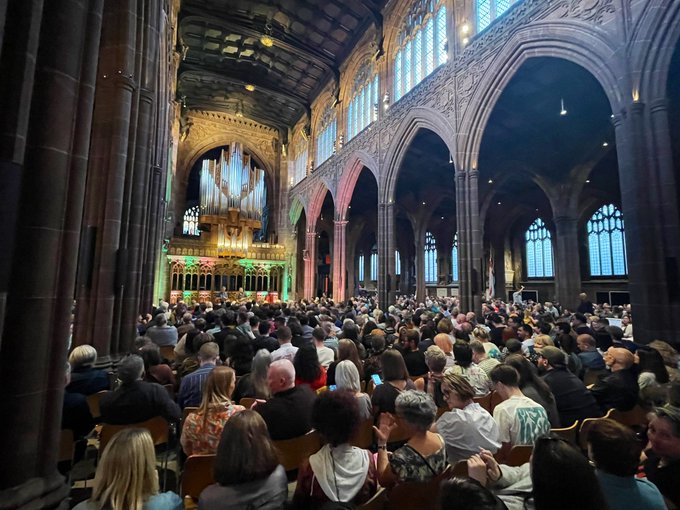

The Enough is Enough rally at Manchester Cathedral
with tens of thousands inside and outside the Cathedral
The Enough is Enough campaign has underlined the momentum of the workers' movement to refuse to shoulder the burden of the cost-of-living crisis. A number of rallies have seen tens of thousands of workers and their unions participate in the campaign. There are 500,000 registered supporters, and growing.
The five key demands of the campaign for the rights of working people are: A real pay rise; slash energy bills; end food poverty; decent homes for all; tax the rich.

Enough is Enough rally in Norwich on September 6
2022 - Photo: Norwich Evening News
The second rally of the campaign, after the launch rally in London on August 7 [1], was held in Manchester on August 30. Tens of thousands of people participated in the rally at Manchester Cathedral. Representatives of the RMT and CWU unions were joined by the Mayor of Greater Manchester, Andy Burnham.
Addressing the rally, CWU general secretary Dave Ward said: "Working people will pay the price unless we come together and fight. Change isn't a spectator sport - are you ready?" He said that the workers from the mail, post offices and telecommunications sectors by taking strike action were reuniting a system destroyed by privatisation. Dave Ward pointed out that working people were becoming aware of the obscene salaries and bonuses of the chief executives of privatised industries and the billions in profits handed to shareholders while profits soared alongside millions being thrown into desperate poverty with potentially worse to come.
Eddie Dempsey, assistant general secretary of the RMT, said his union's slogan "Unity is strength" was fittingly taken from a banner carried at St Peter's Field in Manchester 203 years ago before authorities unleashed troops on a peaceful crowd in the Peterloo Massacre. He declared, "We are the people who created pensions, built the hospitals, schools and social housing, the things they have taken away. We are here to take them back. But our strength comes from unity. That is why the government and the media tries to keep us divided. They want teachers fighting NHS workers, rail workers fighting nurses, and all of us fighting immigrants." He underscored that change is coming as working people unite in action against the multi-national corporations who run the country.
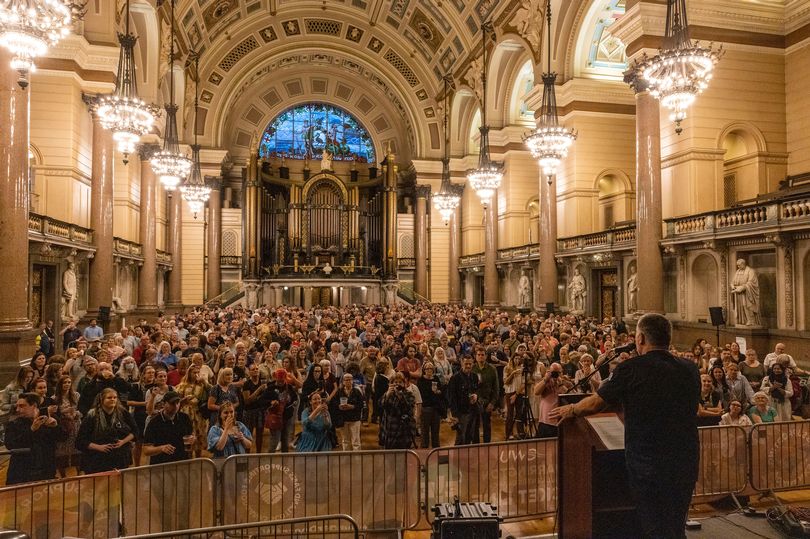
Enough is Enough Rally at Liverpool's St George's
Hall on September 2 2022 - Photo: Liverpool Echo
Other speakers included Jake Johnson of community union Acorn, who listed some of the widespread strike actions by different groups of workers who were coming together to fight. Liverpool MP Ian Byrne pointed to the obscenity of the growing dependence on food banks in Britain, pointing out that there were "more foodbanks than there are branches of McDonald's".
The Enough is Enough campaign came to Liverpool's St George's Hall on September 2, where over 1,000 people were joined by trade union leaders and MPs to declare "Enough is Enough".
The Enough is Enough rally in Norwich on September 6 was one of the biggest indoor rallies in Norfolk in recent years, attracting around 850 people. Speakers included Eddie Dempsey of RMT, singer Grace Petrie, chair of Young Labour Jess Barnard and inequality campaigner Taj Ali. The Norwich Evening News reported that Jess Barnard, who is also a Norfolk youth worker, said: "Norfolk is a place where we have experienced real neglect from government after government, we have seen a lack of investment in council housing and infrastructure. The country is looking at pay stagnation and Norfolk has already been experiencing that, it's another thing making it harder for people." She said: "I have been a youth worker here for a long time what I see is families struggling to put food on the table. Holiday hunger is a big problem."
Further rallies have been planned for Glasgow, Brighton and Leeds, with a day of action in October.
For further details see: Enough is Enough - A campaign to fight the cost of living crisis (https://wesayenough.co.uk/)
Note
1.See: For Your Information: The Enough Is Enough Campaign:
http://www.rcpbml.org.uk/wwie-22/ww22-19/ww22-19-03.htm
A number of people turned out to protest at the cost-of-living crisis on Saturday, September 3, in Newport Isle of Wight. A movement is developing on the Isle of Wight that is growing in scope and depth as part of the movement of the working class and people throughout Britain. More and more people are independently standing up around the message that "Enough is enough" and see their unity as key to taking the political initiative.
The actions so far have been taking place every month in St James's Square at the centre of Newport. Activists have been handing out leaflets, raising banners and placards and delivering speeches to the people who have been consistently stopping and listening to the message, which is "Enough is enough, the cost-of-living crisis is not of our making" and "Join us". People have responded because they are worried about the energy bills and general price increases including food. People are sick of what is happening to their NHS and they are increasingly sceptical about the imperialist war in Ukraine and the role Boris Johnson and Liz Truss have been playing. In discussions, people were conscious of the massive amount of money being made by the energy oligarchs and the price fixing by the government with their "caps" or "no caps". Also, by the oil cartels and multinational producers.
Many discussions about the supply chain and the consequences of global capitalism are widely appreciated, as are discussions about the cartel political system in Westminster and the parties involved, how they isolate and deplete working-class representation. The recent strikes and pickets have shown that people have had enough. The protests in Newport have shown that many students, pensioners, and workers who are not directly tied to the strikes and picket lines are coming forward to build the movement. They are responding to the call to empower themselves, and the experience of participating in the protests has shown to many the need to further build their organisation and make Enough is Enough a reality.
Receive Workers'
Weekly E-mail Edition: It
is free to subscribe to the e-mail edition
We encourage all those who support the work of RCPB(ML) to also support it
financially:
Donate to
RCPB(ML)
Workers' Weekly is the weekly on
line newspaper of the
Revolutionary Communist Party of Britain (Marxist-Leninist)
Website:
http://www.rcpbml.org.uk
E-mail:
office@rcpbml.org.uk
170, Wandsworth Road, London, SW8 2LA.
Phone: 020 7627 0599:
