
|
|
||||
|---|---|---|---|---|
| Volume 52 Number 28, November 19, 2022 | ARCHIVE | HOME | JBCENTRE | SUBSCRIBE |
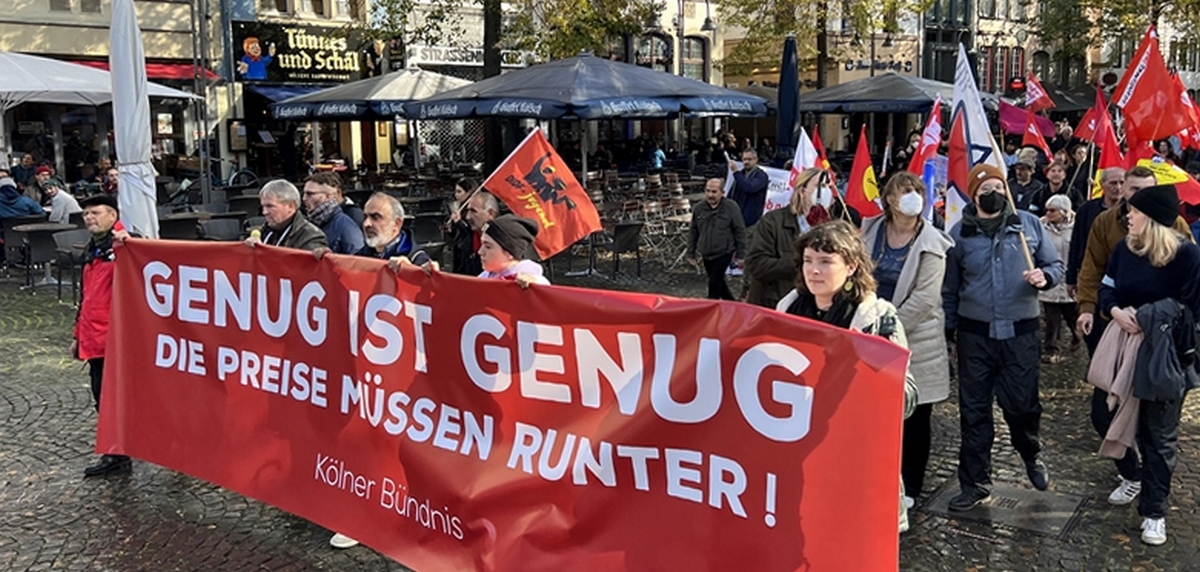
Cologne, Germany, October 1, 2022
There is a growing movement of workers throughout Europe as the global crisis bites. A new sense of internationalism is emerging amongst the international working class. A demonstration called by workers' unions and works' councils recently took place and marched between factories in Berlin. The workers are opposed to the owners of capital, who are trying to make the workers pay for the crisis, which has been exacerbated by the war in Ukraine.
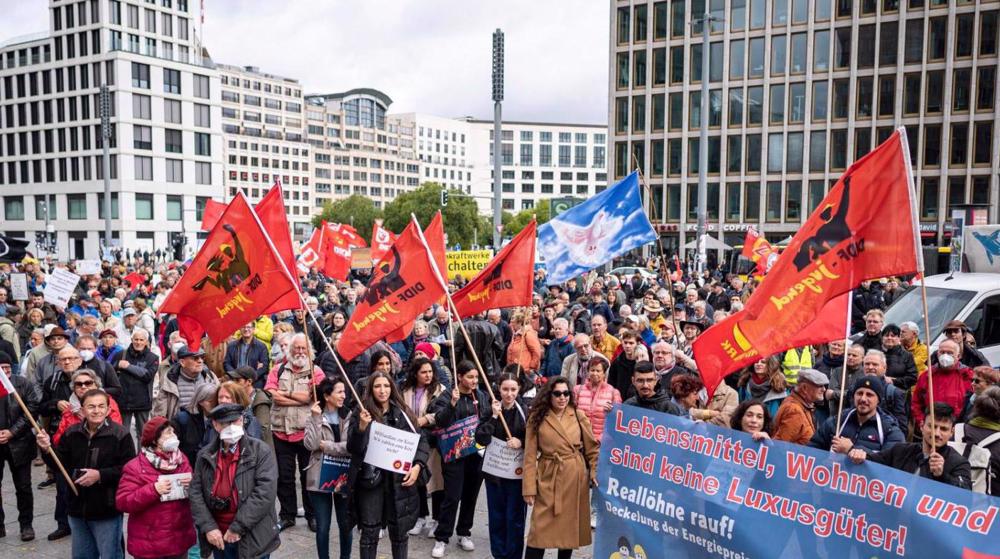
Berlin protests against soaring energy
prices
On November 8, IG Metall in Berlin called a "star march", starting from several factories and finishing with a rally at the Siemens plant on Nonnendammallee, a street in Berlin's north western Spandau district. It reflects the growing resistance in factories and workplaces.
The German government, as all European governments whether inside or outside of the European Union, including Britain, are faced with a force that refuses to be ignored: the resistance of the working class. This movement is growing in the face of rapid price increases, inflation, pandemic, war, attacks on working conditions in hospitals and schools and mass sackings and lay-offs in many industrial sectors, which have their roots in the global capitalist system. Workers and their organisations are discussing strategy and tactics around their developing outlook. The goal of worldwide imperialism and the German elite is to saddle the working class with debt repayment. In all European countries there have been gigantic sums handed out for military rearmament and the billion-dollar gifts given to the super-rich in the pandemic through the imposition of cuts in social spending and wages and price increases particularly in energy and fuel, as well as via direct pay-the-rich schemes.
The federal government in Germany used the war as a pretext for rearmament and military build-up, the biggest since World War II. At the same time, the effect of sanctions against Russia has been an explosion in energy prices, with effects for consumers and businesses.
Various social chauvinists and spokespeople for the reactionary "Germany First" call have hailed this pro-war policy. At the beginning of March, IG Metall and the Federation of German Industries (BDI) issued a joint statement, signed by IG Metall President Jörg Hofmann and BDI President Siegfried Russwurm. It says: "The top representatives of the Federation of German Industries and the IG Metall, who are also co-founders of the 'Future of Industry' alliance, strongly support the sanctions measures against Russia imposed by the German government, the European Union and the Western allies."
A joint statement by IG Metall Baden-Württemberg and Südwestmetall said that Russia's military action has produced a "united and determined" response from Germany, Europe and its allies.
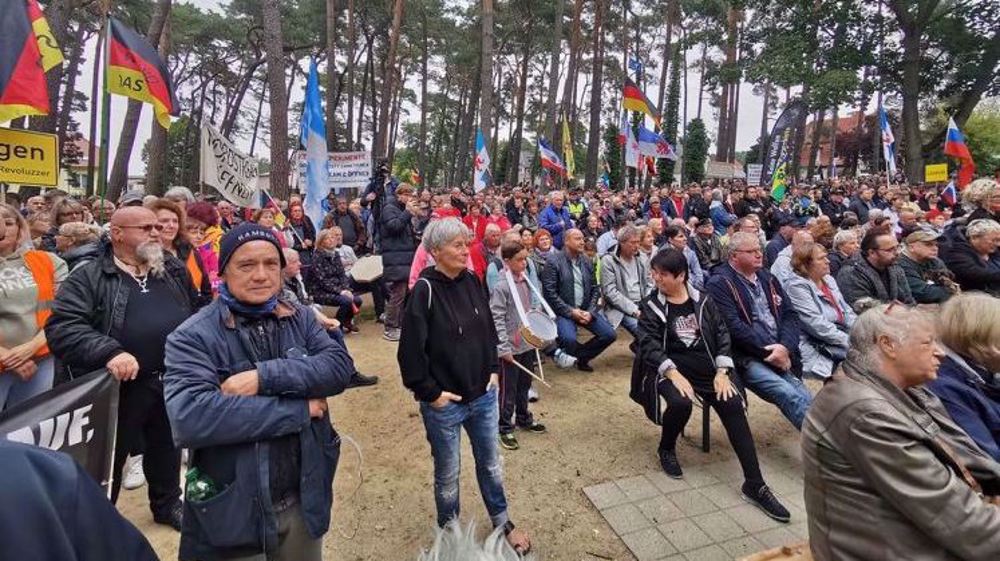
Lubmin, northern Germany protest demanding the opening of
Nord Stream 2
"We support the measures adopted," both organisations emphasised, leaving no doubt that this also means a dramatic increase in military spending. The sanctions against Russia "will demand sacrifices from all of us," the statement says.
Foreign policy across the European powers is itself in crisis, centred on the so-called "unity of NATO". The US wishes to lead NATO and Europe against Russia using the conflict in Ukraine. But NATO remains divided. Neither Germany nor any other European power has any desire to be put on rations by the US because of sanctions on Russia and the gas imports they rely upon. Germany is militarising at a rapid rate and organising to go against the norm since World War II that it would have no troops external to the country. The German question, since that time, which is part of the reason for NATO to exist, remains, which is to keep Russia out, Germany down, and the US on top. Instead, Germany is strengthening itself and conflicts like that over the Nord Stream pipeline and oil continue.
In spite of all of this, workers and their organisations are making it clear that they are determined to step up their struggles. They do not wish to follow the path of war or undermining of their rights or indeed the rights of all. The international working class never wants to see workers of one country fighting workers of another.
Recently, the Leibniz Institute for Economic Research at the University of Munich announced that the rapid rise in energy prices in Germany had resulted in a loss of almost 110 billion euros in real income. The German workers, like all workers internationally, will not accept the direction taken in the economy, and are building their resistance. Their demonstrations and actions are set to continue and are on the increase.