
|
|
||||
|---|---|---|---|---|
| Volume 56 Number 20, June 27, 2026 | ARCHIVE | HOME | JBCENTRE | SUBSCRIBE |
Workers' Weekly Internet Edition: Article Index :
International Anti-War Conference:
The International Conference against War was a huge success!International Conference Against War:
Notes from the Afternoon SessionThe Health Bill 2026:
A Bill to Put the NHS Under Executive Control to Enable Prioritisation of Investment in War IndustriesWorkers Forum:
Strike at Goldsmiths UniversityThe Future of Ireland:
The Irish Unity Bill
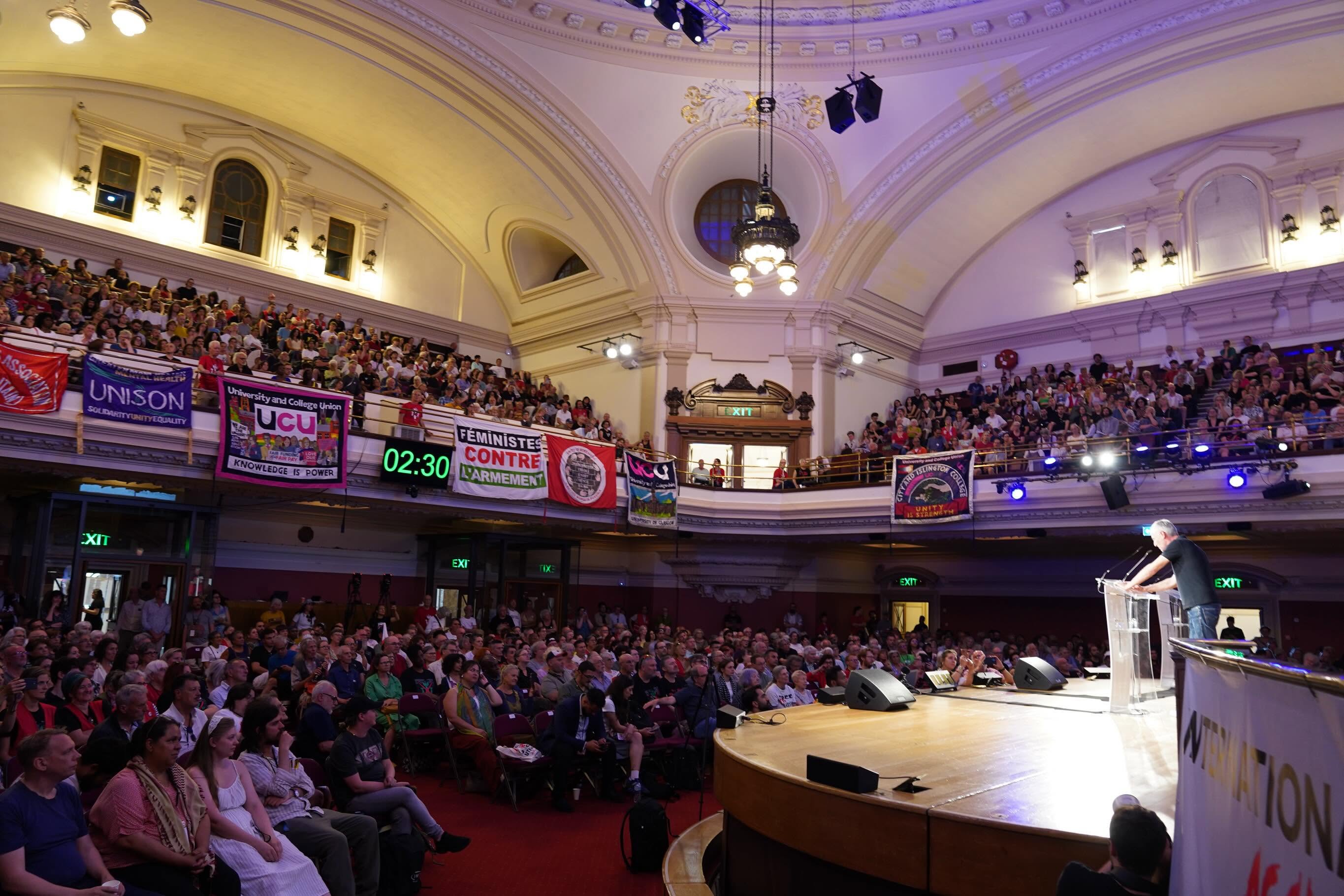
Photo: StW
The International Conference Against War was a great success. It was the second conference of an international movement that was initiated at a huge meeting at the Dôme de Paris last October.
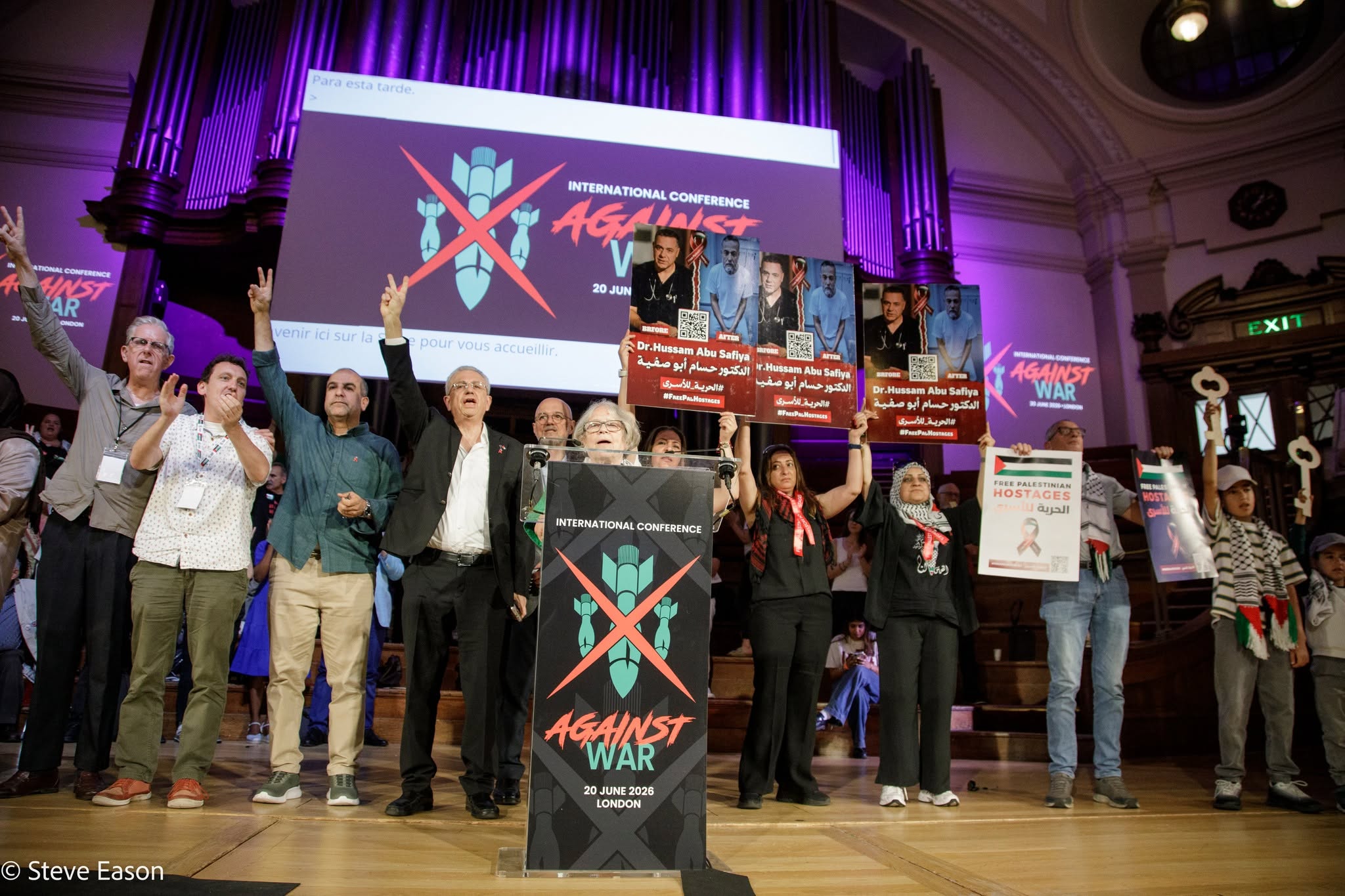
Photo: Steve Eason
More than 2,600 anti-war activists packed into Westminster Central Hall, coming from 27 countries outside of Britain. Hundreds travelled from France, over a hundred from Spain and at least fifty from Germany. In fact, people travelled from across the world - from the USA, Canada, France, Germany, Switzerland, Spain, Italy, Denmark, the Netherlands and more.
Thousands of trade unionists came from across Europe, Britain and beyond. The conference was supported by 14 UK national unions, one hundred other UK organisations and 116 regional and local union bodies. Delegates attended from the Paris CGT union branch of the biggest hospital complex in Europe, from the Federation of Industry of the Spanish CCOO, the dockworkers in Piraeus, Greece, and many more.
Activists were spread across two packed halls in the Central Hall, Westminster. In the Great Hall, the first session opened with a celebration of the unprecedented Palestine movement in Britain. Then members of parliaments and trade union leaders were joined by anti-war and pro-Palestine activists from the US to Iran and Bahrain, including Mustafa Barghouti from the Palestinian National Initiative. The conference was also addressed by Ukrainian and Russian activists.
As the organisers pointed out, the conference was one of the most significant anti-war events in recent decades. It adopted a statement which summarised the key issues and called for three international days of demonstration and action. It was undoubtedly a leap forward for the international movement, as the organisers claimed.
The organisers assessed the Conference as the next big step to co-ordinated action across borders to stop the drive to war. An important conference statement was released, together with a call to action. Congratulations are due to the organisers for their tireless work.
A video capturing the speeches from the Great Hall, and conveying some of the atmosphere, can be seen at: https://youtu.be/YOVqOJ1iU58
Conference Statement
https://d30m66y232rpq4.cloudfront.net/uploads/2026/06/Conference-Statement.pdf
Call to action

1. A joint international day of demonstrations in support of a free Palestine on October 10.
2. A day of action proposed by dockworkers in Italy, France and Greece, date to be confirmed.
3. An international weekend of demonstrations against militarisation, the drive to war and conscription on November 21 and 22.
Austerity and Militarisation
International anti-war conference in London attracts 3,000 activists. Spending on the arms build-up is dismantling social welfare systems. Protests grow louder across Europe. EU imposes draconian sanctions on individuals. Extract from report of german-foreign-policy.com/.
A new movement against the unprecedented militarisation across Europe is gaining momentum as international protests widen and anti-war conferences set the resistance agenda. On June 14, some 12,000 people took to the street in Brussels under the banner "Welfare, not Warfare!" in response to massive rearmament programmes. Social welfare systems are being dismantled across Europe to finance militarisation. The Brussels demonstration was followed on Saturday by a major international anti-war conference in London, attended by nearly 3,000 people from Europe, North America and the Middle East. The discussion highlighted the West's brutal war policies and the dramatic collapse of healthcare, education and pensions. "Austerity and militarisation" are "two sides of the same coin", declared the president of the British food industry union, the BFAWU. Further Europe-wide protests are planned for the coming autumn, including a day of action by dockworkers. But the upturn in protest has been accompanied by increased repression. Journalists, for example, are being targeted with EU sanctions on the grounds that they are allegedly collaborating with an enemy power - Russia. In this way, the EU is putting in place a flexible system of punishment that operates outside the rule of law in order to safeguard its war policy from criticism.
International Anti-War Conference
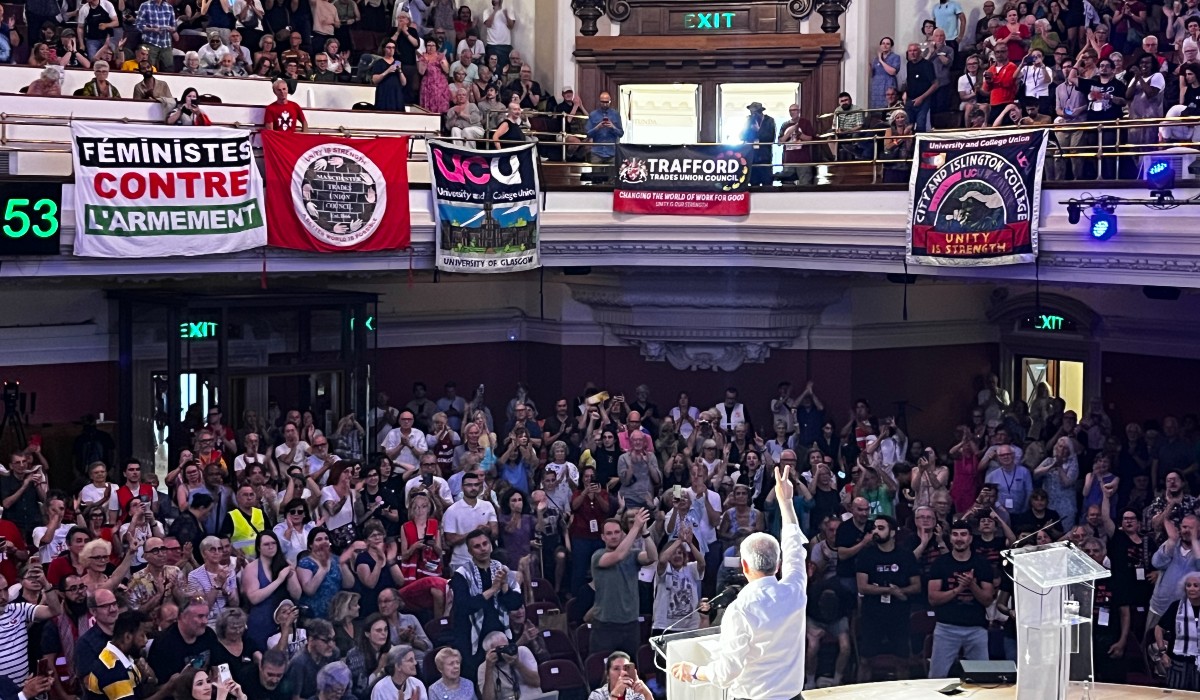
Photo: StW
Attracting almost 3,000 people from Europe, North America and the Middle East, the second international anti-war conference in Europe was held on Saturday within just nine months of the first. On October 5, 2025, more than 4,000 activists had already gathered in Paris for an international meeting to protest against war preparations and the unprecedented surge in militarisation across Europe. In addition to the individuals participating, the follow-up event in London drew delegations from around twenty countries. Trade unions were particularly well represented, including the Britain's public services union Unison - the country's largest union with over 1.4 million members, along with the militant British railway workers' union, the RMT. From France came delegates of the major trade unions CGT and Force ouvrière, and from Italy's CGIL. Other trade unions from a number of other countries also came along to this international show of solidarity in Westminster Central Hall. The conference was organised by the Stop the War Coalition, an organisation founded September 2001 to campaign against the then imminent war in Afghanistan. Back then, it was one of the forces behind the massive demonstration against the impending Iraq War on 15 February 2003. As many as one million people - perhaps even far more - flooded the streets of London to protest against the war.
Two sides of the same coin
The contributions to conference discussion were directed, on the one hand, against current wars, most of which are being waged by the United States, with Israel playing a central role in some cases - such as the bombing of Iran and Lebanon, not to mention the genocidal onslaught in the Gaza Strip. Speakers also shone a light on the US assault on Venezuela and the abduction of its president, Nicolás Maduro. The conference condemned the Trump administration's Cuba blockade and military threats to "own" the country. Speakers also discussed ongoing wars in Sudan, the Democratic Republic of the Congo, and the Sahel. The conference denounced the arms build-up by the EU, as seen in the Commission's 800-billion-euro "ReArm Europe Plan/Readiness 2030". "We do not want US imperialism, and we do not want European imperialism," said Lindsey German, a founding member and, to this day, a leading figure in the Stop the War campaign. Many speakers highlighted the inextricable link between militarisation and the radical dismantling of social security systems currently taking place across Europe. "Austerity and militarisation" are merely "two sides of the same coin", noted Ian Hodson, President of the UK's food workers union, the BFAWU, illustrating the point with the austerity measures imposed by the government of outgoing Prime Minister Keir Starmer [...]
Europe-wide protests
The London Anti-War Conference was preceded by a growing number of national and international protests against militarisation. In Germany, school pupils have seized the initiative and staged so far three school strikes in protest against the reintroduction of compulsory military service. In Belgium, fifteen country-wide demonstrations have taken place over the past year and a half, some attracting up to one hundred thousand participants. They are demanding an end to the Belgian government's harsh austerity policies - and to the military expansion that makes the scale of these austerity measures "necessary" in the first place. On June 14, the first major Europe-wide demonstration against the militarisation of the EU was held in Brussels. Around 12,000 people responded to the call by the "Stop ReArm Europe" alliance and the Belgian Stop Militarisation campaign, whose message is "Welfare, not Warfare". In the winter, tens of thousands took part in protests by dockworkers in over twenty ports, mainly around the Mediterranean. The co-ordinated strike action on February 6 was directed against the militarisation of the EU in general, and against the use of ports for war logistics, in particular, especially the weapon shipments for Israel's genocidal war. Another round of protests is planned for the autumn. There will be a day of action by dockworkers in October and a weekend protest against militarisation in November.
[...]

Lindsay German introducing the session - Photo:
WW
Lindsay German (Chair), introduced the session. Summaries of some of the speakers' contributions follow.
Fran Heathcote, General Secretary of the PCS union, expressed solidarity with all the oppressed, saying that the union stands in solidarity with all those under attack.
John Trickett, Labour MP for Normanton and Hemsworth denounced the funding on arms and the amount spent on "defence". He contrasted arms spending with a situation where people are dying around the world because of extreme poverty and hunger. Working people are paying for arms manufacturing, he declared. Instead, we should be fighting against poverty and world hunger. We need to build an international movement, he said, expressing support for Cuba and its people in this context.
Richard Burgon, Labour MP for Leeds East, and Secretary of the Socialist Campaign Group of Labour MPs, drew attention to what the Cuban government does to support the Cuban people. He stressed that the struggle for sovereignty in Cuba is a struggle for human rights common to the whole Caribbean region.
Mothin Ali, Co-Deputy Leader of the Green Party for England and Wales, condemned the unnecessary war against Iran. He also underlined that the Green Party has consistently stood for the rights of the Palestinian people, and that it will not be silent in condemning the US-led war in the Middle East. During Mothin Ali's speech, the audience themselves participated by chanting "Free, free Palestine!"
Lorena Delgado Varas, Swedish MP, member of the Riksdag, pointed out that the Swedish government is moving to imposition of a war agenda on the Swedish people, and is using the creation of new jobs for the youth as a pretext for its militarism. In Sweden, she said, many children are being deported from immigrant families. She herself has her roots in Latin America, and as such knows that our fight has to unite the peoples from across the world. She denounced the Swedish government for its change to the law to give the executive the right to instigate wars, as well as changing the law to allow the Swedish government to hand over decision-making to foreign forces, effectively overriding Swedish sovereignty.

Jeremy Corbyn, independent MP speaking at the session -
Photo:WW
Ian Hodson, President of the Bakers, Food and Allied Workers' Union (BFAWU), spoke of the rights of refugees, and said that no one is secure who cannot afford food and rent. On Palestine, he said that it is important to recognise that condemning Israel's genocide is not anti-Semitism. It is an illusion, he said, to think that bombing is compatible with democracy.
Jo Brady of the University and College Union pointed out that there are unprecedented attacks taking place on our universities, with any department in danger of being wiped out. But when the government makes the issue one of "defence", it can suddenly find £80 million available and the cash flows. To truly defend our country, we must refuse to collaborate with this outlook, and instead invest in our NHS and public services.
Peter Leary, Deputy Director of the Palestine Solidarity Campaign, recounted that it is nearly three years since Israel started bombing Gaza. The Palestinian struggle matters to us all, he said. Israel is only able to carry out its genocide because of support from foreign governments around the world, including our own. They want to use Palestine to justify the might makes right policy. In the face of this, the campaign for boycott, divestment and sanctions is growing. This week PSC launched a new campaign to boycott the technology systems we sell to Israel. It's the reason Keir Starmer's Prime Ministership is now coming to such an ignoble end, he said. Everyone stands in solidarity with the Palestinian people. In order to ensure all people's freedom we must continue to fight for the right and freedom of the Palestinians.
Medea Benjamin, American political activist and a co-founder of Code Pink, referred to the prospective pro-Palestine Mayor of Washington DC, standing against the AI companies who are funding and supporting weapons manufacturers and opposing the obscene Pentagon military budget, as well as conducting warfare by economic means. This is what they are doing to Cuba, she said. We say "Hands off Cuba!" She noted that Trump had been forced to sign the Memorandum of Understanding with Iran. She declared that the majority of American people are saying, Free Palestine, Hands off Iran, Stop interfering in Cuba!
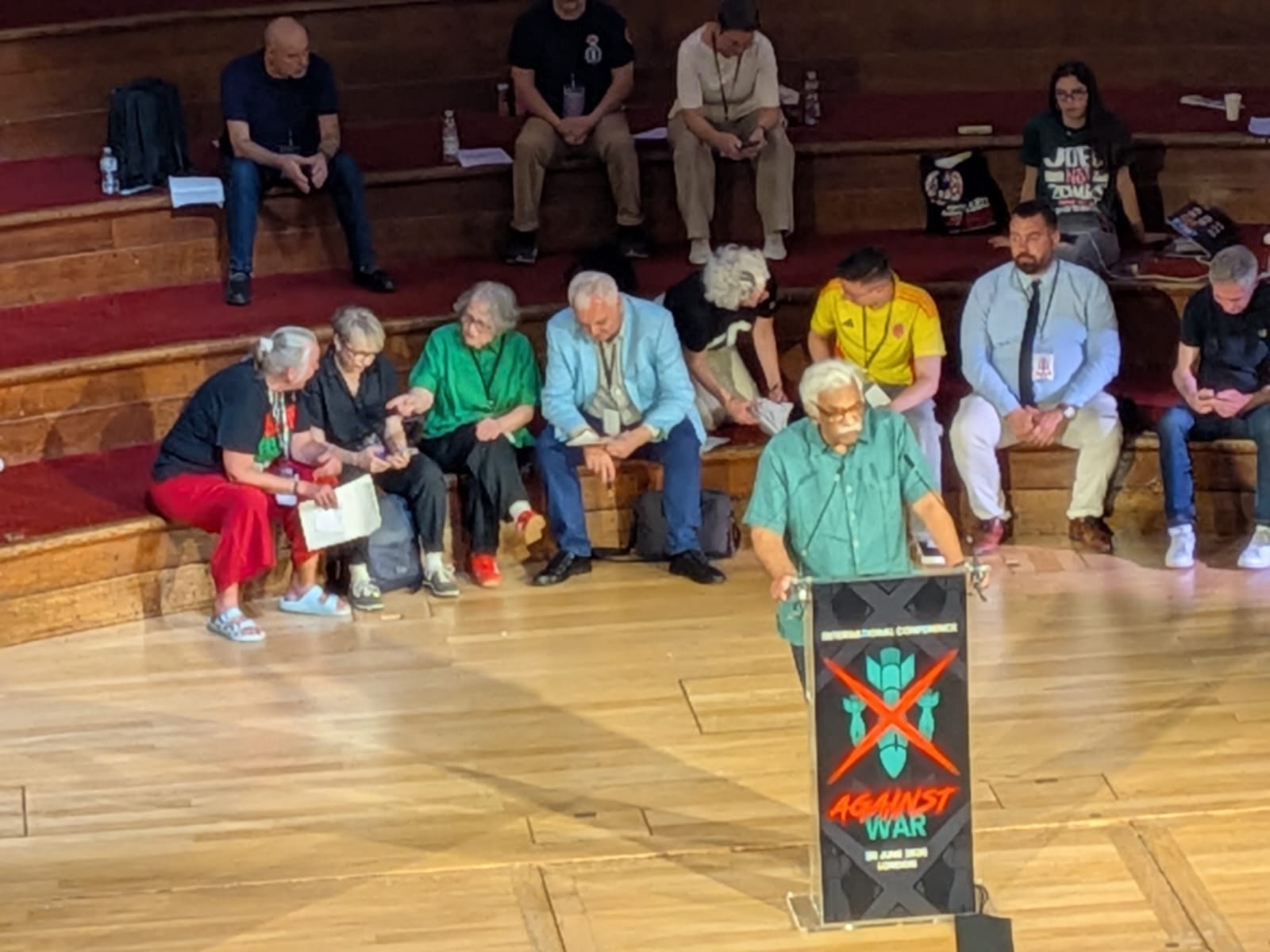
Tariq Ali, political activist speaking at the session -
Photo:WW
Jeremy Corbyn, independent MP, said that there is a global voice for a real alternative. The cause of our time, he said, is the genocide in Palestine, and the complicity of our government in that genocide. The Palestinians must be allowed to decide their own future in peace. Furthermore, there are 70 million people who are now refugees with nowhere to call home. The arms industries with the power to lobby government tell us that the poverty has to continue to pay for the latest weapons. It is time to change the agenda: stop the arms trade, stop the walk into war and build unity for peace and justice
Irene Montero, Spanish MEP, pointed out that we are seeing the first televised genocide. The US, Israel and all their allies are attacking Iran, they have entered Venezuela, they are threatening Cuba. They are committing war crimes, and the billionaires are supporting the terrorist state of Israel. We are not ready to lose our children to war, she said. We should start questioning why we are a part of these military alliances! Peace is the new political armament! Hands off Lebanon, Hands off Venezuela!
Diane Abbott, independent MP for Hackney North and Stoke Newington, expressed the determination to build unity in the movement for peace in Britain and internationally. What stood out in her address was the call to oppose NATO's proxy war against Russia.
Diana Danelys De Los Santos (known professionally as Amara La Negra), the Black Lives Matter movement, explained that we want to build a future based on a new paradigm, that people cannot be divided, oppressed and exploited based on apparent differences. What is required now is that we have an anti-war agenda, she said, commenting that you cannot have an anti-war agenda without also having an anti-imperialist agenda. She stressed the importance of self-determination, and in bringing about a world where peace can be enduring. We reject genocide in all its forms everywhere, she said. We must fight for that vision of the future that guarantees the rights of all.
Dr Mustafa Barghouti, a physician who is General Secretary of the Palestinian National Initiative (PNI), pointed out that no people have been subjected to oppression in the way the Palestinian people have been subjected to over the last 120 years. Now, they are not only facing the genocide of the state but facing the settler gangs. He said that Palestine has become a main issue in every movement for peace around the world. We want you to continue the struggle and your support, he exclaimed. We want you to support by boycott, divestment and sanctions. Dr Barghouti explained that when the war started in Gaza, the physicians were worried about the 70,000 pregnant women. Israel did carry out mass killings. But we saved the lives of 82,000 people. This is the resistance! Nothing should prevent us from standing with the resistance!

Photo:WW
Felix Kreklow Rojas, a 19-year-old political activist from Aachen, Germany, serves as a deputy national chairperson for the Jugendbündnis im BSW (JSW), and is an anti-conscription activist. He pointed out that Europe is gearing up for war; yet the structure of life built by the European politicians is already crumbling.
Zarah Sultana, MP for Coventry South, pointed out that for the government there is always money for war and never for the poor. She said that millions around the world experience food insecurity. This is the result of capitalism. In Gaza entire communities have been and are being destroyed, journalists killed, all in full vision of the world. Shame on the UK government, she declared! The MP highlighted the stand of the dock workers in Italy and Portugal; ordinary people are fighting back, she said. Another world is not only possible, but she is on her way!
Sophie Bolt, General Secretary of the Campaign for Nuclear Disarmament (CND), referred to President Macron's plans to deploy nuclear weapons across Europe and here in Britain, too, where there are plans to buy F-35 nuclear-armed and capable planes. She declared: Stop this war drive! Fight for a better world! We have the solutions to all these crises, not the warmongers. We don't want these nuclear weapons in our country, which are being used to carry out genocide in Palestine and beyond. Shut down our military bases, she stressed. Together we can create the global majority for peace.
Andrew Feinstein, former Member of the National Assembly of South Africa for the ANC (African National Congress), pointed out that 40% of all corruption globally takes place in the global arms trade. Our most senior politicians benefit. Tony Blair has profited personally from the unlawful attack on Iraq. These are the most awful and egregious human beings ever. We learned in South Africa, he said, that from the darkness emerges the light. And as we fought for the liberation of all South Africans, we know that Palestine too will be free.
Daniel Kebede, General Secretary, NEU, stressed that we are standing on the edge of an abyss. We cannot rely on our politicians to sustain the peace for us. They are cutting welfare, accompanied by a global increase in military funding. A single fighter jet, he explained, could fund education for 200,000 children for a year. He underlined that educators and unions continue to work to keep education alive. Daniel Kebede referred to the more than 8,500 attacks on education in Gaza, and to the bombing of school girls in Iran. As arms manufacturers enrich themselves the people are forced to pay the price, he said. This conference has shown that together we are more than the sum of our parts, he declared. Solidarity!
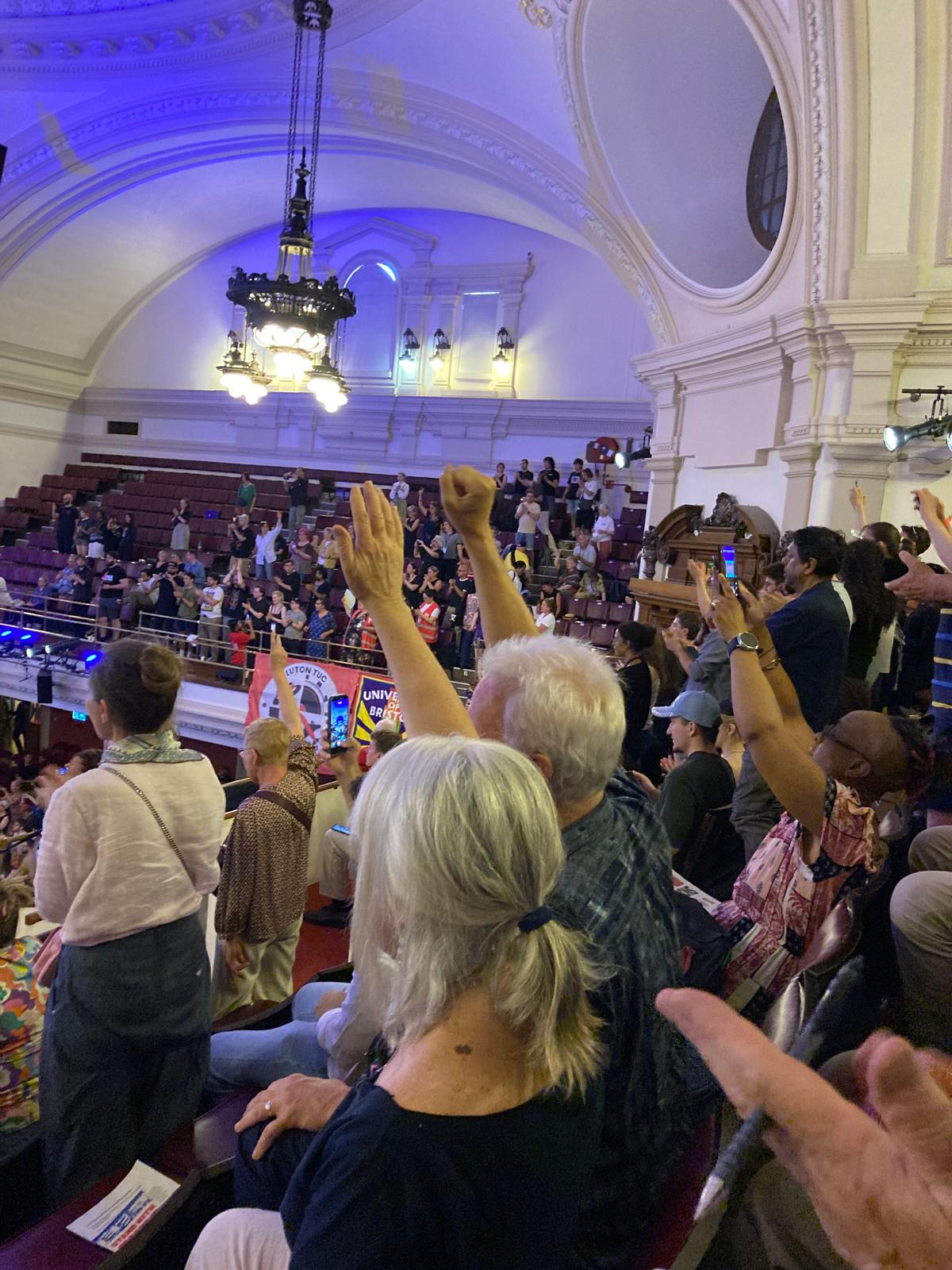
Photo:WW
Ulrike Eifler, of the IG Metall (Industrial Union of Metalworkers), Germany, said that it is becoming increasingly clear that Gaza was not the exception but the norm. Our governments, she said, want to abolish the retirement age. And as regards hospitals, they must be more than places where people are just patched up. They do not belong to our governments; they belong to the people who use and run them. She concluded that our task is to build a strong anti-war movement with deep roots in the labour movement
John Rees, co-founder of the Stop the War Coalition, spoke to much acclaim, ending with the call, "Proletarians of the world unite!"
Jérôme Legavre, a prominent anti-war politician from the left-wing party La France Insoumise (LFI), referred to the French phrase "Sang sans de nee", which, he said, is a phonetic or colloquial reference to the French department Seine-Saint-Denis, a highly diverse and working-class area just north of Paris. Seine-Saint-Denis is a major stronghold for French left-wing and anti-war politicians. For working people in France, the issue is to confront our own government. It is by confronting our own governments that we can stop the march to war, he said. We need to unite everyone against war.
Tariq Ali, political activist well-known for his participation in the Grosvenor Square protest in 1968 against the Vietnam War waged by US imperialism, condemned the politics of assassination, pointing out that the imperialists think they can act with impunity. But when resistance comes, he said, it has an impact. In the course of his address, he paid tribute to the Italian dock workers of Genoa.
Maryam Eslamdoust, General Secretary of the Transport Salaried Staffs' Association (TSSA), began by mourning the death of a train driver who the union believes was the victim of lack of investment. She continued: I am a leader of a British union but I am also a proud Iranian woman. The brave people and women of Iran have held their heads high against the greatest military might on the planet. Dare we hope, amidst the awful murder of young girls in Mina, amidst all the terror, that the Iranian enormous strength of spirit will prevail. Long live Iran! Long live Cuba! Long live Palestine!
Jordi Salvador Duch: MP from Spain (ERC), declared, "¡No pasarán!"
Eddie Dempsey, General Secretary of the RMT, spoke about the sacrifices members have made opposing war. We remember joining the anti-war demonstration against the war in Iraq in 2003, he said. We have always stood with the people of Cuba also. Our security is counted in terms of a good health service, good homes, education and social provision. Stop the war machine before it's too late! Solidarity!
Markos Bekris spoke on behalf of the dockworkers in Piraeus, Greece, specifically those represented by the ENEDEP union (Union of Container Handling Workers). These workers made headlines for staging militant actions and strikes to protest against the militarisation of ports and to halt the transport of military cargo.
José Nivoi, a leader of the Genoa dockers, was joined by Italian trade unionist Graziamaria Pistorino from the CGIL union. It was pointed out that within 10 days of the strikes against Gaza there were two days of general strike in Italy. The movement, it was explained, was led by the most advanced section of the working class. The response had emerged from the development of consciousness. Such general strikes don't just happen, they must be organised.
Peter Mertens, leader of the Workers' Party of Belgium, made the point that it is normal to stand up against war; it is normal to stand against fascism. In the turmoil of today, he said, that situation can change very rapidly. No to warfare!
The film "Gaza" was shown at the lunch break and after the whole conference.
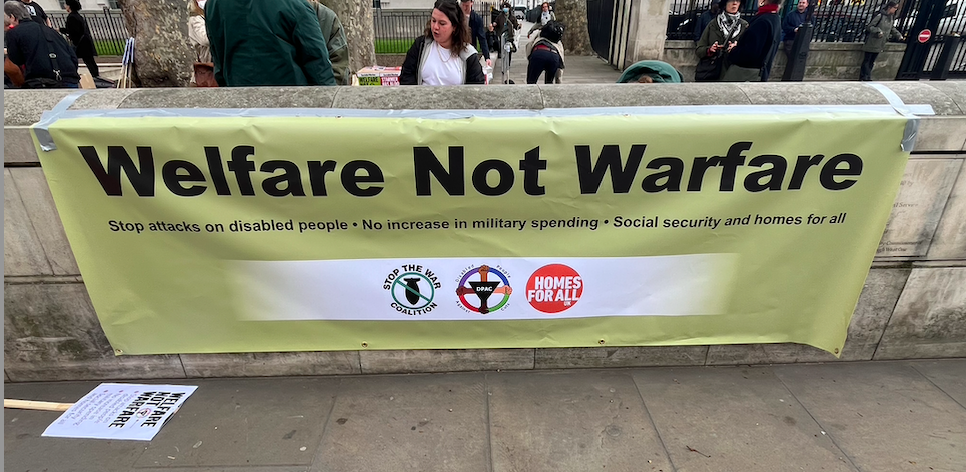
The Health Bill 2026 [1] was introduced in the King's Speech in the new legislative session on May 13 as the "NHS Modernisation Bill". It is said that it will abolish NHS England ("NHSE") and transfer the bulk of its functions to the Secretary of State for Health and Social Care (the "Secretary of State") and to integrated care boards ("ICBs"). As a result of the abolition of NHSE, the Bill proposes to transfer NHSE's property, rights and liabilities to various bodies including, primarily, the Secretary of State (SoS) and integrated care boards (ICBs).
Amongst the main measures of the Bill is the aim to "modernise the NHS in England" by "abolishing NHS England" creating a "Single Patient Record" (SPR), and "centralising certain powers under the Secretary of State". However, the then Secretary of State for Health and Social Care, Wes Streeting, who introduced the Bill to Parliament the next day on May 14, then on the same day resigned as the Health Secretary stating that "he had lost confidence in Starmer's leadership". This was in spite of the fact that over a year earlier he and the Prime Minister Sir Keir Starmer, who also resigned last week, were both the authors of this plan to put the NHS under the control of the Executive and to abolish NHS England. Now, the measures of the Bill are still the same as those put forward by Starmer and Streeting, even with the new Secretary of State for Health and Social Care James Murray, who introduced its second reading in the House of Commons on June 1.
In other words, Ministers come and go, and these days it is the same with Prime Ministers, so the working class and people have to ask why nothing changes for the better, and the crisis of government and the Westminster cartel party system goes on relentlessly. This happens whilst power is concentrated in those that control the Westminster government on behalf of the rich and private interests rather than public well-being. What has to be looked at with the Health Bill is its purpose in the context and aim of this system that is prioritising war over the health of the people and their interests.
It must be remembered that in March last year Starmer had set out this context of the NHS Health Bill [2]. Firstly, his remarks focused on trying to justify the massive increase in defence spending. He declared that "security" was increasing the expenditure on the arms industry, actively supporting the escalating war in Ukraine against Russia, alongside its support for Israel and its criminal war against the Palestinian people over the three years of genocide. This path is pursued without any hint from these warmongers of wanting to bring about real peace and security in Europe, either in Ukraine or in Palestine or elsewhere. This he had to admit was at the expense of investing in public services like the NHS and education.
Starmer claimed that this was now pressing "for greater urgency and to go further and faster on security and renewal". He tried to justify this "renewal" of the state by summoning up the spectre of what he called the "bureaucracy of the state". So, the context for this Health Bill was aimed at justifying making huge cuts to the "staffing in the NHS by 50%", claiming that this was just affecting "administrative" staff and "quangos" when in fact since the announcement it has also been aimed at further cutting health services and clinical staff.
Starmer claimed that the NHS would be brought back into "democratic control" by concentrating power back into "direct control by government" in the form of the Secretary of State and the executive power of the government. This was a lie, as this was not "democratic control" but, as the Bill shows, a central path to make further cuts to the NHS. This can be seen by looking at the Health Bill 2026 and its measures. It can be seen that it is not even about restoring the responsibilities of government for health care but to further ensure the other priorities for this warmongering elite. The Bill that the government hails as restoring "direct control by government" does not make the Secretary of State responsible for "a comprehensive health service" as stated in previous Acts since 1947. It does not recreate a non-delegable duty to ensure universal provision of health services for all who reside in the country.
Prior to the Health and Social Care Act 2012, the National Health Service Act 2006, Section 1, imposed a direct, personal, non-delegable duty on the Secretary of State. "The Secretary of State must continue the promotion in England of a comprehensive health service designed to secure improvement - (a) in the physical and mental health of the people of England, and - (b) in the prevention, diagnosis and treatment of illness." This was universally understood as the core constitutional duty: the Secretary of State was responsible for the NHS as a whole. The duty was direct, unqualified, and non-delegable. Ministers were accountable for the comprehensive health service itself. This is the duty of the foundation of the NHS as a universal, national service. With the Health and Social Care Act 2012 the Secretary of State's role became one of oversight, mandates, and regulations, not of direct responsibility. The 2012 Act severed the link between the Secretary of State and the duty to provide a comprehensive health service and put in place commissioning bodies including the central commissioning body NHS England. This is not reversed by the Health Bill 2026 as claimed by the government. The Health Bill 2026 "increases ministerial direction powers", but does not recreate the pre-2012 constitutional settlement where the Secretary of State was legally responsible for the NHS provision itself. It does not reverse the structural fragmentation into arms length unelected "commissioners" and "providers" introduced in the Health and Social Care Act 2012.
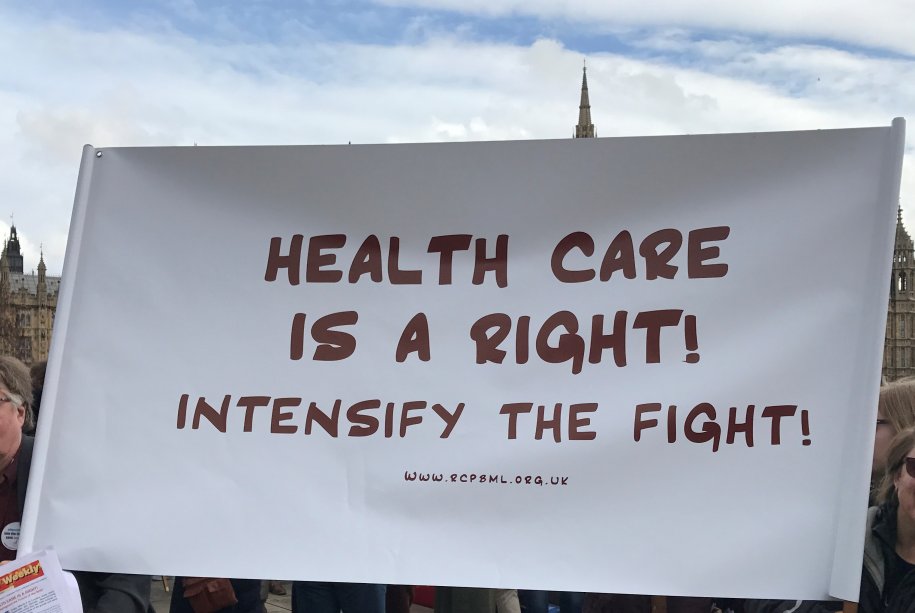
Instead, the Health Bill 2026 states in section 4-11 that the "Secretary of State's functions" are to be "duty to reduce inequalities", "patient involvement and choice", "promoting innovation." These "functions" also include a list of "directions" to Integrated Care Boards (ICBs) including powers on their failure. Most notably the Bill limits the Secretary of State's "duty as respects variation in provision of health services". The Secretary of State must not cause "a variation in the proportion of health services provided by the public or private sector", or the proportion of health services provided by "different kinds of legal entity [i.e. private companies [3]], unless the Secretary of State considers that to do so is in the interests of the health service". In other words, commissioners will be able to continue to privatise the NHS without the Health Secretary causing a "variation in the proportion of health services".
On creating a "Single Patient Record" (SPR), section 47 gives the Secretary of State mandatory powers to require NHS Trusts, Foundation Trusts, ICBs, and GP practices to share any patient data the Secretary of State specifies. Through this undemocratic measure in the Bill, the government is trying to enforce GPs, hospitals and other providers to share patient data for the SPR contract with Palantir [4] and other data companies. This is part of the government's plan to embed Palantir and other data companies who are part of the war industries into the British state and with it control all of the NHS data of patients. This goes directly against the people's response that is No Palantir in the NHS! and opposing Palantir and the government's joint abuse of people's data, as well as demanding the right to privacy of patient and other data where only they can decide.
The Health Bill 2026 is not an "NHS Modernisation Bill" as claimed. It is a Bill to put the NHS under the Executive of government to enable the prioritisation of investment in war industries rather than the NHS. This whilst they try to maintain the illusion that they care about our health services and the NHS. However, this crisis will continue and the NHS Bill will be further exposed and increasingly opposed as has happened since Starmer and Streeting's announcement of it last year. This is further shown by the struggle of the doctors and other health workers against the attacks on their jobs, wages and conditions.
These struggles of health workers are continuing in the context of the growing broad unity of the people against war, and the right to resist the violence of war and militarism. Health workers and people in the communities should not become overwhelmed by this present situation but put their energy into discussing, planning and organising to resist cuts to their health services and oppose the militarisation of the economy that is destroying health services and peace and security.
Notes
1. Health Bill: A Bill to make provision about health and social care.
https://publications.parliament.uk/pa/bills/cbill/59-02/0009/260009.pdf
2. Putting the NHS under the Control of the Executive: On Starmer and
Streeting's Decision to Abolish NHS England, Workers' Weekly, March 16,
2025
https://www.rcpbml.org.uk/wwie-25/ww25-06/ww25-06-01.htm
3.In UK law, a "legal entity" is any organisation that has a legal
personality - meaning it can enter contracts, employ staff, hold property, sue
and be sued.
4. No Palantir in the NHS: Oppose Palantir and the Government's Joint Abuse of
People's Data, Workers' Weekly, May 16, 2026
https://www.rcpbml.org.uk/wwie-26/ww26-15/ww26-15-02.htm
.jpeg)
Photo: Counterfire
Goldsmiths University and College Union (GUCU) launched indefinite strike action on Monday, June 8, in response to sweeping proposed redundancies and an effective management lockout. Senior management argues that major staffing cuts are needed as part of plans to make £22 million in savings by the end of the 2026-27 academic year, with £20 million of those cuts coming from staffing. The proposals could put hundreds of academic and professional-services jobs at risk.
.jpeg)
This reflects the wider funding crisis facing English universities, but GUCU points out that huge sums have been spent on consultants, recruitment services and senior-management salaries. Goldsmiths has an internationally recognised history of creativity, including in art and music, but GUCU argues that it is in danger of entering a death spiral of repeated cuts, declining provision and falling student confidence.
GUCU began a marking and assessment boycott on April 27. This is a powerful tactic which the branch previously used as part of a successful campaign to prevent compulsory redundancies. In a ballot that closed on April 10, 81% of members who voted backed strike action and 92% backed action short of a strike, on a turnout of 63%.
In response to the boycott, senior management announced the threat of 100% pay deductions for participants - an effective lockout. GUCU, which has a history of effective militancy, then launched indefinite strike action to force management to withdraw both the threat of full pay deductions and the compulsory redundancies.
There has also been strong support from students, who recently carried out a 32-day occupation of the library to protest against proposed staff cuts. A 24-hour sit-in - which featured overnight shifts, community meals, and study sessions in solidarity with staff facing potential redundancy - ended the occupation on May 20, 2026, after university management threatened participants with campus bans.
GUCU notes:
"This would be the third round of mass cuts in five years. Every previous restructure was presented as the route to financial stability. Instead, staff and students have paid the price while management has continued costly external spending and repeated restructuring. Through Freedom of Information requests, our branch uncovered more than £14 million spent on consultants between 2019 and 2026, alongside at least £6.6 million on recruitment services since 2022. Much of this followed the failed Recovery Programme, which removed internal capacity only for management to spend millions attempting to replace it.

Photo: Lucro Di Mambro-Moor
"Our branch believes Goldsmiths cannot shrink its way out of crisis. The university needs stability, investment, and a serious focus on rebuilding student confidence and recruitment, not another round of cuts that undermines its future." [1]
The threat of a 100% pay deduction places participating staff under severe financial pressure, and GUCU has launched a fundraising appeal. To donate to the strike fund, visit:
https://goldsmithsucu.org/support - fund
Notes
1. Goldsmiths University and College Union homepage, accessed 14 June 2026
https://goldsmithsucu.org
.jpg)
On June 16, 2026, Sinn Féin President Mary Lou McDonald introduced Private Members' legislation known as the Irish Unity Bill in the Dáil.
In social media posts, Ms McDonald, who is TD for Dublin Central and Leader of the Opposition in the Irish Republic, made the clear call: "The future of Ireland should be decided by the people of Ireland." In other words, the vision is for a united sovereign Irish Republic, a united Ireland (Éire aontaithe), a new Ireland (Éire nua). A "New Ireland" has been the vision and aim of those who have fought for Irish unity and independence, particularly during the period when British troops were committing atrocities against the Irish people in the north of Ireland in the 1970s and 1980s and Sinn Féin and Irish patriots were fighting to drive these British forces out of Ireland.
Mary Lou McDonald declares: "We have a huge opportunity to reunite our country and shape our own future, here at home. By seizing this opportunity, we can build a new Ireland that works for everyone."
McDonald is actively campaigning to pass the Irish Unity Bill in the Dáil on July 7, framing it as an unprecedented generational opportunity. The legislation seeks to legally force the Taoiseach and the Irish government to establish structured, responsible planning for constitutional change. It mandates the publication of a government Green Paper to consult with the public and explicitly outline what a unified state would look like within the European Union. The bill dictates the creation of an all-island Citizens' Assembly, bringing together various communities - including Unionists and Protestants - to co-design a shared future state.
The Commission on the Future of Ireland, a grassroots consultation, was launched by Sinn Féin in 2022 to plan and prepare for Irish Unity and constitutional change. The initiative gathers public input on healthcare, the economy, and governance through public assemblies across the island and internationally.
Mary Lou McDonald writes: "Keir Starmer's departure is the latest chapter in the revolving door of Westminster politics. That is why the time to prepare for Irish Unity is now. Ireland's future lies in our own hands. The opportunity before us is to build a new and united Ireland - one that delivers good public services, economic opportunity and a better future for all who share this island."
She concludes: "The conversation is no longer about if constitutional change will happen, but how we prepare for it and ensure that it works for everyone that calls this island home."
Receive Workers'
Weekly E-mail Edition: It is free to
subscribe to the e-mail edition
We encourage all those who support the work of RCPB(ML) to also support it
financially:
Donate to
RCPB(ML)
Workers' Weekly is the weekly on
line newspaper of the
Revolutionary Communist Party of Britain (Marxist-Leninist)
Website:
http://www.rcpbml.org.uk
E-mail:
office@rcpbml.org.uk
170, Wandsworth Road, London, SW8 2LA.
Phone: 020 7627 0599:
