
|
|
||||
|---|---|---|---|---|
| Volume 56 Number 23, August 1, 2026 | ARCHIVE | HOME | JBCENTRE | SUBSCRIBE |
Workers' Weekly Internet Edition: Article Index :
Stand with Revolutionary Cuba!:
Anniversary of Assault on Moncada and Carlos Manuel de Céspedes Barracks, July 26, 1953Cuban President in Pinar del Río: "May each dawn find us ready to fight"
Condemn Desperate Diatribe of US State Department
US State Department's Cuba Conspiracy Report Exposes its Own Desperation
Parliamentary Pressure Grows for Cuba
Anniversary of Signing of Armistice in Korean War, July 27, 1953:
The Importance of Solidarity with the DPRK and its People in Today's Global SituationComing Events:
Public Meeting: Stop Bombing Iran.......Palestine

On the occasion of July 26, Moncada Day, known in Cuba as the National Day of Rebellion, RCPB(ML) sends its revolutionary greetings to the Cuban leadership and people, and expresses its deep admiration for their resistance to the brutal offensive that the United States is waging against them.
The celebration of National Rebellion Day in Cuba was dedicated to the centennial of Commander-in-Chief Fidel Castro Ruz, the 95th birthday of Army General and Leader of the Revolution, Raúl Castro Ruz, and the 50th anniversary of the eastern city of Pinar del Río first hosting this commemoration.
It is evident that the Cuban people are imbued with the spirit with which Fidel Castro led the assault on the Moncada and Carlos Manuel de Céspedes Barracks in Santiago de Cuba and Bayamo respectively. Moncada in particular was the Batista regime's military stronghold in the south-east of Cuba, the second largest barracks in the country and a symbol of its power.
Today RCPB(ML) declares its full confidence in the revolutionary mettle of
the Cuban workers and youth. It is sure that, in spite of all the
 challenges they face
today, imbued with the defiant spirit of Fidel and those youth who undertook
the assault on July 26, 1953, they will prevail. We know that with this
revolutionary spirit also, they will not be diverted or deterred from the goal
of breaking the US blockade of Cuba once and for all.
challenges they face
today, imbued with the defiant spirit of Fidel and those youth who undertook
the assault on July 26, 1953, they will prevail. We know that with this
revolutionary spirit also, they will not be diverted or deterred from the goal
of breaking the US blockade of Cuba once and for all.
Our Party honours the memory of the 70 young people who were killed in the battle in 1953, and those who were captured, tortured and executed. The survivors, including Fidel Castro, the 100th anniversary of whose birth falls on August 13, 2026, were subsequently put on trial and sentenced to long prison terms. At his trial, Fidel Castro delivered his famous speech "History Will Absolve Me". This laid out the national and social goals of the revolutionary movement that eventually triumphed over the Batista dictatorship on January 1, 1959.
RCPB(ML) salutes the courageous youth, paying homage to the legacy of Fidel Castro and the other heroes who went on to lead the Cuban people to victory. Up until the present, the Cuban people have defended the revolution and its cause in the face of the brutal blockade and acts of terrorism organised by the US imperialists to bring Cuba to its knees and surrender.
To this day, this bold action on July 26, 1953, symbolises the revolutionary spirit and audacity of the Cuban people. It symbolises their recognition of their right to decide their own fate free from foreign interference and domination. It is this same spirit of defiance that has enabled Cuba not only to withstand the genocidal blockade by the US imperialists, but to consolidate the Revolution and provide for the well-being of its people.
The achievements of the Cuban Revolution and the ongoing work of the Cuban
people and their Communist Party inspire support for revolutionary Cuba. As the
US sanctions intensify, as disinformation and interference aimed at
counter-revolution are being stepped up by US imperialism, it becomes ever more
necessary to stand as one with the Cuban people. In these present
circumstances, the British government have the duty to speak out against the
new anti-communist tirade of the United States. And the working class and
people of this country, as a crucial act of solidarity, must boldly declare
that they will defend their own human right to speak out. Let us take the cue
to further provide assistance to the Cuban people, as well as to all people of
the world who stand with Cuba.
Viva Cuba!
Long Live the Cuban Revolution!
End the Blockade Now!
Radio Habana Cuba - July 27, 2026

Cuban President Miguel Díaz-Canel in Pinar del
Río
"Dear people of Pinar del Río, on this July 26, please accept my affection and recognition for having earned, through your effort, dedication to the revolutionary cause, and creative work, the great honour of hosting the central commemoration of the 73rd anniversary of the attacks on the Moncada and Carlos Manuel de Céspedes barracks, National Rebellion Day. A warm embrace to all, Raúl Castro Ruz."
With this heartfelt message from the Leader of the Revolution, Army General Raúl Castro Ruz, the First Secretary of the Central Committee of the Communist Party and President of the Republic, Miguel Díaz-Canel Bermúdez, began his speech at the National Commemoration of July 26.
The Cuban president emphasised that "Cuba is waging a historic battle today, a new Moncada", and recalled Fidel Castro's words when he described the Moncada attack as the small engine that later powered the great engine that is the Revolution.
Díaz-Canel insisted that today Cubans are fighting "fiercely and stubbornly for our sovereignty and our right to freely choose how to govern ourselves, with the same passion with which José Martí set out to achieve complete justice".
In his remarks, he recalled the example of Commander of the Revolution Ramiro Valdés Menéndez, who remained true to his ideals until the very last moment of his life.
Once again, the President referred to the displays of everyday heroism, among which he highlighted the results of the Maternal and Child Health Programme in Pinar del Río, with 4.8 live births per 1,000 live births and zero maternal deaths, "amid blackouts and shortages of all kinds". He also acknowledged other elements that were essential to the results the province boasts today, such as food production, tobacco production, and the food industry supply chains.
He also highlighted the work in science and innovation, cultural development, and heritage protection. The province also has a work system that has fostered greater engagement with communities. "Congratulations to Pinar del Río for its heroism and achievements," the President said. He also commended Matanzas and Villa Clara, outstanding provinces, and recognised the achievements of Guantánamo and Sancti Spíritus.
Díaz-Canel reflected that the historical adversaries of the Cuban nation "launch a threat against the Revolution every day, and every week announce a new punishment for Cuban companies and officials, even for those, whether Cuban or foreign, who dare to send an oil tanker or invest in Cuba". He especially condemned as infamous the arguments for the sanctions targeting Cuban Public Health entities and officials.
"They have declared a world war against the left and against Cuba, as the capital of Communism in the 21st century," the President said, adding that they are not only criminalising protest, but also opportunistically seeking a new excuse to justify their genocidal policy against Cuba, which the world condemns. "Let Cuba live in peace," he affirmed, adding that "Cuba is not a threat to the United States, nor to any other country on earth."
He also spoke of the merits of our island in terms of international solidarity, highlighting that, despite the difficulties, Cuban universities have graduated more than 30,000 professionals, more than 300 of whom come from other countries. He emphasised that, among them, 23 were Palestinian doctors and five were Americans. "Is this what they call terrorism? Is this what they call a threat?" he questioned.
"The only threat to security in the region, the true and real threat to world peace and to human life, is the policy of aggression that causes famine, impoverishment, disorderly migrations, chaos, instability, and tens of thousands of deaths worldwide," he stated.
The President firmly declared: "From this platform, I denounce that Cuba is the victim of a coldly calculated genocide. The United States government has consciously designed and implemented a policy of maximum economic strangulation against the Cuban people. It has intensified its six-decade-long blockade policy, imposing an energy and financial embargo, causing a profound crisis in the electrical power system that results in blackouts lasting more than a day, the paralysis of industries, and the impact on tens of thousands of workers."
He also denounced statistics that reveal the suffering of Cuban families, such as deaths due to a lack of medicines that were always free in the country; more than 100,000 surgeries that cannot be performed because hospitals cannot be protected from unexpected power outages during the already frequent failures of the National Electric System (SEN) and due to the lack of fuel for backup power plants. More than 118,000 cancer patients, including 1,200 children, are unable to receive first-line treatments and are forced to resort to second- and third-line alternatives. "And what is just as, or even more, painful, the infant mortality rate has risen to 9.3 per 1,000 live births, compared to 4.5 in previous years. Those numbers include the faces of children who never saw life as a consequence of the blockade," he said, adding that it is illegal and criminal to torture a people simply to provoke them to rebel against their government.
"The blockade is a weapon of war and causes deaths," he stated, adding that the blockade only works because of the complicity of those who fear Washington's power more than the judgment of history. "This is a new call to the conscience of the world: do not become complicit in another genocide."
"Before it was Gaza, Lebanon, Iran; today it is Cuba." "Tomorrow it could be any other nation," he said, recalling that international solidarity arrived too late for thousands of Gazans, including more than 21,000 children. He emphasised that, for this reason, solidarity with Cuba cannot wait, and therefore thanked those who risk everything to bring their solidarity to the island and the governments that voted in favour of the Cuban resolution against the blockade at the UN, despite the pressure.
Díaz-Canel said that 2026 has special significance not only for Cubans, in that "the centennial year of Commander-in-Chief Fidel Castro Ruz, has universal resonance," he affirmed, adding that Cubans honour his memory not only with words, but also with deeds, with work, with unity, with dignity, and "with sufficient clarity and determination to implement, in the shortest possible time, the transformations that the moment and the nation demand of us".
He told young Cubans that they are the present and the future, saying, "You are the youth of Fidel's centennial; you are called to lead this moment from every neighbourhood and every corner of this island."
Towards the end of his remarks, the President said, "The call now is to action, not to wait, not to lament, not to be complacent, to think as a nation, to seek alternatives with boldness and creativity, to care for every resource as if it were the last, to produce, to substitute imports, to develop our potential, to trust in our own strength." He called on every Cuban to be a protagonist of the moment we are living through and said that "today's call is to hope".
"May each dawn find us standing ready to fight," he concluded.

RCPB(ML) condemns the most recent desperate diatribe of the US Secretary of State Marco Rubio against Cuba in 100 pages of nonsense titled Cuba, the Capital of 21st Century Communism.
According to Rubio, for nearly 70 years, Cuba has "waged a sustained campaign of subversion against the United States [...] that has infiltrated the highest reaches of the US government, recruited and cultivated generations of American activists, backed an unprecedented wave of left-wing terrorism on American soil, and carried out one of the most durable and damaging foreign intelligence penetrations in American history."
This anti-communist hysteria is for purposes of giving the US president a green light to make use of the Insurrection Act within the United States against the peoples opposing the counter-revolution unleashed in that country and its accompanying use of extreme violence abroad. This includes stepping up attempts to subjugate Cuba which have failed time and time again since the Cuban revolution succeeded on January 1, 1959.
Stand As One With Revolutionary Cuba!
Cuba Solidarity Campaign, July 24, 2026

Cuban Ambassador to the UK Ismara Vargas Walter
addressing PCS conference in May
The Cuba Solidarity Campaign condemns the US State Department's latest propaganda attack on Cuba and the international solidarity movement.
Its report, Cuba: The Capital of 21st Century Communism, presents the extraordinary claim that the Cuban government is the "connective tissue" of a vast global anti-US conspiracy. According to the report, Havana is responsible for everything from the Sandinista Revolution and the Black Panthers to Black Lives Matter and today's anti-ICE and Palestine solidarity movements.
CSC's solidarity brigades and delegations and Jeremy Corbyn MP's recent humanitarian convoy to Cuba also are mentioned in the report. The document's attempts to isolate Cuba by smearing the US and international solidarity movement will fail and only strengthen our determination to campaign against the inhumane blockade.
For an extended version of the CSC statement, see:
https://cuba-solidarity.org.uk/news/article/4729/us-state-departmentrsquos-cuba-conspiracy-report-exposes-its-own-desperation
For a CSC report on taking Cuba's case to Britain's trade union movement,
see:
https://cuba-solidarity.org.uk/news/article/4726/taking-cubaʼs-case-to-britainʼs-trade-union-movement
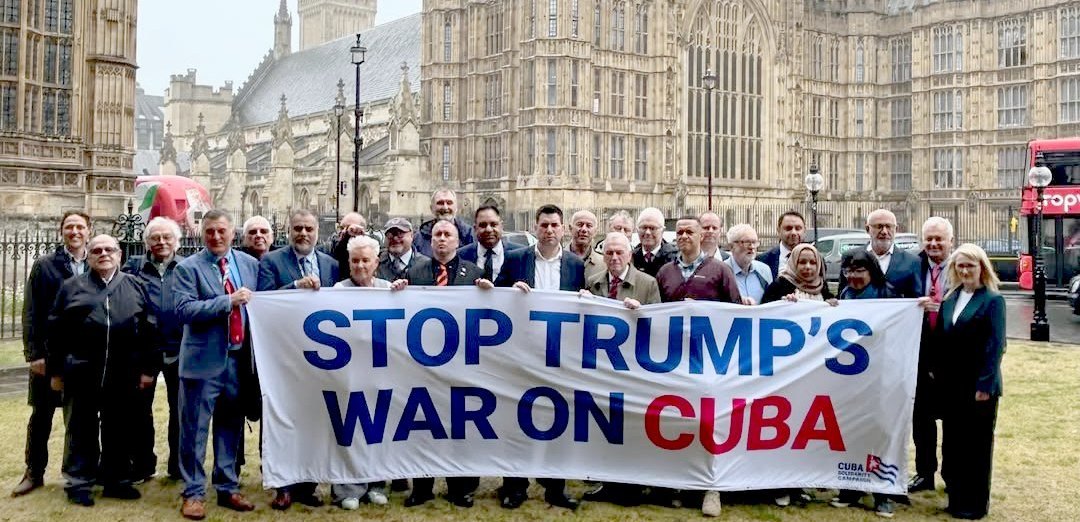
Photo: Cuba Solidarity
The Cuba Solidarity Campaign reports that parliamentary pressure on the British government over Cuba has intensified in recent weeks, with MPs and peers using debates, parliamentary questions and public campaigning to challenge the humanitarian impact of the US blockade and escalating sanctions. Following a Westminster Hall debate secured by Jeremy Corbyn, MPs have continued to press ministers over Britain's response to the worsening crisis.
Emily Thornberry MP, Chair of the Foreign Affairs Select Committee, questioned then Foreign Secretary Yvette Cooper on the Britain's position, while MPs, peers and trade union leaders had also gathered outside Parliament for a CSC photo-call urging the government to oppose the Trump administration's escalating economic warfare and reject any threat of military intervention against the island.
An EDM on Cuba which reached 117 parliamentary signatures under the last parliament has also been retabled with a new number. Early Day Motion (EDM) 118 calls on the British government to oppose President Trump's new executive order and reject extraterritorial sanctions which endanger the wellbeing of the Cuban people.

From left to right, Dermot Hudson of the Korean
Friendship Association, Michael Chant of the Revolutionary Communist Party of
Britain (Marxist-Leninist), Keith Bennett of Friends of Socialist China and
Andy Brooks of the New Communist Party
On July 27, the Korean people, as well as peace-loving humanity, celebrated the anniversary of the signing of the Korean Armistice Agreement between the Democratic People's Republic of Korea (DPRK) and the United States in 1953 which brought a ceasefire to the Korean War, known in the DPRK as the Great Fatherland Liberation War. The war against Korea was launched just five years after the defeat of fascism which brought WWII to an end. The signing of the Armistice Agreement in the Korean War also signalled the first military defeat of the US following the Second World War - a humiliation which has haunted the US imperialists ever since, and for which it has yet to forgive the DPRK and the Korean people.
In the context of the month of solidarity, which runs from June 25, the date of the anniversary of the beginning of the Korean War, 1950, to July 27, a meeting was held on July 4, in hybrid format at the John Buckle Centre and online. Organised by the Co-ordinating Committee of Friends of Korea in Britain, as one of an occasional series, it was chaired by Andy Brooks of the New Communist Party (NCP) of Britain, and the speakers were Kim Song Gi, then Chargé d'Affaires and Minister of the DPRK Embassy in London, Michael Chant of the Revolutionary Communist Party of Britain (Marxist-Leninist), Dermot Hudson of the Korean Friendship Association (UK KFA), and Keith Bennett of Friends of Socialist China, followed by discussion and Q&A.
We reprint below the presentation of Michael Chant, Secretary of Friends of Korea, at the meeting.

Michael Chant, Secretary of Friends of Korea, and Kim
Song Gi, then Chargé d'Affaires and Minister of the DPRK Embassy in
London
Solidarity is the affirmation of the bonds between peoples and their leaders in struggle. As such it is more than just a declaration; it is the expression of standing shoulder to shoulder in the struggle, in the cause of humanity for peace, justice and democracy. Today we are declaring the importance of solidarity with the DPRK, not only in today's global conditions, but looking back, in this month of solidarity, and remembering the Korean War - that is the Fatherland Liberation War - and affirming the right of the people of the DPRK to sovereignty and independence, to choosing and building their own social system which favours the people.
It was on June 25, 1950, that the US imperialists, under the aegis of the United Nations, launched a brutal illegal war of aggression against the Korean people. The UN coalition, under the military command of the US, involved troops from 16 other countries including Britain.
Today, when the US imperialists and their allies, particularly Britain, are rapidly militarising the Asia-Pacific and endangering the peoples of the region, it is more important than ever to recall the terrible tragedies visited upon the Korean people during the Korean War and to speak out, organise and ensure that the US, Britain and others do not wage another tragic war against the Korean people.
The US and its allies falsely accuse the DPRK of being a terrorist state, a danger to peace, abuser of human rights and all sorts of slanders that in fact apply to themselves. The Republic of Korea (ROK) remains under the dictate of the US which maintains some 28,000 troops and one of the largest arsenals of weapons including nuclear and chemical weapons, fighter planes, warships, submarines and other weapons in order to constantly threaten the DPRK and use the Korean Peninsula as a forward staging ground for US-led wars of aggression.
During the Korean War, the US and its allies carried out massive bombing raids, massacred hundreds of thousands of civilians in the north and south of Korea, engaged in germ warfare and chemical warfare and bombed cities and infrastructure north of the 38th parallel, razing them to the ground. Civilians were buried alive, dismembered, burned to death and drowned. Many were forced to dig their own graves before being executed in the same manner that the Nazis massacred civilians, particularly those who resisted. Chinese and Korean prisoners of war were tortured and murdered on Koje Island and in other prisoner of war camps. By the time of the signing of the Korean Armistice Agreement on July 27, 1953, some four million people, mostly civilians, had perished and countless others were wounded, and most of Korea had been destroyed.

Korean People’s Army celebrating
victory
Britain contributed the second-largest international force to the Korean War after the United States, deploying over 81,000 service personnel between 1950 and 1953. The British contribution was multi-faceted, spanning ground, naval, and air forces. Around 60,000 British combat troops-both regular soldiers and young National Service conscripts-saw heavy action. The Royal Navy provided nearly 50 ships and 17,000 sailors throughout the conflict. The RAF provided a wing of Sunderland flying boats based in Japan. Many British aircrews also flew alongside Commonwealth squadrons.
There was organised opposition to Britain's involvement from the start. Anti-war demonstrations at Marble Arch and Connaught Place (part of the larger Trafalgar Square/Hyde Park convergence routes) highlighted the intensity of people's opposition to the commencement of the war in 1950. For example, a Communist Peace Demonstration took place at Marble Arch in 1950, condemning US imperialist aggression against the Korean people. Other demonstrations were held, with placards such as "Hands Off Korea", "Refuse to Die for Yankee Bankers", "Not a Man nor a Gun for the American War on Korea", and "Stop USA Intervention in Korea". A feature of the Marble Arch rallies was the prominent participation of women's cooperative guilds and maternal peace groups. If the marches attempted to move from the Hyde Park toward Westminster or the US Embassy, police were deployed to block protesters from advancing and the police were frequently used to physically push crowds back into the Park. The police attacks resulted in regular arrests of activists for "obstruction" and "breach of the peace". Demonstrators, however, were able to routinely surround the US Embassy. Trafalgar Square also served as the location for demonstrations against the Korean War organised throughout the duration of the war by the British Peace Committee, with marches to Whitehall and Downing Street. Crowds of thousands demanded an immediate ceasefire, the withdrawal of British troops, and the recognition of the People's Republic of China at the UN.

Demonstration against the Korean War, London
Rally
The resignations of Aneurin Bevan and Harold Wilson in 1951 were tied to the Korean War. Grassroots trade union bodies opposed the war. In the final year of the war, the TUC received over 60 formal letters from regional Trades Councils opposing the TUC leadership's aligning with the government. Notable figures like eminent scientist Joseph Needham and writer and town-planner Monica Felton visited the north of Korea and China and publicised how the US military were using biological weapons against the Korean people. It is reported how the state actively damaged the reputations of high-profile opponents of the war, revoked their passports, or ensured they lost their employment. Monica Felton, who chaired the inaugural meeting in 1952 of the National Assembly of Women, was fired, after her visit to the north of Korea, from her job as Chairman of the Stevenage Development Corporation, was expelled from the Labour Party and was threatened with prosecution for treason. Standard military censorship was amplified by British newspaper owners who deliberately suppressed the true extent of the war's devastation to ensure Britain "stuck with America".
The Korean Armistice Agreement was signed on July 27, 1953, in Panmunjom, signifying the defeat of the US. The US has never been reconciled to this situation, and has never fully complied with the agreement, particularly that the two sides would sign a peace treaty as soon as possible which the US has refused to do.
The US refusal to formalise the peace shows its true intent. The US and the ROK, along with a remilitarising Japan, continue to carry out joint military exercises which involve other countries, including particularly Britain.
Following the end of the Korean War, during the Cold War, Britain acted as a trusted ally of the US, refusing to support the DPRK's integration into international bodies, and maintaining that the government in Seoul was the sole legitimate representative of the entire Korean Peninsula. It was not until 2001 that Britain opened its Embassy in Pyongyang, following the establishment of full diplomatic relations between Britain and the DPRK in December 2000. The DPRK embassy in London formally opened in 2003. Despite this, Britain has expanded its military involvement in joint war exercises with the US around the Korean Peninsula, exercises which are a dangerous provocation that destabilises regional peace under the guise of maintaining regional stability. Deployments of the UK navy in the Indo-Pacific are continuing, documented examples occurring for example, in 2021, 2022, 2024 and 2025.
Given this record of participating in the war drills against the DPRK and the damage to bilateral relations this causes, it further seriously damages these relations that recently, on May 11, the British Foreign Office staged an extremely provocative act of including the Songdowon International Children's Camp in the DPRK in the recently-issued list of sanctions against Russia, announcing "sanctions measures" against Russia's "organisational activities" to "forcibly transfer" and "militarise" Ukrainian children.
It must be emphasised how provocative is this measure, carried out as part of the British government's moves to demonise Russia. It must be condemned by all justice-loving people, which, as a DPRK Foreign Ministry spokesperson has said, is a "malicious act of the British government which even targets the camp, a sacred base for education and growth of children, to achieve its purpose of political machinations".
This act can also be seen as a component of the serious provocations of the Trump administration and its allies against China and the DPRK which they call undemocratic dictatorships and threats to western civilisation and the "free world". It should be emphasised that it is in the context of these ongoing threats from the US and its warmongering allies, that the DPRK has built its own nuclear deterrent to maintain a state of equilibrium on the Korean Peninsula and maintain peace regionally and on a global scale. The developing unity of the DPRK, China and Russia is also to be seen in this context.
On this 76th anniversary of the start of the Korean War, it is time once again to demand that the US stop its threats and bullying of the DPRK, withdraw its 28,000 troops from the ROK, close all its military bases in and around the ROK, remove all its nuclear and chemical weapons from the Korean Peninsula as well as promptly sign a peace treaty with the DPRK. This is the demand of the Korean people and peace and justice-loving peoples of the world including in Britain.
Friends of Korea also demands that the British government end its hostile actions against the DPRK, which are so damaging to the friendly relations between the peoples of Britain and the DPRK and globally. To restore friendly relations in the interests of peace and sovereignty, rather than exacerbate war-mongering and "war readiness" under the banner of "national security", is the demand of the times.
Remember the Korean War!
Solidarity with the DPRK!

When: August 5, 2026 6:30 pm
Where: Online
Stop Bombing Iran
Cut War Not Welfare
Join this online public meeting co-organised with CND to discuss Trump's major new escalation in the war on Iran - plus how we maximise pressure on the new Burnham government to cut British support for US and Israeli aggression, prioritising welfare not warfare.
The US president's erratic behaviour along with the widening of the war is extremely concerning and an incredibly dangerous development. As Trump hits Iran hard, is the period of restraint over?
Join Stop the War and CND for an online public meeting to discuss how the anti-war movement should respond to this fast changing situation.
After two weeks of bombing a fragile "pause" in hostilities was announced only to be broken a short while later when the US struck dozens of targets in Iran on Wednesday night, killing three people in a residential building. In retaliation Iran has targeted US military facilities in Kuwait. Iran has said they will no longer allow the US to dictate when to pause and when to start the war.
This latest phase in the war has seen the conflict expand in the region with joint US-Saudi strikes in Iraq and the Saudis announcing a new offensive against the Houthis in Yemen. There is also concern that President Zelenskyy is attempting to merge the US-Iran conflict with the war in Ukraine into a single strategic theatre. With speakers including Shabbir Lakha (Stop the War), Atefeh Zandi (Iranians Against War), Sophie Bolt (CND) and Maryam Eslamdoust (TSSA General Secretary).
Click here to Register on Zoom.
https://us02web.zoom.us/meeting/register/_FQPDCYBQYGtv9Ye4u6uQw

When: August 15, 2026 1:00 pm
Where: Fairford
Protest at RAF Fairford
A US B-1 bomber flew from RAF Fairford to bomb Iran the day after Andy Burnham became prime minister. The majority of us don't want British bases used in this illegal war. Join us at RAF Fairford on August 15 to call on Burnham to send the US bombers home for good!
Now is the time for the new Burnham government to cut support for Trump's
wars and profoundly reassess the UK's diplomatic and economic priorities.

When: October 10, 2026 12:00 pm
Where: London
London demonstration part of the International day of demonstrations
It's time to build October 10. This demonstration is part of a global day of protest in support of Palestine. Make sure you are part of it.
Receive Workers'
Weekly E-mail Edition: It is free to
subscribe to the e-mail edition
We encourage all those who support the work of RCPB(ML) to also support it
financially:
Donate to
RCPB(ML)
Workers' Weekly is the weekly on
line newspaper of the
Revolutionary Communist Party of Britain (Marxist-Leninist)
Website:
http://www.rcpbml.org.uk
E-mail:
office@rcpbml.org.uk
170, Wandsworth Road, London, SW8 2LA.
Phone: 020 7627 0599:
