|
|
||||
|---|---|---|---|---|
| Volume 56 Number 25, August 29, 2026 | ARCHIVE | HOME | JBCENTRE | SUBSCRIBE |
Workers' Weekly Internet Edition: Article Index :
A Centenary of Legacy and Solidarity:
Militant London Meeting Marks Centenary of Birth of Fidel CastroCentenary of Birth of Fidel Castro:
Cuban President's Address to International Meeting of Communist and Workers' PartiesFirst International Colloquium "Fidel: Legacy and Future":
Fidel's Legacy Challenges Us Today with More Force than EverComing Events:
All Out to Build the United Front against War and in Defence of the Rights of All!
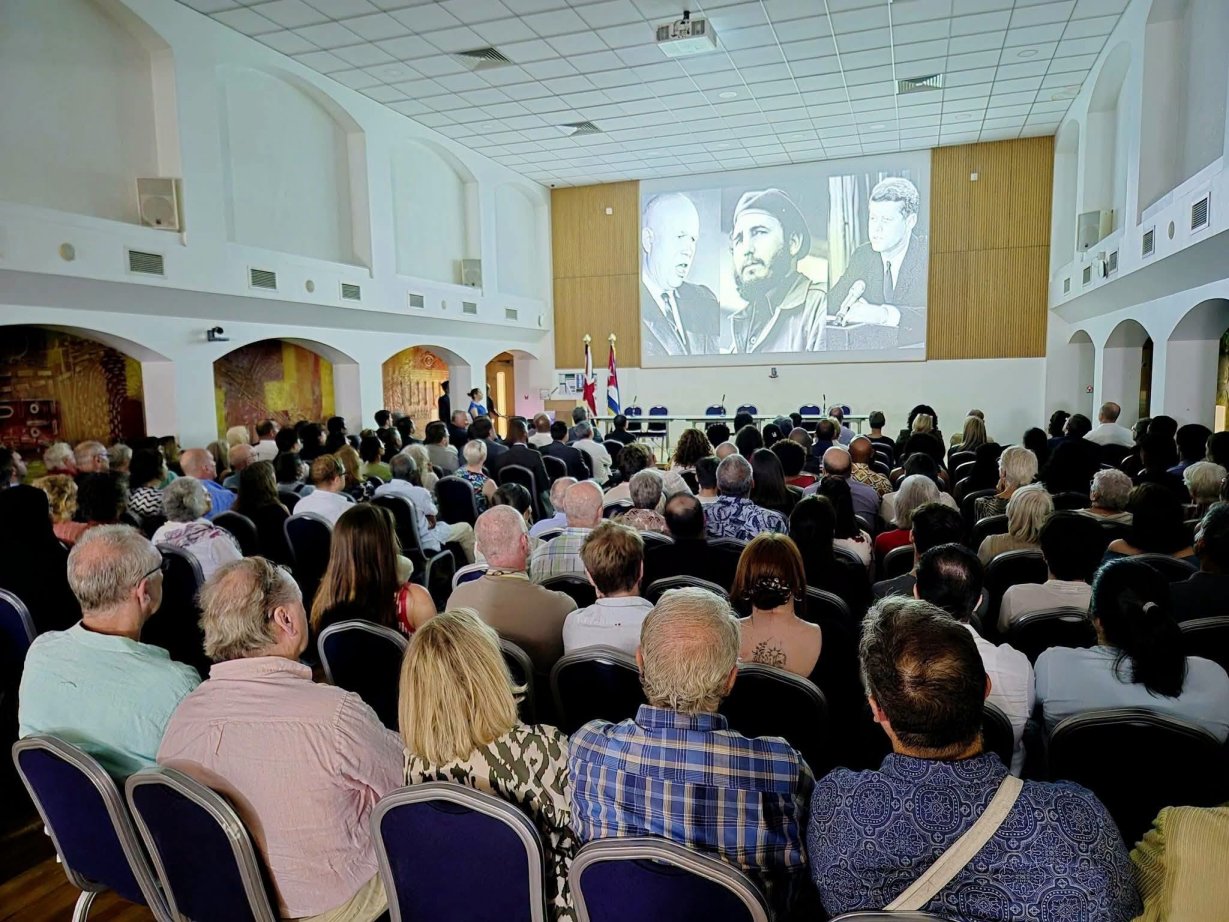
The Cuban Embassy in the UK welcomed nearly two hundred guests to Mander Hall, Hamilton House, central London, on the morning of August 13, the 100th anniversary of the birth of Fidel Castro. Ambassadors and members of the diplomatic corps, staff from the Cuban Mission, Cuban residents from across Britain, members of the Cuba Solidarity Campaign, academics, trade unionists, people from the business world, and activists and friends of Cuba who simply would not miss it packed the hall. By the time the lights dimmed the Hall could not hold everyone who wanted to be there, and not a spare seat was left.
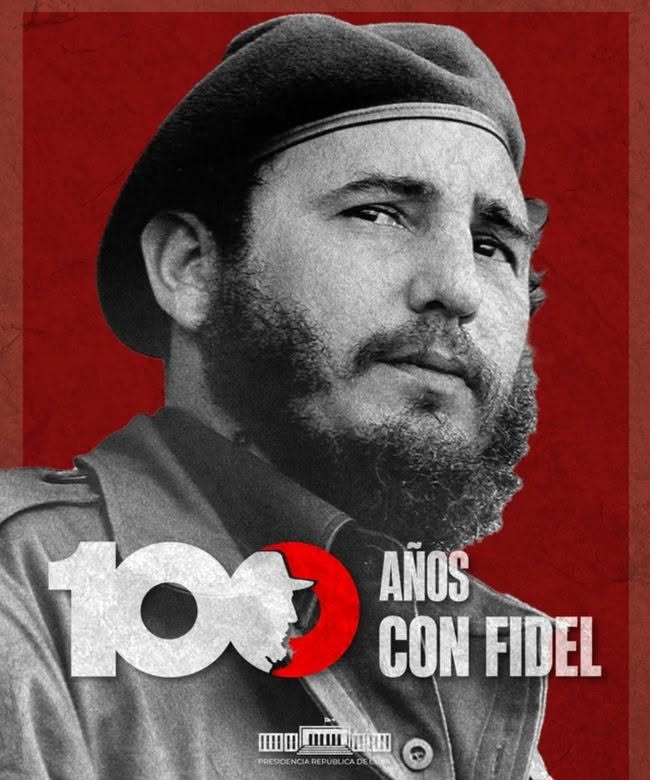
It was the very date of the centenary - August, 13, 1926, to August 13, 2026: one hundred years since a boy from a modest house in Birán, Oriente, grew into a country.
The morning opened with a short tribute film tracing Fidel's life, his legacy, the achievements of the Cuban Revolution he led, and the international solidarity he built across the world. Woven through it were brief contributions from doctors, trade unionists, academics, film-makers, campaigners and politicians, each speaking to what that legacy means in their own corner of society. Some of them had actually known Fidel in person. They were friends speaking about a legacy, friends remembering a man.
MP Jeremy Corbyn took the platform next, and spoke with real feeling about what Fidel built for every corner of Cuban society and for the cause of international solidarity, then went further, calling on Britain to deepen its solidarity with Cuba at every level, including government to government. To applause, Jeremy Corbyn called on the British government to stand up to the USA and break the US oil siege on Cuba and send humanitarian aid to the island. Coming from someone who, this March, rode in the Nuestra América convoy into Havana and stood inside a cancer hospital struggling to keep its machines running through a blackout, with Richard Burgon MP alongside him, those words carried weight.
The Cuban Ambassador, Ismara Vargas Walter, closed the event, and the room was filled with expectancy as she took the podium.

MP Jeremy Corbyn speaking for the cause of international
solidarity
The Ambassador took us back to the beginning: a twenty-six-year-old leading the assault on the Moncada barracks, captured, standing alone at his own trial to say the words that outlived every judge in that courtroom: "Condemn me. It does not matter. History will absolve me." Prison. Exile in Mexico. Eighty-two men on a leaking yacht called Granma, scattered on a beach under fire, barely a dozen reaching the Sierra Maestra alive. From that dozen, in under two years, a country and a Revolution.
She reminded us what he did with that victory: over one hundred thousand volunteer teachers, many of them teenagers, walking into the mountains until Cuba could declare itself free of illiteracy. Cuban doctors in Chile and Algeria by 1961 and 1963. Cuban internationalists at Cuito Cuanavale, standing with a nation fighting apartheid, the same struggle Nelson Mandela himself later called a turning point in the liberation of his continent.
And then she brought us to the present: a naval armada in the Caribbean, oil tankers tracked and seized on the high seas, a total fuel blockade, "a profound breach of the equality of states and sovereignty", in her words, not a bilateral dispute. Families cooking over firewood. Blackouts lasting entire days. Eleven thousand children among more than one hundred thousand people waiting for surgeries that cannot be safely scheduled. Survival for a Cuban child with cancer and infant mortality, fallen. "When a hospital in Havana loses power tonight," she said, "it is not the weather. It is policy, arriving exactly as designed."
And still, three hundred Palestinian students are training as doctors in Cuba right now, free of charge, because Fidel taught his country that internationalism is a debt paid, not a favour granted. And to be internationalist is to pay our own debt to humanity.
She thanked the National Education Union for opening Hamilton House's doors to the Cuban Mission once again, she thanked the 117 MPs who backed this year's Early Day Motion against these illegal unprecedented sanctions, and she paid tribute to six decades of the Cuba Solidarity Campaign's unwavering friendship.
Fidel is a hundred years old today, she told the room. Cuba is still standing.
¡Hasta la victoria siempre, Comandante!
(Embassy of Cuba in the UK)
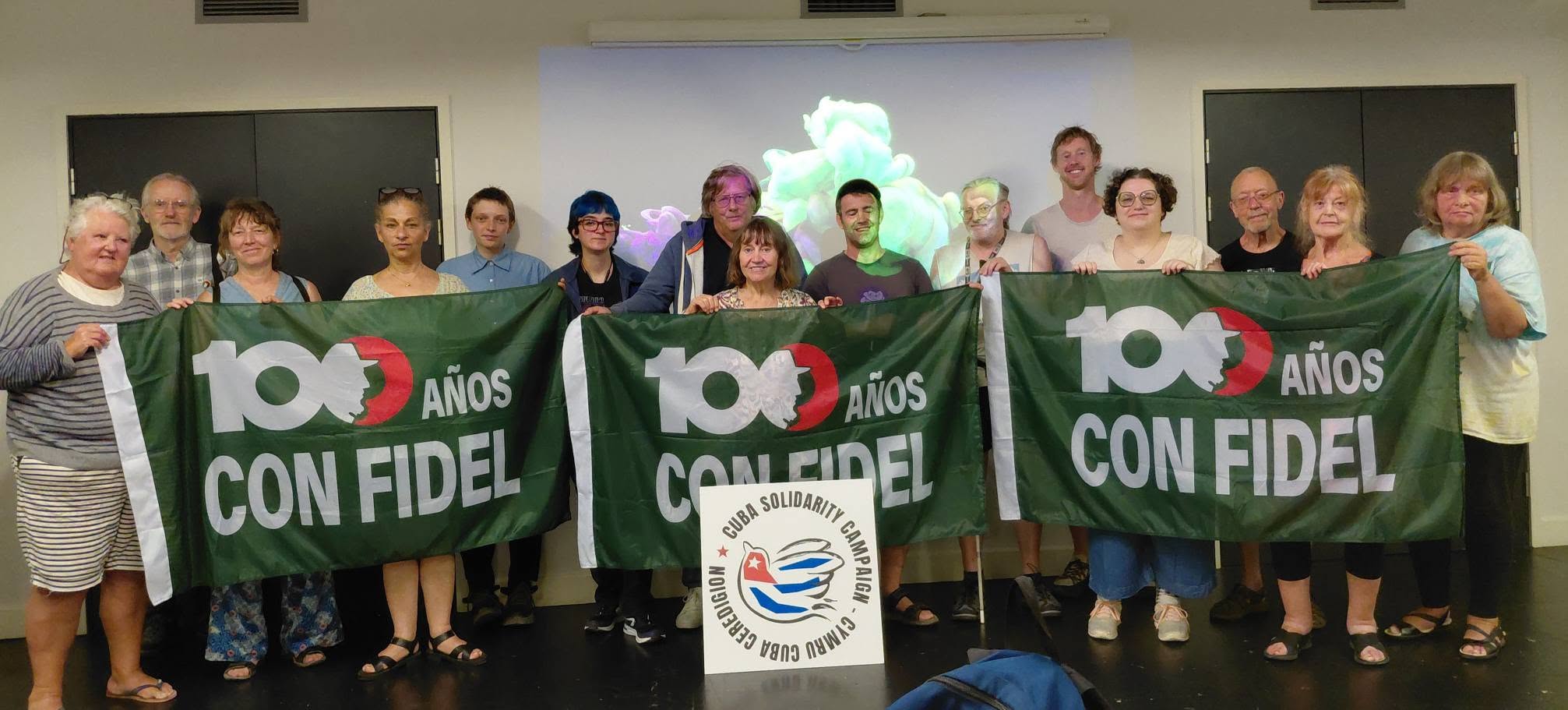
On August 13, Theatr AradGoch in Aberystwyth hosted a special centenary screening of Moments
With Fidel, a powerful documentary by Cuban filmmaker Rebeca Chávez. The film examines Fidel's pivotal role leading the Cuban Revolution and the global anti-imperialist movement. The audience, drawn from Aberystwyth and neighbouring towns, was united in its condemnation of the US blockade and its collective determination to step up international solidarity.
(Cuban Embassy in the UK)
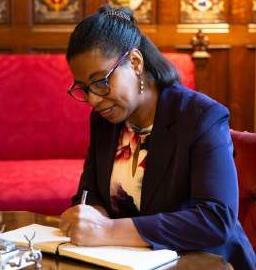
H.E. Ismara Mercedes Vargas Walter, Ambassador of Cuba to
the United Kingdom
Writing on behalf of the Cuban Embassy in the UK, Ambassador Ismara Mercedes Vargas Walter affirms that Fidel's guiding conviction was simple, and it has never gone out of date: that a nation's sovereignty, its dignity and its solidarity with others are not negotiable, not even under the heaviest pressure a great power can bring to bear.
This year, in Britain, we have watched that carrying-forward happen in real time, she writes. Parliamentarians who have kept Cuba alive across motions, written and oral questions, and pushed for ratification of the Political Dialogue and Cooperation Agreement [1]. A Trades Union Congress that has invited the new leadership of Cuba's Workers' Central to address its Brighton Congress in September, the clearest possible descendant of the internationalism Fidel built between Cuban and British working people. Trade unionists who filled halls from Liverpool to Warwick to Brighton to hear, plainly, what a blockade does to a hospital, a household, a harvest, a people.
Note
[1] Lithuania is the only EU member state that has officially refused to ratify the EU-Cuba Political Dialogue and Cooperation Agreement (PDCA), effectively blocking its full legal implementation. Because it is a "mixed agreement", the treaty requires unanimous ratification from all EU member states. While the agreement has been provisionally applied since November 2017, it remains stuck in diplomatic limbo. Countries/Entities That Have Ratified - Cuba: Formally ratified the agreement on May 20, 2019. The European Parliament gave its official consent on July 5, 2017. The vast majority of the 26 EU member states completed their domestic ratification processes between 2017 and 2020. Official records from the Council of the European Union confirm ratifications from countries such as: 2017: Hungary, Slovakia, Latvia, Finland; 2018: Luxembourg, Poland, Romania, Slovenia, Malta, Austria, Portugal, Cyprus; 2019: Croatia, Italy, Netherlands; 2020: Sweden (among the last of the group ). The United Kingdom also ratified the agreement in 2018 while it was still an EU member state. Countries That Have Not Ratified - Lithuania: The Lithuanian Parliament (Seimas) passed a formal resolution explicitly refusing to ratify the pact.
.jpeg)
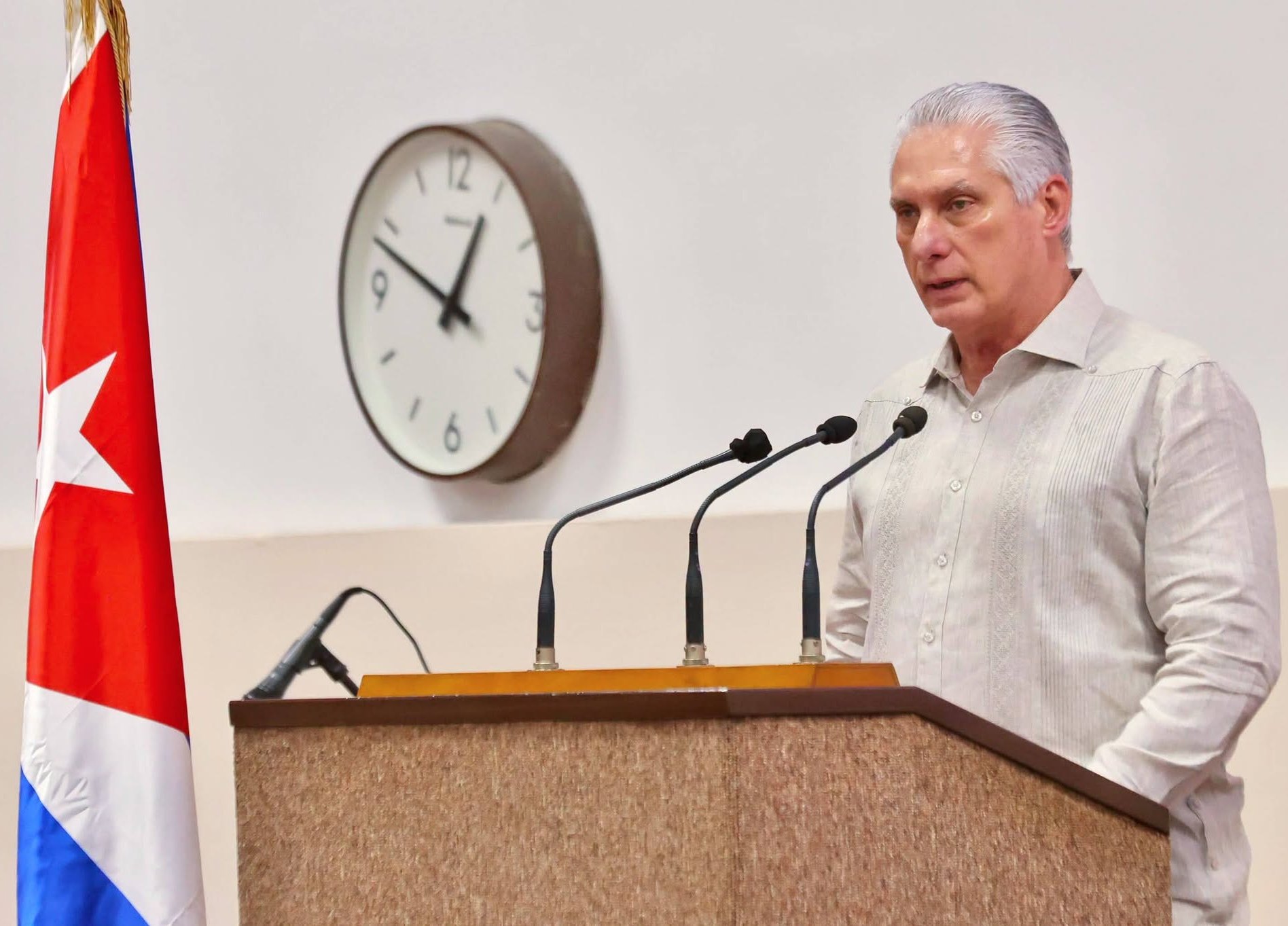
Cuban President Miguel Díaz-Canel addressing the
International Meeting
Workers' Weekly is posting below the speech delivered by Miguel Díaz-Canel, First Secretary of the Central Committee of the Communist Party of Cuba and President of the Republic, at the closing ceremony of the 24th International Meeting of Communist and Workers' Parties at the Convention Centre in Havana, Cuba, August 8, 2026, "Year of the Centennial of Commander-in-Chief Fidel Castro Ruz".
"Cuba Doesn't Have to Indoctrinate Anyone. It Doesn't have to Export Ideas. History Teaches Us Lessons."
Comrades of the communist and workers' parties of the world;
[...]
It is an honour to have celebrated this meeting in the context of Fidel Castro's Centenary, whose undeniable legacy calls us to confront the enormous challenges of this turbulent and threatening present we are living through.
Cuba, island of dignity and historical resistance against imperialism, and today also against fascism, welcomes you with open arms and thanks you for your courage and determination in coming here, amidst so much pressure, blackmail, and lies.
At the previous meeting in Havana, in October 2022, representatives of communist and workers' parties from more than 60 countries, who gathered at that time, agreed to warn about the dangerous situation humanity was facing. Almost four years later, we can reaffirm, without a doubt, that the world is going through one of its most uncertain and dangerous periods.
We are living through a period of extreme intensification of capitalist contradictions: excessive concentration of wealth in the hands of a few, inequalities in its distribution, environmental destruction, and wars fought over markets, resources, and spheres of influence.
Marxist-Leninist analysis remains fully relevant in asserting that these crises are not accidents, but rather the result of the laws governing the development of monopoly and imperialist capitalism.
Capitalism, consumed by its own contradictions, has unleashed a perfect storm: wars of aggression in Eastern Europe and the Middle East; open genocide in Gaza; a climate crisis that is no longer a warning, but a reality; structural hunger that devours millions; and an external debt that the peoples of the Global South will never be able to repay, because it was conceived to enslave us, not to develop us.
In this scenario, the resurgence of fascism sends us a stark warning. Fidel warned us about this years ago, about how it was transforming its appearance, but maintaining its essence. Today we denounce the re-establishment of fascist regimes around the world.
Nationalism, hegemony, supremacy, and racial discrimination; xenophobia, displacement, and population extermination; wars of conquest for territories and natural resources; punishments that fall upon millions of human beings; and the proscription of ideologies and civil liberties are unmistakable features of this current fascism and its Hitlerian predecessor.
The genocide in Gaza and its shameful public broadcast are not enough for them; they are now attempting to replicate it in Cuba through an aggressive and criminal policy, one that is both stated and denied, both refuted and intensified without any attempt at concealment.
The total suffocation to which we are subjected constitutes a collective punishment that seeks, through the deprivation of the most basic resources and services necessary for survival, to foster exhaustion, discouragement, and social division, with the objective of destroying the Cuban socialist project.
Those who sadistically devise an energy blockade against an entire nation, leaving a humanitarian toll of alarming proportions that deprives Cuban children of their lives at birth, reduces the life expectancy of cancer patients, and denies our people access to medicine, food, electricity, water, transportation, and many other resources for a full life, can be called nothing less than criminals and fascists.
I am going to give you some data on the impacts of the blockade on Cuban society.
Particularly in the energy sector: we had recovered, with enormous effort, more than 1,400 megawatts of power for electricity generation in a group of distributed generation units. These plants are currently not generating power due to a lack of fuel; they run on diesel and fuel oil. If we had those 1,400 megawatts available every day, the troublesome blackouts in Cuba would only last three hours, not twenty or more hours as our people suffer today.
In healthcare, such a sensitive issue, and one where you are all aware of the full potential of our universal and free healthcare system, with opportunities for everyone, with things we know how to do: there are 98,500 patients on the surgical waiting list, including 12,000 children. These are surgeries we can perform in Cuba, but we lack the resources; we lack the energy to power our operating rooms.
There are 34,000 pregnant women who cannot receive enough prenatal ultrasounds during their pregnancies.
There are 67,000 children under one-year-old who have been born in recent months without up-to-date immunisation schedules, even though vaccinations in Cuba and our immunisation system were always current.
There are 117,000 adults and 1,200 children with cancer who are not receiving adequate treatments, and we have to resort to secondary or tertiary therapies.
There are 16,000 patients experiencing difficulties accessing the services they need for radiotherapy, 12,400 for chemotherapy, and 3,000 for haemodialysis. Only 30 per cent of the essential medicines are available, even though we are capable of producing all of our own.
The ambulance availability rate is only 22 per cent. Medical transport is overwhelmed.
We are unable to purchase cobalt-60 sources for cancer treatments, and there are delays in obtaining licenses to release medical supplies at ports, also due to the refusal of international shipping companies, which have been pressured by US imperialism not to bring the necessary goods to Cuba.
And as if this weren't enough, we had always maintained infant mortality rates between 4 and 5, which are first-world infant mortality rates; however, in recent years, our rate has doubled and is currently over 9.8.
Wherever any meticulously calculated genocide may appear or find relief, the henchmen of this ignominious policy will be there, ready to tighten the noose of suffocation, if that were even possible.
Their plans conceive of the Cuban people only as a tool, a dying society, to turn against the government and achieve their sinister aims of overthrowing the Revolution. This is not our own interpretation; it has been written and conceived this way for over sixty years by the State Department.
All of this that I have described constitutes flagrant violations of international law and human rights, condemned by the vast majority of the international community, as recently occurred at the United Nations where 136 nations supported Cuba in its just denunciation.
However, the world based on laws and norms for peaceful and civilised coexistence among states has disappeared, replaced by the will of the strongest and most powerful, to the detriment of the poorest nations.
We are living through the most dangerous time since the Cuban Missile Crisis. Alongside the economic war, Cuba is being subjected to a high-intensity unconventional war through digital subversion, the financing of internal mercenaries, media smear campaigns, and networks of influence that attempt to disguise blatant intervention as "humanitarian aid."
In this regard, we are not at all surprised by the recent revelations in major US media outlets regarding an increase in CIA operations in Cuba to subvert the internal order. These are not random leaks, as they are presented, but part of the deliberate plan of the US regime to wage psychological warfare against Cuba.
In the height of cynicism and perversity, the Secretary of State recently declared that US sanctions against the Cuban regime will only be tightened. "What we are trying to teach them," he said, "is that there are no escape valves."
This is an unabashed admission that a difficult situation exists in Cuba as a consequence of an unprecedented economic war. This statement constitutes an open threat of extermination against an entire people if they do not submit to the dictates of the empire.
The United States government has intensified its military threats and updated its "regime change" doctrine, maintains Cuba on the spurious list of state sponsors of terrorism, and, to top it all off, has invented the ridiculous accusation of "espionage power" or hotbed of subversion of the so-called radical terrorist left, of which it seems all of us here are a part, a pathetic and fanciful name, only credible in their psychotic minds, but which they use to confuse, justify more punishments and legitimise their aggressions.
On this matter, United Nations experts emphasised that the illegal unilateral coercive measures imposed by the United States against Cuba violate Article 2 of the UN Charter and are part of a broader regime change strategy that encompasses decades of embargo against Cuba.
"The United States government must end all threats and hostile acts against Cuba's sovereignty and revoke all measures it has imposed on the country that are contrary to international law," the experts said.
They added: "The Security Council and the General Assembly must urgently address these threats as a matter of international peace and security."
There can be no greater act of cynicism than for the perpetrator to try to portray itself as the victim, when its misdeeds have been public and notorious for decades. The United States has no moral authority or right to single out Cuba, which has arguably been the nation most spied on by them and with the largest funds for economic and ideological subversion.
Cuba does not have to indoctrinate anyone. It does not have to export ideas. History teaches us lessons, showing the depths to which empires can sink to satisfy their insatiable appetite for domination and possession of the material and human resources of other nations.
In this meeting, and before you, we denounce the criminal policy of the United States against Cuba, and also those who remain silent and tolerate the excesses of the emboldened American fascist far right, which lies, steals, kills, and pretends to be the arbiter of all destinies.
The United States blockade only works because of the complicity of those who fear the power of Washington more than the judgment of history. The world cannot become complicit in another genocide.
Every time a part of the world remains silent in the face of aggression against Cuba, international law is weakened. Every time a government accepts the illegitimate sanctions of the United States, the principle of non-intervention is eroded. Every time a company is pressured to abandon its investments in Cuba and others do not decide to do so for fear of reprisals, the economic dictatorship of a single power is strengthened.
Faced with this proven and undeniable reality, Cuba has defended itself, within its legitimate rights, as any country in the world would. The Cuban people have also counted on the solidarity of men and women with a strong sense of justice and morality, aware that reason and truth are on our side, many of whom are now being persecuted or threatened for their solidarity activism.
The resurgence of McCarthyism in its worst form and with a transnational reach, which places Cuba at the centre of its irrational crusade, attempts not only to criminalise solidarity with Cuba or create a new false pretext for its aggression, but also to silence dissenting voices against the world order they want to impose.
What common cause unites the left and progressive movements around the world? Undoubtedly, social justice; labour and children's rights; the defence of feminist, gender, and racial causes; the care and preservation of the environment; popular participation; historical memory and respect for Indigenous Peoples; World peace and harmony among nations; international solidarity, among many other things that are generally projected in terms of human dignity.
Can anyone with a rational mind believe that the left or progressive forces are therefore a danger to humanity? The obvious answer is no.
Only fascism can see such a danger in the left, because it seeks to impose by force an ideology and value system that are completely contrary to it; that is why, in its current rise, it desperately seeks to criminalise, neutralise, and silence it.
The extermination of the Palestinians in Gaza, the coup in Venezuela, the collective punishment of the Cuban people are events serious enough not to remain passive. Tomorrow, any nation could end up like Gaza or Cuba if fascism is not confronted. The key lies with the people, in their awareness, their mobilisation, and their international unity.
Faced with this suffocation, Cuba has not yielded. We have answers that prove it: the COVID-19 vaccines, food production using agroecological techniques amidst scarcity, the advance of clean energy, popular participation in neighbourhoods, and the defence of the entire territory by a people transformed into militias and ready to defend their self-determination, their independence, and sovereignty.
Yes, we have many shortcomings. We are burdened by blackouts, water shortages, inflation, and long lines. But no material lack has extinguished the flame of solidarity, in which Fidel raised us, nor have we renounced Martí's principle that "homeland is humanity" (Applause).
One fact that confirms this is that in these final days of the school year, tense and difficult like no other, 30,185 young professionals have graduated from Cuban universities, 735 of them from 62 countries who were trained in Cuba. And a statistic we are honoured to share: 23 new Palestinian doctors and five American doctors (Applause).
The people's response, under the leadership of the Communist Party of Cuba, has been firm and creative resistance, unity, the defence of their achievements, and the updating of their economic and social model, without ever renouncing the principles of socialism and without yielding to pressure or blackmail. This capacity to resist and transform has its roots, firmer than ever, in the thought and action of Commander-in-Chief Fidel Castro Ruz (Applause).
Fidel understood, like few others, the need to combine ideological firmness with tactical flexibility. He taught us that "Marxism-Leninism is not a dead doctrine, not a catechism, but a method, a guide, an instrument for concretely solving life's problems."
Cuba works under this conception on the uncharted path of building socialism, as Army General Raúl Castro Ruz also once stated. Not even the classical Marxists could have ever imagined how to do it on a small island, threatened by the largest empire in the history of humankind and completely blockaded, its state cut off from all sources of resources, financing, and trade.
Faced with this dilemma, it is necessary to produce and generate wealth to redistribute it with the greatest possible social justice and to preserve the historic and essential achievements of the Revolution in strategic areas such as health, education, culture, science, energy, and communications.
Doing so will be everyone's task, from state-owned and non-state enterprises, along with other forms of economic management that together make up the Cuban business network, all focused on a single goal: building the prosperous and sustainable socialism that the heroic Cuban people deserve.
I know that the topic of economic and social transformations has been the subject of much reporting and debate. However, I want to emphasise some key concepts: this is a process to revitalise the economy, not to establish capitalism; there will be no rampant privatisation, the fundamental means of production remain in the hands of the people, and above all, national sovereignty and independence are preserved.
For such a complex process, the Communist Party of Cuba, as the supreme leading force of the State and society, stands as the primary authority responsible for its direction, coordination, and control.
The Party will continue to be the vigilant guardian of the interests of the people, the working class, the social gains, and the social justice that has driven the Revolution since its inception. It is not, nor will it ever be, a party of elites or lobbies. Its role as the sole party requires it to be increasingly democratic and representative, as Rael has called upon us to be on so many occasions, without ever losing sight of the people, the Revolution, and socialism. (Applause)
In a world where attempts are made to convince us that there are no alternatives, our common task is to demonstrate with facts that there are alternatives, that socialism remains the only realistic and humane way out of capitalist barbarism, as scientific Marxism taught.
Dear comrades in struggle:
Today, on the centenary of his birth, Fidel is not physically present, but his presence is stronger than ever. What did the Commander-in-Chief bequeath to us? He bequeathed us the certainty that dreams are won by defending ideas; he left us the lesson that internationalism is not just a phrase, but an attitude that should distinguish us; he taught us the conviction that socialism is the only path to save humanity from the abyss.
Fidel was the first to denounce neoliberal globalisation as the empire of death, and also the first to raise his voice for a better world for all.
He taught us that the struggle for the preservation of the environment and the human species is also a socialist battle, that science must be at the service of the people, and that the unity of revolutionaries is more important than any tactical differences.
In Fidel, we find not only a historical leader, but a school of revolutionary work: to study, analyse, anticipate, listen to the people, and act with boldness and honesty. As he declared amidst the worst threats: "If what the imperialists want for peace is for us to stop being revolutionaries, we will not stop being revolutionaries, we will never lower our flag!" (Applause.)
Brothers and sisters:
May this meeting in Havana, in Fidel's homeland, serve to renew our commitment, coordinate our actions, and strengthen our conviction that the organised working class, guided by its vanguard parties, can change history. The moment demands more than declarations of principles. It demands a qualitative leap in our international articulation and coordination. We, the communist and workers' parties, have the historic duty to weave a network of effective solidarity, one that is not limited to statements but translates into concrete actions:
To break the fascist media blockade, using platforms to disseminate the truth about Cuba, Palestine, and all peoples under aggression.
To stand with the Cuban people in their just struggle for the lifting of the criminal blockade against Cuba, mobilising parliaments, unions, and social movements.
To strengthen the mechanisms of economic and technological cooperation between our countries and organisations.
And, fundamentally, to advance the theoretical debate on 21st-century socialism, adapting Marxist-Leninist principles to the new conditions of the digital revolution, communication, and the ecological crisis, without ever abandoning the central objective: the full dignity of humankind.
Furthermore, I call for self-criticism. It is not enough to condemn the empire; we must build popular power at the grass-roots level, win the streets, the neighbourhoods, the factories, the schools. The unity of communists must be solid, but as flexible as Fidel's intelligence in engaging in dialogue with all progressive sectors. Unity is not uniformity; unity is the will to fight and to win together! (Applause.)
Faced with the imperialist offensive and the structural crisis of capitalism, communist and workers' parties are called to play a vanguard role, not only in the electoral or institutional arena, but - and above all - in the organisation, politicisation, and mobilisation of the working class under the complex conditions imposed by contemporary capitalism.
It is our responsibility to strengthen the unity of the international communist movement, respecting the diversity of experiences, but with strategic clarity in the face of the common enemy: imperialism, fascism, and monopoly capital.
We must deepen our political and ideological work, challenge cultural hegemony, and confront the disinformation machinery that seeks to present capitalism as the only possible future.
We must organise the working class and popular sectors in the new realities of work, where digitalisation, automation, and the platform economy change the forms of exploitation, but not its essence.
Brothers and sisters in arms:
Despite the military might of the United States, the international communist movement does not back down; it resists and stands firm (Applause).
It is impossible to predict how long this imperial offensive will last. We may yet see more aggression and more blockades, but we have the certainty, inherited from our own history, that the future belongs to those who dream and build, not to those who destroy and lie.
Defending Cuba with strength and urgency means halting the advance of supremacist, racist, xenophobic, elitist, and exclusionary ideas, enemies of true freedom and human emancipation.
Defending Cuba means fighting against 21st-century colonialism, against hegemony, against the pretension that a single country should decide the destiny of all. Comrades, on the eve of Fidel's centenary, I call upon you to redouble your efforts.
Let us not be content with mere survival; Let us aspire to build together a world where the word "solidarity" is not merely an ornament, but the driving force behind everything. Where children do not die of hunger while food is thrown into the sea. Where science heals, not profits. Where politics is, as Che said, the art of serving others.
Always onward to victory, always! (Exclamations of:
"Always!")
Long live Fidel on his Centennial and forever! (Exclamations of: "Long
live!")
Long live the unity of the communists! (Exclamations of: "Long
live!")
Long live the struggle of our peoples! (Exclamations of: "Long
live!")
(Applause.)
(President's Office, Government of Cuba)

First International Colloquium: Fidel, Legacy and Future
held in Havana, Cuba, August 10-13, 2026
At Havana's Palace of Conventions, from August 10-13 Cuba hosted the First International Colloquium "Fidel: Legacy and Future," serving as the intellectual centrepiece of the centenary. Over 1,500 delegates from 63 nations gathered for panels and debate, reinforcing that Cuba is not alone and the Revolution remains a vital socialist inspiration. The events concluded at the Karl Marx Theatre with Raúl Castro, Miguel Díaz-Canel, and cultural performances, rounding off a vibrant nationwide celebration.
Miguel Mario Díaz-Canel Bermúdez, First Secretary of the Central Committee of the Communist Party of Cuba and President of the Republic, gave a keynote address at the opening on August 10, "Fidel's legacy challenges us today with more force than ever".
In his address to the distinguished academics, intellectuals, artists, social and political leaders, young students, and comrades who had come from the five continents to share this week of profound reflection on the man who marked the 20th century and whose thought illuminates the 21st, Miguel Díaz-Canel said: "Your presence in Cuba is an act of courage and consistency, because coming to Cuba today, amidst the intensification of the blockade and imperial hostility, is a gesture of militant solidarity that honours Fidel's legacy."
Miguel Díaz-Canel shared with the audience ideas that spring forth with no order other than that imposed by feelings, emotion, and the revolutionary commitment to the privilege of speaking about Fidel. He said, "Studying and embracing with conviction the immense work of the Commander-in-Chief, both in thought and action, is an imperative necessity for all of us who are committed to promoting economic and social transformations that will stop the process of suffocation to which the Cuban Revolution is being subjected, as part of a criminal war that has lasted for more than six decades.
"Saving the Cuban Revolution from one of the most serious threats it has faced in 67 years, under aggression of all kinds, is the greatest challenge of our generation, and we are honoured to take it on, convinced that we will prevail. This is not an unfounded certainty. We have a history steeped in heroism, a people trained in resistance, and the legacy of a leader who, always at the forefront of that people, transformed setbacks into victories.
"Preserving the gains that gave this heroic people the Revolution and socialism, breaking all the sieges that seek to annihilate the nation as collective punishment for its dignity, its resistance, and its decision not to surrender to the most powerful empire in history, is the first tribute we owe to Fidel, born 100 years ago in a country marked by injustice, inequality, and dependency-a painful reality that he vowed to change from his years as a rebellious and outspoken university student."
Miguel Díaz-Canel gave a profound appreciation of the Commander-in-Chief and his achievements. He emphasised that neither the Cuban Revolution nor Fidel Castro can ever be discussed without acknowledging this reality, this starting point, this state of affairs that demanded the most radical transformation of the 20th century in this part of the world.
He continued: "One need only review the country's current statistics, even under the terrible restrictions imposed by more than six decades of economic, financial, and commercial blockade and seven months of energy embargo, even amidst harsh blackouts, water shortages, high prices, and other problems that damage the very essence of society: the indicators for health, education, science, culture, and sports remain better than in other countries of similar development."
Miguel Díaz-Canel further explained Fidel's legacy of coherence and ethics, his legacy of intellectual audacity, his legacy of internationalism, and his legacy of revolutionary optimism.
Fidel taught us, Miguel Díaz-Canel said, that "Marxism-Leninism is not a dead doctrine; it is not a catechism, but a method, a guide, an instrument for concretely resolving life's problems."
Under Fidel Castro's leadership, he said, Cuba eradicated illiteracy in 1961 with a campaign that mobilized more than 250,000 volunteers. Just two years after his victory, he defeated an invasion at the Bay of Pigs (Playa Girón) financed, trained, and escorted by the neighbouring empire, inflicting its first major defeat in Latin America. Cuba built the most advanced universal healthcare system in the developing world. Cuba sent more than 600,000 healthcare professionals to 165 countries through the International Medical Co-operation Programme. Cuba developed a free education system from preschool through university. Fidel Castro designed the principles of Cuban foreign policy and built a robust cultural and sporting system, making it a benchmark for the world.
After discussing the international order, Miguel Díaz-Canel declared that the United States has no moral authority or right to single out Cuba, which has arguably been the nation most spied on by them and with the largest funds allocated to economic and ideological subversion. The intensified blockade of recent years, he said, is not just an economic measure; it is an undeclared act of war against a people who chose to be free. It is a systematic attempt to subdue, through hunger and despair, a nation that has demonstrated, for more than six decades, that dignity is non-negotiable.
"I am not exaggerating," he emphasised, "when I say that this colloquium is being held at one of the most difficult moments the Revolution has faced, but we are not here to indulge in nostalgia. We are here because Fidel Castro's thought remains the most accurate compass we have to navigate the storm the Cuban people are experiencing!" (Applause.)
"This capacity to resist and transform is rooted more firmly than ever in the thought and action of Commander-in-Chief Fidel Castro Ruz. It is about continuing the construction of socialism on a small island threatened by the greatest imperialism in the history of humanity and completely blockaded, whose state is cut off from all sources of resources, financing, and trade.
"Faced with this dilemma, it is necessary to produce and generate wealth to redistribute it with all possible social justice and to preserve the historical and essential achievements of the Revolution in strategic areas such as health, education, culture, science, energy, and communications.
Achieving this will be everyone's task-state-owned and non-state-owned enterprises, along with other forms of economic management that together comprise the Cuban business network-all focused on a single goal: building the prosperous and sustainable socialism that the heroic people of Cuba deserve."
Addressing the audience, Miguel Díaz-Canel said that Fidel is not the exclusive property of Cubans. Fidel belongs to all those who fight for a better world. And you, participants in this Colloquium, intellectuals and activists who have embraced its thought, have a decisive role to play.
He gave a call to spread the truth about Cuba and all peoples in resistance. He said, "In a world where the mainstream media fabricate lies and convenient narratives, you have the responsibility to be spokespeople for the reality that Cubans live: a reality of hardship, yes; but also of achievements, solidarity, and hope. Every book you write, every article you publish, every lecture you give in your countries is a bulwark against disinformation. The battle of ideas today is being fought in the digital arena against technological illiteracy and new forms of cultural colonisation.
"You must build effective solidarity networks; it is not enough to deliver speeches of support. Solidarity must be translated into concrete actions: campaigns for the lifting of the blockade, proposals for scientific and cultural co-operation, fair trade projects, and complaints before international organisations."
Fidel's Centenary is a starting point, Miguel Díaz-Canel said. It is the moment to recognise that his legacy is not in the past, but in the present and in the future we are building. It is not enough to remember him; we must study him! It is not enough to admire him; we must emulate him! (Applause.)
In concluding, Miguel Díaz-Canel thanked the audience as "the ambassadors of truth, the witnesses that Cuba does not surrender, the comrades on the journey of a revolution that transcends borders."
And he concluded by quoting Fidel: "We are prepared to resist the imperialist blockade with dignity and selflessness for as many years as necessary. If others compromise, if others allow themselves to be bribed, if others betray, Cuba will know how to remain an example of a revolution that does not surrender."
For the full speech, see:https://en.granma.cu/cuba/2026-08-11/fidels-legacy-challenges-us-today-with-more-force-than-ever
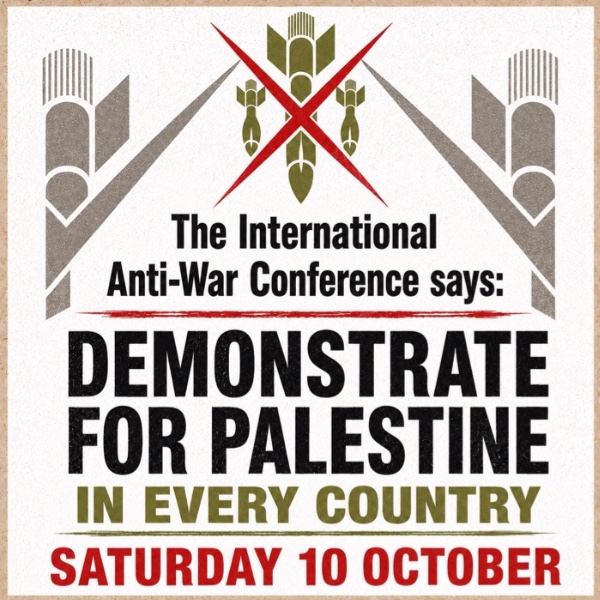
Stop the War in its recent newsletter quotes the opening line of the statement agreed at June's International Conference Against War, which included an agreement on building for a series of international days of action and for the conference logo to be promoted: "From this International Anti-War Conference we raise our united voices: against war and genocide, and the growing nuclear threat, and for peace." Workers' Weekly calls on the working class and people to take this opportunity to go all out to build the united front against war and in defence of the rights of all.
One important call is to mobilise for the Youth Network rally on September 8, in order to build for the November 20 Youth Strike against militarism and conscription.
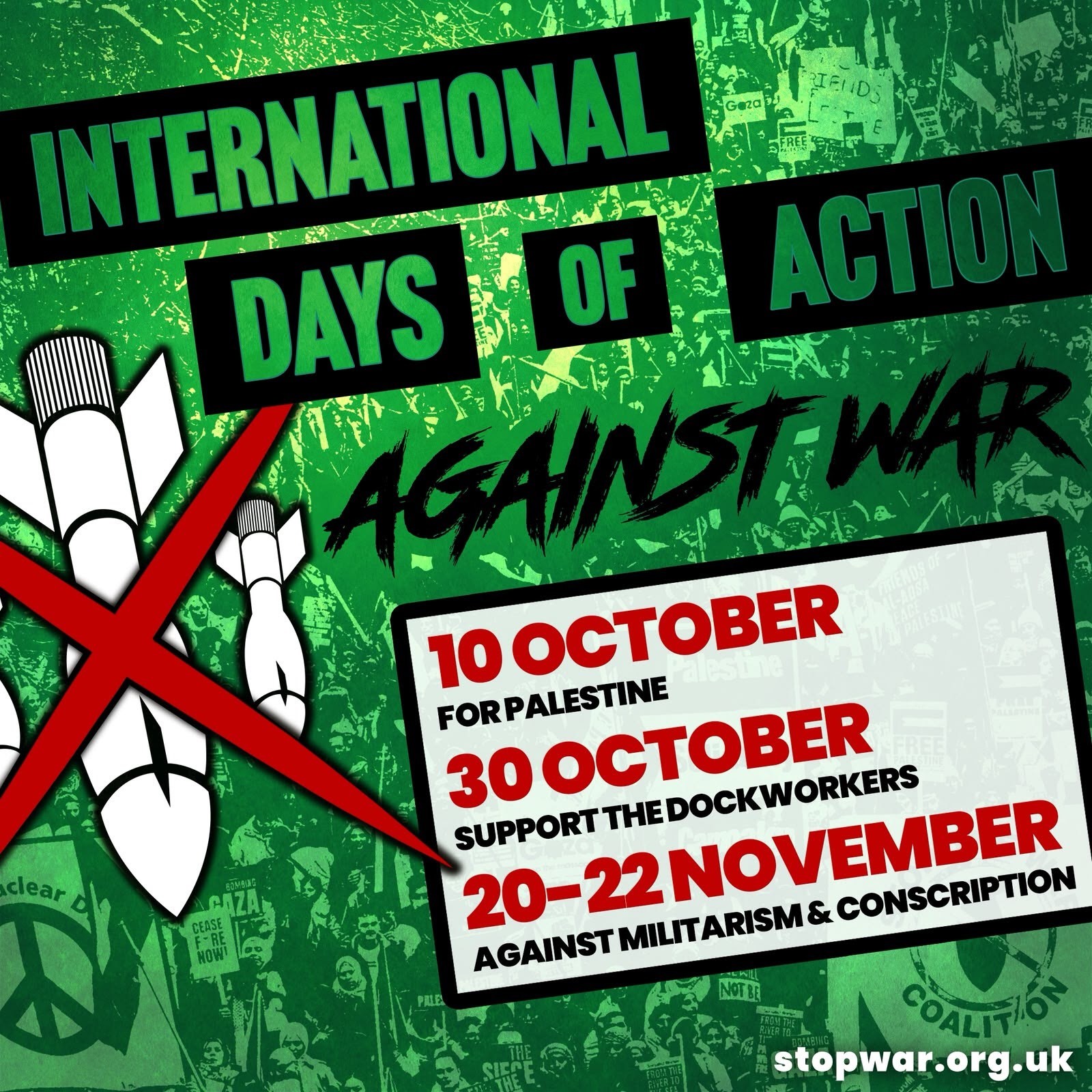
Of particular importance is to mobilise for the international days of action on the following dates:
October 10 - International day of demonstrations for Palestine.
October 30 - International day of support for the dockworkers' action.
Dockworkers and port workers across more than 40 European and Mediterranean
ports are preparing for an upcoming international day of action against war and
militarisation.
November 20-22 - International weekend against militarism and conscription,
starting with the Youth Strike on Friday, November 20.
The demonstration on October 10 will be part of a day of international demonstrations for Palestine. Palestine remains the issue where the cartel parties refuse to break with the genocide of US/Israeli genocide which is still ongoing. The demand of the people's movement is to end the criminalisation of support for the resistance of the Palestinian people, and to push ahead with the demand that the British government end all complicity in the genocide in Palestine which is still ongoing.
The day of action on October 30 is being called with the slogans: "Ports for Peace - Jobs with Dignity" / "Dockworkers do not work for war". Following the 3rd International Meeting of Mediterranean and European Dockworkers' Unions in Istanbul, participating unions include CGT Ports and Docks (France), ENEDEP (Greece), LAB (Basque Country), Liman-Ä°ÅŸ (Turkey), ODT (Morocco), and USB and ORSA Porti (Italy). The main demands are: to refuse to be complicit in handling or shipping weapons, military equipment, and supplies to active war zones; to demand an end to military aggression and the war economy, which also degrade safety, wages, and working conditions; to reject the militarisation of port infrastructure, deregulation, and forced automation. The October 30 mobilisation follows an earlier co-ordinated day of action held on February 6, 2026, which saw strikes and protests across multiple Mediterranean ports. It is reported that individual national unions will determine their specific actions - ranging from rallies to localised strikes - based on regional conditions.
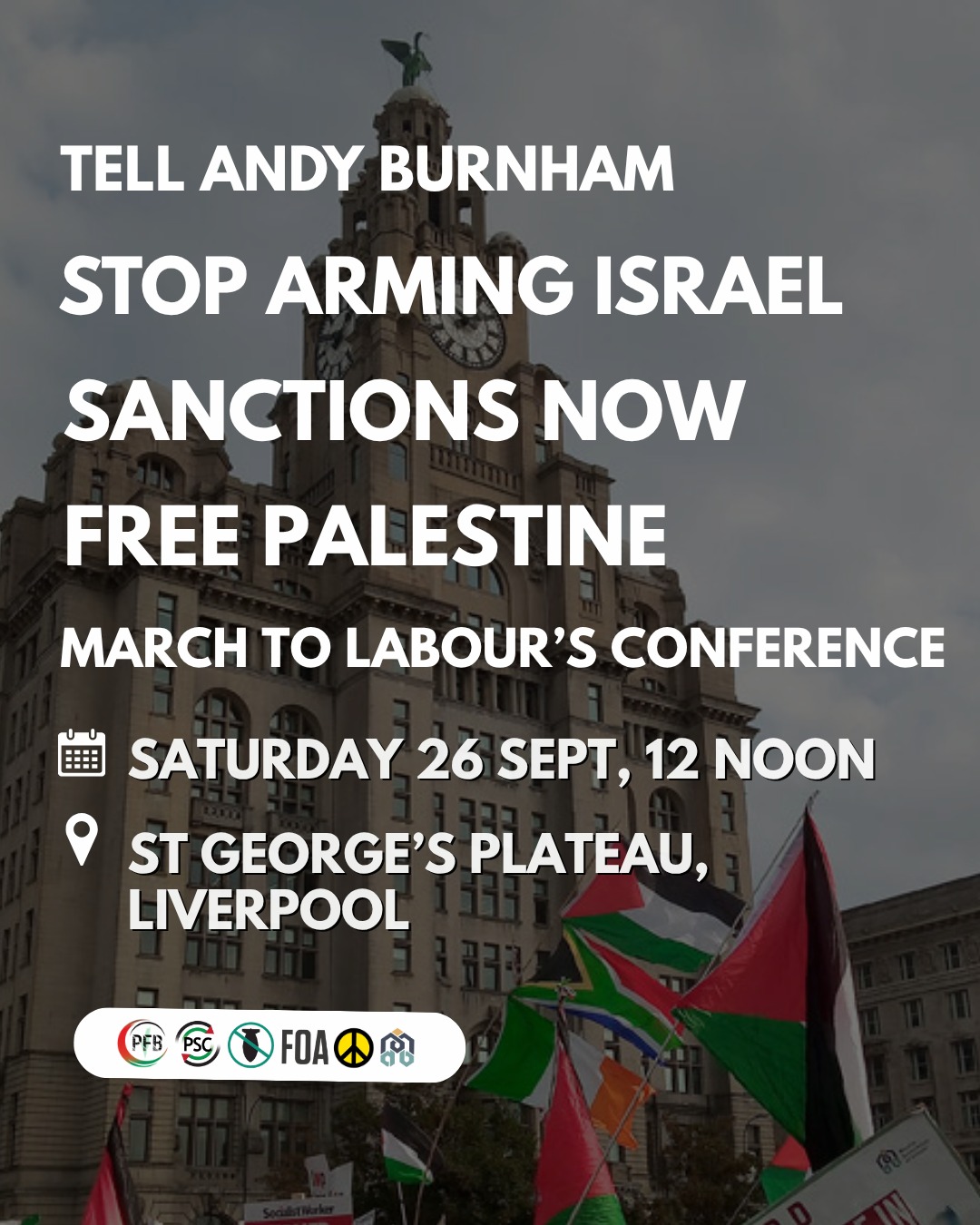
When: September 26, 2026 12:00 pm
Where: Liverpool
The march to the Labour Party conference in Liverpool on September 26 is to demand that Andy Burnham go beyond his "apology" over Keir Starmer's position on Gaza and take urgent action to stop arming Israel and to impose immediate sanctions. The complicity in US/Israeli genocide must end, as must the criminalisation of all those in various ways who protesting against this genocide.
The Palestine Coalition has issued a statement demanding real action by the Burnham government against Israel, one year after Britain's recognition of a Palestinian state and nearly three years of genocide.
August 19, 2026
Palestine Coalition calls for real action to end Israel's attacks on Gaza and settler violence in the occupied West Bank.
Nearly three years into Israel's continuing genocide in Gaza, Palestinians still face killing, starvation and displacement, while British-funded humanitarian aid remains subject to Israeli restrictions.
The Government must secure an end to Israeli attacks and unrestricted humanitarian access to Gaza. Across the occupied West Bank, including East Jerusalem, settlement expansion, settler violence and restrictions on Al-Aqsa Mosque continue to intensify - restrictions the Government must act to end.
A year on from the UK's recognition of the State of Palestine, that decision has yet to be matched by action. Britain's commitment to international law cannot be hostage to Israel's election timetable. Real action means confronting Britain's own complicity.
That means ending the arms trade with Israel, suspending military and intelligence support that facilitate violations of international law, and stopping British businesses, banks, universities and charities from supporting occupation or settlement activity - starting with a ban on trade connected to Israel's illegal occupation and comprehensive sanctions on Israel.
On Saturday, October 10, at 12 noon, join us for the national march in central London to mark three years of the ongoing genocide. We call on people across the country to stand together in demanding justice and an end to British complicity.
Palestinian Forum in Britain Palestine Solidarity Campaign
Stop the War Coalition
Campaign for Nuclear Disarmament
Friends of Al-Aqsa
Muslim Association of Britain
Receive Workers'
Weekly E-mail Edition: It is free to
subscribe to the e-mail edition
We encourage all those who support the work of RCPB(ML) to also support it
financially:
Donate to
RCPB(ML)
Workers' Weekly is the weekly on
line newspaper of the
Revolutionary Communist Party of Britain (Marxist-Leninist)
Website:
http://www.rcpbml.org.uk
E-mail:
office@rcpbml.org.uk
170, Wandsworth Road, London, SW8 2LA.
Phone: 020 7627 0599: