|
|
||||
|---|---|---|---|---|
| Volume 56 Number 34, November 21, 2026 | ARCHIVE | HOME | JBCENTRE | SUBSCRIBE |
Workers' Weekly Internet Edition: Article Index :
Youth Have the Future in their Hands:
Incoherence of Government's Proposals to Solve NEETs CrisisFighting for the Dignity of Labour:
Workers Defend Their Claims and Organise to Make Their Voice PrevailNo to Military Production! Fight for the Alternative!:
BAE Systems and the Direction of ProductionNo to Military Production! Fight for the Alternative!:
Fiftieth Anniversary of the Lucas Workers' Plan against Militarisation of the EconomyFor your information:
Defend the Pensions Triple Lock!Build the People's Front for an Anti-War Government!:
Militant Actions against Britain's and International Warmongering

Alan Milburn, the former Labour Health Secretary under Tony Blair, released his final report on November 17 on what the current Labour government defines to be the problem of young people not in employment, education or training (NEETs). "Young people" here refers to those who are aged 16 to 24. The gist of Milburn's report, entitled "From a Welfare State to a Working State", is that Britain faces a crisis because the young people who are not in employment, education or training number almost a million, and that Britain "is at risk of losing a generation of young people" [1].
On schools, the report says that they should be judged on their pupils' work-readiness and made to identify those at risk of becoming "NEET". The report's recommendations for schools include judging schools on their pupils' work-readiness by 2028, creating a new 14 to 19 framework, and new writing, numeracy and oracy checks at key stage 3. It also includes new targets, with 90 per cent of pupils expected to be "school ready", and 90 per cent achieving the expected standard at the end of primary school, by 2036. According to Milburn, work experience should become a statutory duty, while all schools including primaries should be required to use data to identify and support pupils at risk of becoming NEET [2].
Speaking in the House of Commons the same day, Pat McFadden, the Work and Pensions Secretary, said that this crisis "creates a human cost that no country should ask its young people to bear". He told MPs, "It robs them of the thing that is most important to their lives: the prospect of a good future, and it demands a response that is much more than a conventional departmental response." [3]
However, the Milburn report does not suggest the remedy of the government's ensuring a future for the youth, either by investing in creating that future through all-round education, through putting the young people at the centre of considerations in setting the direction of the economy, or most importantly through empowering the youth to participate in shaping that future. At this point the social wealth created by working people is not being directed at shaping a society in which the future of the youth is cared for. Rather it is siphoned off by the billionaires and trillionaires who extract it from the economy.
Even a brief look at the relatively recent history of what are being called NEETs will show that the rights of the youth to employment and to education and training have not been recognised or guaranteed. The 1970s saw the social welfare state going into crisis. Throughout this period, youth unemployment rose sharply. Then unemployment rose dramatically in the 1980s also, as neoliberalism took hold, and broadly speaking the youth were encouraged to fend for themselves in the so-called "labour market". The period of New Labour in power saw reducing the numbers of NEETs as a policy objective, and the mantra of "education, education, education" become a smokescreen for an actual crisis in education and training. Precarious work became a phenomenon, while the youth have been resisting the attacks on their education, and resisting their disempowerment, social exclusion, the problem of homelessness, and the trend towards war.
Rather than recognising that the "NEETs" crisis is not an anomaly and taking steps to urgently change the direction of the economy and invest social wealth to the benefit of individuals, collectives and society as a whole, the Burnham government has come up with a "10-year project", framing the NEETs situation as a "moral crisis". It is laughable that while talking of this "moral crisis", the aim is said to be that of reducing the NEET rate to around five per cent by 2036, which Alan Milburn called "an effective rate of NEET Zero". It is as if the cartel parties were trying to make a mockery of the critical situation facing the youth.
Shall we see the increased onus on the "public sector" to lead the way when it comes to maximising opportunities for the young? Are the relatively minor changes going to provide incentives for the "private sector" to step in and realise the "NEET Zero"? The issue is that the interests of the youth and their empowerment are not being put at the centre of considerations. Instead, as commentators have been pointing out, many young people could lose social security support through the measures, while substantial subsidies are to be provided to employers, with no thought of the long-term consequences or the type of work which will benefit the 16-24-year-olds, not to speak of the interests of society. The rights of the young, in short, are not being guaranteed; nor is the issue of full employment nor the necessary support for all young people, and indeed working people as a whole, being aimed at. The root causes of the "NEETs crisis" are being ignored, and the support for vulnerable youth, the lack of which is so much part of this crisis, is being downplayed.
It is not for the youth to fit in with the aims of the oligarchs and the cartel parties which reflect their outlook. A transformation is needed and the demands and interests of the youth must be directly served.
The youth and young workers are taking steps to voice their interests and demand a society in which they are in control of their own lives. They are also demanding an end to war preparations, the war machine and the gearing of "solutions" to the advantage of weapons manufacturers.
The youth have the future in their hands!
Response of teaching unions
An article in Schools Week reported on the response of the teaching unions:
Pepe Di'Iasio, general secretary of ASCL, said his organisation supported the focus on vocational and technical education, as well as work experience and careers guidance. But it was "disappointing to see how quickly the report defaults to the usual mishmash of targets, tests, and new accountability measures which are a hallmark of many other reports over recent years". He said the ready-for-work standard "will create yet more pressure on a system which is already overwhelmed with expectations and which is simply not resourced to deliver a whole new tier of requirements". He continued, "If the government intends to do this then it must come up with a realistic plan and the funding to enable schools to deliver this expectation." The union will be "calling on ministers to ensure that the implementation of any new changes is assessed against the funding and workforce capacity required to deliver them." Di'lasio added that the key stage 3 writing, numeracy and oracy check "will detract from curriculum time in already overcrowded timetables" and that there needs to be a "practical plan" to meet the raised key stage 2 attainment targets, given how they are affected by wider socio-economic challenges.
Paul Whiteman, general secretary at NAHT, said: "Schools will also wonder how 'work readiness' would be defined and measured. Schools do not need another accountability measure judged by Ofsted at a time when they already have serious concerns about school inspection." He added that this, and the use of destination data, "also risk partly judging schools on factors beyond their control", such as local labour markets. Whiteman added that while earlier identification of at-risk pupils would be helpful, "schools would be concerned if this was used primarily as a monitoring, reporting or accountability tool". Whiteman acknowledged that some of the ambitions were "laudable", but that school leaders will wonder how they will be achieved, especially with ongoing reforms to the curriculum, SEND and enrichment. He added that plans for 90 per cent of pupils to be school ready, and for 90 per cent to meet the expected standard in key stage 2, would require "significant investment" from government. Whiteman warned that the checks "should be genuinely diagnostic rather than high stake assessments", that ministers would need to explain how they would create more flexibility "within an already crowded curriculum" at key stage 3. Whiteman added that it "will also require employer capacity to be addressed and must not impose extra unfunded administrative burdens upon schools".
Leora Cruddas, chief executive of the Confederation of School Trusts, said they were concerned about the proposals. "We should be cautious of over-emphasising the role of schools and underplaying the economic arguments around the number of young people not in education, employment or training." Cruddas said CST was also cautious about primary schools being told to use NEET indicator tools. "The best thing that we can do is focus on ensuring that more children can read and write to an expected standard."
Daniel Kebede, general secretary of the National Education Union, welcomed a proposal for less GCSE exams and freeing up 10 per cent of the key stage 3 from the national curriculum. "But Milburn's prescriptions for schools contradict his diagnosis, with more tests and targets: a statutory key stage 3 check on top of the Year 8 reading test, and a ready-for-work rate and destination measure for Ofsted to inspect. Whatever Milburn intends, statutory tests become high stakes: schools chase the metric, not learning, and more pupils disengage." Kebede said that "large employers should have to offer placements" if schools have a statutory requirement to offer work experience.
Notes
[1] "From a Welfare State to a Working State: a new settlement for the next generation", DWP, November 17, 2026
[2] See full report pdf: https://assets.publishing.service.gov.uk/media/6afb1fc5ccb3ea58ac8743c1/from-a-welfare-state-to-a-working-state-full-report.pdf
[3] "Milburn Review: Final Report", Hansard, November 17, 2026
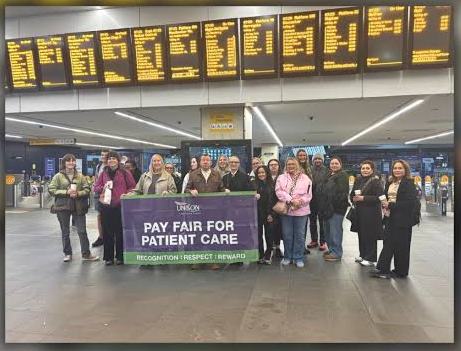
Leeds NHS - Photo: FB
Across education and health care, workers are sustaining their struggles in defence of wages, livelihoods and collective rights. November has brought further strikes against pay cuts and compulsory redundancies.
A common issue runs through these struggles: employers and authorities are treating workers' conditions and negotiated agreements as obstacles to be removed. Workers are organising to uphold the dignity of labour and to exercise control over their working lives. Their actions bring to the fore the question of who determines the future of social programmes and the direction of the economy.
Defending the future of education
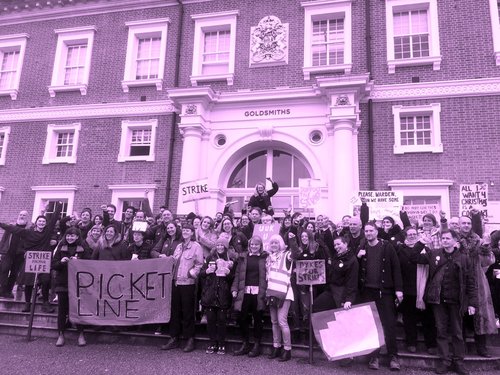
Goldsmiths, University of London, UCU members
At the University of Nottingham, sustained strike action against compulsory redundancies and course closures has forced movement from management. In this struggle, workers have defended teaching and research and challenged management's assertion of the authority to close courses and dispense with staff. On November 11, UCU members voted to suspend action from November 12 following an improved offer containing measures to mitigate redundancies. The union stresses that the dispute continues and that members remain prepared to reinstate action if meaningful progress is not made. [1]
At Goldsmiths, University of London, UCU members are sustaining an indefinite strike which began on June 8 against another round of restructuring and job cuts. The branch says management responded to a marking and assessment boycott by imposing 100% pay deductions, effectively locking participating staff out. Workers are demanding the withdrawal of those deductions, meaningful consultation and a voice in decisions over the college's future. [2]
The struggle has now taken a further step. From November 17, Goldsmiths has been subject to an international academic boycott, or "greylisting", with the national UCU formally announcing the escalation on November 19, 2026. The appeal asks academics elsewhere to withhold participation in activities including conferences, new research collaborations and new external-examiner appointments. Support for the boycott and the branch's hardship fund strengthens the workers' stand against management's attempt to impose restructuring and silence their opposition. [3]
At the University of Brighton, staff are resisting plans to terminate union recognition and collective agreements. UCU reported that management had given notice in September that the existing agreements would end from June 2027. UNISON is also affected. The campaign to defend recognition continues. This attack threatens the collective means through which workers defend sick pay, leave, working arrangements and other conditions won over many years. [4]
Meanwhile, cleaners and catering workers employed by Compass at Forest School in Snaresbrook, east London, organised a further period of action for November 2-17 against pay cuts of up to 13.5%. Unite reports that the cuts follow a reduction of contracts from year-round to term-time working. Parents and students have supported the picket lines, and the student council has voted to back the workers. Their stand affirms the claims of those whose daily labour makes the school function. [5]
The national day of action called by UCU for Friday November 20, supported by UNISON, provides an immediate occasion to bring struggles together. UCU is encouraging rallies, public teach-outs, fundraising and joint activity with students across universities and colleges. [6]
Safeguarding the future of the NHS
Theatre assistants at Leeds General Infirmary, St James's, Chapel Allerton and Wharfedale hospitals are maintaining an indefinite strike for proper recognition of their duties. UNISON says they undertake clinical tasks, use specialist equipment and support surgical teams while remaining on the lowest NHS grade, earning less than £13 an hour. They are demanding regrading and pay in line with colleagues performing the same tasks at other trusts. [7]
Across the Northern Care Alliance, more than 400 workers, including nurses, clinical support workers and housekeepers, are escalating their dispute over overtime payments. UNISON announced further walkouts at four Greater Manchester hospitals for November 18, 23, 24 and 27. The union says routing additional shifts through NHS Professionals deprives some staff of the overtime rates due to them, with losses exceeding £80 a shift. Workers are also taking their campaign to regional health leaders and organising a city-centre march for November 27. [8]
At Guy's and St Thomas' NHS Foundation Trust, Unite called hundreds of cleaners, porters, stores operatives and food service assistants out on November 17 over pay and treatment at work. The union reports complaints about bullying and racist behaviour, insecure bank arrangements and inadequate facilities. After management restricted attendance at workplace union meetings, reps organised a mass members' meeting at Conway Hall for the strike day, to discuss the dispute and plan further action. Workers are defending their collective ability to meet, deliberate and determine their next steps. [9]
Blood sciences workers employed by Lancashire Teaching Hospitals NHS Foundation Trust are taking further action over holiday pay irregularities and unpaid overtime and absence payments. Unite's programme includes November 16-20 and 23-27. The union says the trust has spent more than £1 million outsourcing work to mitigate the strikes while failing to resolve the workers' claims. [10]
This use of public resources to sustain outsourcing while a pay dispute continues raises directly whose claims management recognises. The skilled workers who sustain diagnostic services are demanding that the payments owed to them be honoured.
In the north of Ireland, the struggle for pay restoration and parity is developing across the health service. Resident doctors are due to hold a 24-hour walkout from November 20, with consultants and specialist, associate specialist and specialty doctors providing Christmas Day levels of cover during action on November 23. The BMA connects their demands to the recruitment and retention of staff and the future of safe care. [11]
Unite has also announced a ballot of almost 4,000 health and social care workers, opening on November 23 and closing on December 14. It concerns the failure to implement the 3.3% pay increase already paid in England and Wales and to honour commitments on the Real Living Wage. Workers are organising across the service to make their claims prevail. [12]
In England, consultants' planned late-November strike has been paused to allow formal negotiations on pay and working conditions. The dispute continues, and the BMA says members remain prepared to announce new dates if talks do not deliver. [13]
The importance of sustained organisation is also shown by the health visitors' struggle at Cwm Taf Morgannwg in Wales. On November 10, Unite announced an agreement in principle under which all band 6 health visitors would be offered band 7 roles, following nine months of strike action. The union announced a return to work for November 16, with the agreement subject to ratification. Their stand has forced recognition of the specialist skills and responsibilities of health visiting. [14]
At St Helier and Epsom hospitals, around 250 cleaners, porters and catering workers organised in UVW are pursuing claims for lost pay and pension contributions, alleging indirect race discrimination. The predominantly Black, Brown and migrant workers became NHS employees in 2021 but remained on inferior terms. UVW reports employer pension contributions of just 3%, compared with around 23% for NHS colleagues. [15]
Their organisation has already forced progress. After workers voted overwhelmingly for strike action, they secured an agreement providing for full NHS terms to be phased in. Their continuing claims concern the losses incurred before that agreement. The struggle to end divisions in pay, pensions and conditions remains a matter for the whole workforce.
Notes
[1] "UCU members suspend strike action at University of Nottingham following improved offer", UCU, November 11, 2026.
https://www.ucu.org.uk/article/14714/UCU-members-suspend-strike-action-at-University-of-Nottingham-following-improved-offer
[2] "GUCU IS ON INDEFINITE STRIKE!", Goldsmiths UCU, current campaign statement, accessed November 19, 2026.
https://goldsmithsucu.org/
[3] "Goldsmiths is Greylisted!", Goldsmiths UCU, November 18, 2026.
https://goldsmithsucu.org/2026/11/18/goldsmiths-is-greylisted/
[4] "UCU condemns University of Brighton derecognition plans", UCU,
September 15, 2026; "Scrapping union recognition at University of
Brighton will affect student experience, says UNISON", UNISON,
September 15, 2026.
https://www.ucu.org.uk/article/14642/UCU-condemns-University-of-Brighton-derecognition-plans
https://unison.org.uk/news/2026/09/scrapping-union-recognition-university-brighton-will-affect-student-experience
[5] "Forest School London staff strike over pay cuts to escalate", Unite, October 30, 2026.
https://sharepoint.unitetheunion.org/news-events/news/2026/october/forest-school-london-staff-strike-over-pay-cuts-to-escalate
[6] "National Day of Action", UCU, October 28, 2026, updated November 6.
https://www.ucu.org.uk/20November2026
[7] "Leeds hospital bosses need to get back to talks to end pay strikes", UNISON, November 3, 2026.
https://unison.org.uk/news/2026/11/leeds-hospital-bosses-need-get-back-talks-end-pay-strikes
[8] "Strikes and city centre protests as Greater Manchester
hospitals pay row escalates, says UNISON", UNISON, November 16, 2026.
https://unison.org.uk/press/2026/11/strikes-and-city-centre-protests-greater-manchester-hospitals-pay-row-escalates-says
[9] "Low-paid London Guy's and St Thomas' workers to strike this week", Unite, November 16, 2026.
https://sharepoint.unitetheunion.org/news-events/news/2026/november/low-paid-london-guy-s-and-st-thomas-workers-to-strike-this-week
[10] "Further strikes at East Lancashire Blood Sciences department", Unite, October 27, 2026.
https://sharepoint.unitetheunion.org/news-events/news/2026/october/further-strikes-at-east-lancashire-blood-sciences-department
[11] "Doctors prepare to strike", BMA, October 15, 2026; "Industrial
Action Update | November 2026", Western Health & Social Care Trust,
November 17, 2026.
https://www.bma.org.uk/news-and-opinion/doctors-prepare-to-strike
https://westerntrust.hscni.net/industrial-action-update-november-2026/
[12] "Northern Ireland facing pre-Christmas health strikes", Unite, November 16, 2026.
https://sharepoint.unitetheunion.org/news-events/news/2026/november/northern-ireland-facing-pre-christmas-health-strikes
[13] "Consultants in England pause strike action", BMA, November 17, 2026.
https://www.bma.org.uk/news-and-opinion/consultants-in-england-pause-strike-aciton
[14] "Welsh health visitors secure historic pay win", Unite, November 10, 2026.
https://sharepoint.unitetheunion.org/news-events/news/2026/november/welsh-health-visitors-secure-historic-pay-win
[15] "NHS pension scandal: Hundreds of St Helier and Epsom NHS
workers take trust to court over four years of unlawful pension denial,
and inferior pay", UVW, November 4, 2026.
https://www.uvwunion.org.uk/en/press-releases/2026/11/nhs-pension-scandal-hundreds-of-st-helier-and-epsom-nhs-workers-take-trust-to-court-over-four-years-of-unlawful-pension-denial-and-inferior-pay/
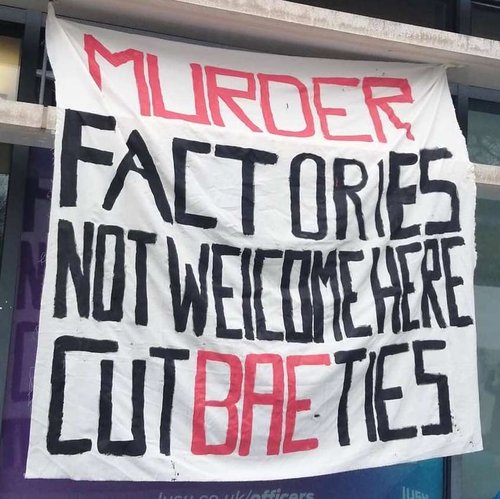
BAE Systems brings together advanced engineering, international production networks and government military contracts in a business which generates substantial returns for the owners of its capital. Its operations show how state decisions organise a market for arms and direct productive capacity towards military aims. Examining the company's work, contracts and finances brings out the relations through which militarisation becomes a source of private accumulation.
BAE's own account identifies Cowes on the Isle of Wight as the principal base of its radar business. It describes work on signal processing, electronic systems and research involving artificial intelligence, in collaboration with universities. Its military radar portfolio includes Artisan, Sampson and Commander systems. [1] These activities draw on highly developed engineering knowledge and collective labour. Military requirements shape the development and application of these skills, connecting research and design with the operational priorities of the armed forces purchasing the equipment.
Radar forms part of integrated military systems. BAE describes Sampson as the surveillance and tracking sensor on the Royal Navy's Type 45 destroyers, capable of tracking hundreds of targets and providing guidance for missiles. [2] The production of sensors and electronic equipment is consequently integral to military capability, even where the equipment is not itself an explosive weapon.
The Cowes operation belongs within a wider corporate and military network. Elsewhere in its business, BAE reports a 13-15% workshare in each F-35 aircraft, including manufacture of rear fuselages in Britain and electronic warfare equipment in the United States. [3] Production is organised internationally across different sites and specialisms, with individual components contributing to military systems whose development, manufacture and support extend across national borders.
The company's financial results reveal the scale of this network. For 2025, BAE reported group-defined sales of £30.7 billion and statutory revenue of £28.3 billion. Group operating profit was £2.9 billion. The same results record the British government's agreement for Türkiye to acquire Typhoon aircraft and an associated weapons package, anticipated to be worth £4.6 billion to BAE. [4]
Government military decisions thus organise demand for production and establish long-term priorities for investment and employment. Corporate decisions then direct resources towards fulfilling these programmes and securing returns. Workers and communities are presented with the resulting allocation of work as the condition on which their livelihoods depend.
The company's recent market update on November 12 makes the direction particularly clear. BAE reported £33 billion in orders secured during the year so far and identified rising government military expenditure as a basis for continued growth. The orders included approximately £4.3 billion in further funding for work on Britain's Dreadnought nuclear submarines. BAE also reported that subdued growth and margins in its Maritime sector reflected the stage reached in the Type 26 frigate programme. [5]
These group-wide figures and programmes show the scale on which military spending provides BAE with a basis for expansion. Long-term procurement commitments shape investment across its operations and supply chains. The workers whose labour fulfils those commitments are denied a determining say over the aims their labour serves.
BAE's published financial summary records £1.1 billion in dividends paid in 2025, including payments to non-controlling interests, and £502 million spent purchasing its own shares. [6] Its November update anticipates approximately £1.6 billion returned to shareholders during 2026 through dividends and share repurchases. The financial resources generated through the business support substantial distributions to owners alongside continued investment in military production.
Public expenditure on arms purchases equipment, labour and other inputs. It also sustains the conditions in which private owners secure returns and direct further accumulation. This is a concrete relation through which the state's allocation of social wealth supports the arms monopolies. The claim that military orders create jobs cannot settle whether this use of society's resources serves the people.
Workers produce the wealth and sustain the technical capacities on which these programmes depend. Their claims to wages, pensions, training and security must prevail. Those claims also provide a basis for challenging the owners' authority to make the purpose of production subordinate to the interconnected aims of private returns, militarisation and a pro-war direction for society and the economy.
A current contract shows how military priorities enter decisions extending beyond arms production. In a parliamentary answer on April 1, 2026, the government confirmed a £95 million contract with BAE for radar designed to enable air defence and offshore wind installations to coexist. The Ministry of Defence is funding it with financial support from the Department for Energy Security and Net Zero. The government says the upgrades could enable up to 10 gigawatts of offshore wind capacity. [7]
The government's announcement says installation of the new radars is due to begin in early 2029. [8] Energy development is thus connected with a further programme of military procurement and its timetable.
The example demonstrates that sophisticated engineering can address problems affecting energy development. It also shows the direction under which the work is commissioned: renewable energy and military requirements are being accommodated through a government-funded arms-company contract. Assessing such development requires examining who identifies the needs, sets the priorities and controls the outcome. Its connection with offshore wind does not by itself transfer those decisions to workers or communities.
BAE's business brings together a definite set of relations. Governments commission military capabilities and commit public resources to their development. The company organises production across workplaces and countries, while its owners receive dividends and benefit from share repurchases. Workers supply the knowledge and labour on which the whole process depends, but corporate and state authorities determine the purposes to which that capacity is put.
Employment, research and investment are being developed within military programmes whose priorities working people have no determining power to set. Workers' claims to secure livelihoods and the development of their skills must be upheld together with their claim to decide the direction of production. BAE's own accounts demonstrate how closely that direction is bound to government military expenditure and the returns sought by private owners.
No to Military Production! Fight for the Alternative!
Notes
[1] "Radars", BAE Systems, accessed November 14, 2026.
https://www.baesystems.com/en-uk/uk-businesses/maritime/radars
[2] "Sampson Multi-Function Radar", BAE Systems, February 13, 2025.
https://www.baesystems.com/en-uk/product/sampson-multi-function-radar
[3] "F-35 Lightning II", BAE Systems, accessed November 14, 2026.
https://www.baesystems.com/en/product/f35-lightning-ii
[4] "2025 full year results", BAE Systems, February 18, 2026.
https://www.baesystems.com/en-uk/article/2025-full-year-results
[5] "Market update", BAE Systems, November 12, 2026.
https://www.baesystems.com/en-us/article/market-update-nov-2026
[6] "Five Year Summary", BAE Systems Investors, figures for the year ended December 31, 2025, accessed November 14, 2026.
https://investors.baesystems.com/five-year-summary
[7] Written question 123404 on the cost of procuring new air defence
radar systems, answer by Michael Shanks, Department for Energy Security
and Net Zero, April 1, 2026.
https://questions-statements.parliament.uk/written-questions/detail/2026-03-24/123404
[8] "New radar systems to unlock offshore wind", Department for
Energy Security and Net Zero and Ministry of Defence, March 20, 2026.
https://www.gov.uk/government/news/new-radar-systems-to-unlock-offshore-wind
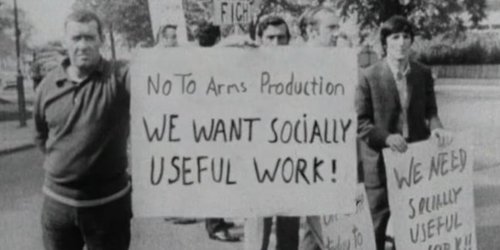
This January marked the 50th anniversary of the Lucas Workers' Plan, still famous in many quarters. In opposition to militarisation of the economy, a stand was taken by the workers at Lucas Aerospace against war production.
Lucas Industries plc was a British manufacturer of components for the motor and aerospace industries. Based in Birmingham, at its height it was a monopoly in the sector, though it has since been rendered defunct through a series of mergers and acquisitions, with the Lucas trademark now owned by German monopoly ZF Friedrichshafen. It had one of its aerospace factories in Shaftmoor Lane in Hall Green, Birmingham, which dated back to 1938 when it housed gas turbine equipment. There is nothing left of the factory now: it was demolished and the Birmingham Mail reported in March 2023 that houses were being built on the former Lucas factory site, with a 300-home plan. The military production, though, has remained. Lucas Aerospace workers moved to a new hi-tech site in Solihull in 2014, built at a cost of £60m.
In 1976, during that decade's deep economic crisis, the narrow self-serving plan of the management of Lucas Aerospace was to cast into redundancy a fifth of its workforce of 18,000 and close a number of factories. In response, the cross-union shop stewards committee, formulated an alternative plan with the full involvement of the workers. This was a plan for "socially useful and environmentally desirable production".
Despite the fact that they were heavily involved in military production, the workers and their elected shop stewards were conscious of the need to end production for military purposes and envisaged a future of peaceful production at their plant. At the time, production relied at least in part on state support and was divided roughly equally between military and civilian contracts. Workers argued that public money ought to be spent on production for pro-social rather than military aims.
The workers' initiative was based on the workers' own experience, harnessing their knowledge and skills while utilising experts such as scientists and environmentalists, and centring on the needs of themselves, their communities and their environment. It pointed to a different way of planning, or carrying out production, and of different aims.
This had to be learned in practice: the shop stewards had first turned to the research community and received a very limited response. When they turned to their own forces, the workers themselves, and sought the assistance of academics in that context, it took just a year to formulate their fully worked-out alternative plan, from what alternative products to manufacture to the training required. It also included proposals on reorganisation to bring together the practical and theoretical knowledge on the production line versus the design shop.
The level of detail and seriousness of the Lucas Workers' Plan was unprecedented. The Financial Times (January 23, 1976) called it "one of the most radical alternative plans ever drawn up by workers for their company". It received international media coverage and was even nominated for the 1979 Nobel Peace Prize.
The workers' aim was to create a movement, going beyond the perspective of workers at a particular firm protecting their jobs. One of the leaders of the initiative, a designer sacked from Lucas for his activism, said they intended to "inflame the imaginations of others" and "demonstrate in a very practical and direct way the creative power of 'ordinary people'".
The workers organised shows and events to educate others, eventually leading to the establishment of the Centre for Alternative Industrial and Technological Systems (CAITS) at North-East London Polytechnic, and networked with other related activism, including in other countries, particularly in Germany and Scandinavia.
Though the anti-social offensive with its neo-liberal ideology launched by Thatcherism at the end of the 1970s sought to sweep aside all such workers' consciousness and organisation and leave all technological development to the monopoly-dominated markets, the experience of the Lucas Workers' Plan shows that working people can provide solutions to the problems, crisis and militarisation facing the economy and society.
In particular, central to their concerns was the issue of control over both the production process and, importantly, the motive of production. The Lucas Workers' Plan was a manifestation in practice of the workers' right to a say over the direction of the economy in favour of socially useful production. It showed what workers have the potential to achieve. It was therefore of no surprise that the Plan was rejected by the company and the government; it stood in direct opposition to their outlook, aims and status quo. It showed that there is an alternative to the militarisation of the economy based on the workers' independent aims. What is necessary is the power to implement that alternative.
Fifty years on, the Lucas workers' achievement affirms the capacity of working people to provide solutions. Taking that experience forward means organising to acquire the authority to implement those solutions and to keep the direction of the economy in the people's hands, and taking up the work for an Anti-War Government in which people themselves exercise decision-making power.
Based on "Looking Back on the Lucas Workers' Plan against Militarisation of the Economy", Workers' Weekly, March 24, 2018.
https://www.rcpbml.org.uk/wwie-18/ww18-08/ww18-08-03.htm
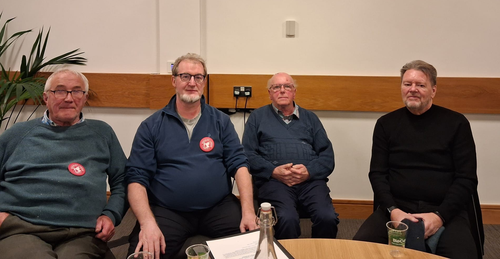
Birmingham panel
The Socialist Labour Party carried the following article on its website entitled, "Inaugural meeting of the campaign to save the Triple Lock"
This Saturday (November 14), saw the first meeting of the Socialist Labour Party's campaign to save the triple lock.
Although turnout was modest, it was a useful opportunity to hear why this issue is so important and worth fighting for.
Ian Hodson, President of the Bakers, Food and Allied Workers Union, gave the campaign an excellent start by explaining that this attack on pensions is a class war issue. He broadened out the issue and made it clear to us, that government's attack on pensions was part of the same ideological attack on young people and disabled people by threatening to cut their benefits. He cogently pointed out that incongruity of forcing young people to work for free for companies that had recently laid off staff, and at the same time, expecting them to saving for their retirement.
He reminded us that the backdrop to this policy is the reality of workers who are squeezed into low-paid work, yet pay taxes, but then the government turns round and tells them that the public services they need are 'unsustainable'. Yet, he reminded us, the government continues to funnel money into the war in Ukraine, weapons seeming more important than pensions.
SLP General Secretary, Allistair Lomax, laid out the Party's position on why it feels it is so important to preserve the triple lock in its current form, he also laid out the reasons why the Party opposes it. This is on the grounds that it is fundamentally unfair to inflict the government's austerity plans on the pensioners, but that was inter-generational issue, and that the Party is fighting for future pensioners, not just current pensioners. He spoke of the Party's plans to develop the campaign and link to interested groups to pursue this common purpose.
They were contributions from representatives from pensioners groups in Birmingham and from the 1950's women who are also affected by this government and previous governments reluctance to provide justice for those women who were denied the right to retire and receive their pensions.
This was the central theme of the meeting, that this campaign touches on some many aspects of how the working classes, people of all ages, are being attacked not only benefits, but also by poor wages and conditions.
This is the start of the campaign, if you wish to kept in touch, or want to be part of this campaign, then message us and join the fight. There are already plans in the pipeline for the next meetings.
You can find details of the campaign here: https://socialistlabourparty.org.uk/savethetriplelock/
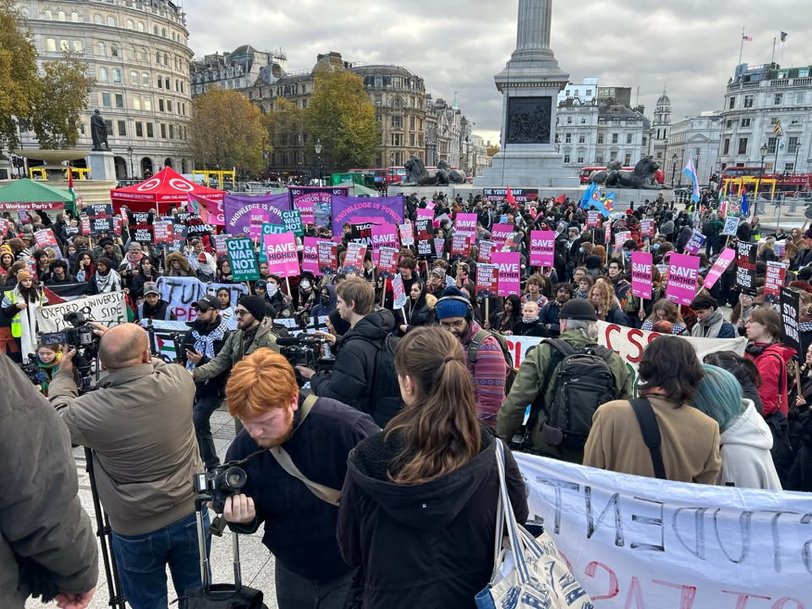
International Youth Strike in Britain on November 20
As Andy Burnham met with the so-called Coalition of the Willing, it was announced in Berlin, Germany, by the Prime Minister, that Britain will provide Ukraine with 1,000 long-range strike drones to target Russia beyond the front line. This is part of a new £260m package to keep the proxy war against Russia going, despite the crisis of the Zelenskyy government, and is part of Burnham's project to further militarise Europe.
In contrast, the International Youth Strike in Britain on November 20 was the biggest day of organised student protest since the climate strikes, and by far the largest youth anti-war action for many years. Thousands of young people throughout Europe walked out of class, under the slogan "Fight for our futures not their wars". In London, universities including: Westminster, UCL, KCL, LSE, SOAS, LSBU and Goldsmiths all held walkouts from 11am, meeting in Trafalgar Square for a city-wide rally at 1pm.
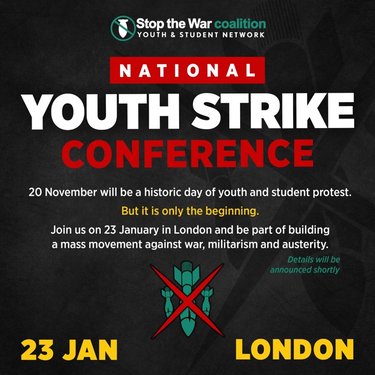
Youth Strike Conference - Saturday, January 23, 2027

At a time when education and welfare for the young are being cut, an extra £15 billion is being set aside for the military. Young people have had enough! Stop the War has called a national youth strike conference in London for Saturday, January 23. Please save the date, share and tell any young person or student you know to come along.
This Saturday, November 21, on the International Day of Action Against War, Militarism & Conscription, people across Europe will be taking to the streets, demonstrating against the European drive to war and rearmament.
These demonstrations are further anti-war actions as part of a global weekend of protest against war and conscription. From Cornwall to Cambridge, Edinburgh to Blaenannerch, there will be protests, vigils, meetings and conferences taking place.
In London Stop the War will be heading to the Department for Work and Pensions where an open letter demanding the government cut war not welfare will be handed in. A rally outside the Department for Work & Pensions, Tothill Street, SW1H 9NA, will be held at midday. Speakers include: Jeremy Corbyn MP, Stephen Kapos, Lindsey German, Fran Heathcote, Andrew Feinstein, Haya Adam and Maryam Eslamdoust.
Defence Secretary Wes Streeting warned that Britain may be "1,000 days away from war". Now, over 1,000 people including MPs and trade union leaders have signed our open letter, in less than 48 hours. The government is considering a cut to young people's benefits, taking PIP from the under-25s, while simultaneously proposing spending an additional £15 billion annually on the military.
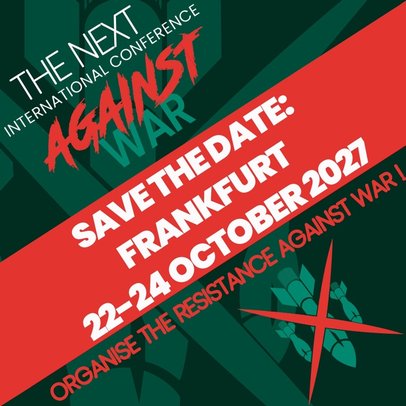
The next international conference against war - Frankfurt, October 2027
Following the successful anti-war conferences in Paris and London, Frankfurt will be hosting the next international conference in October 2027. Germany is a primary driver of militarisation in Europe and sets the course for other European states.
Europe has seen strikes and general strikes against social spending cuts and rearmament. Mass action has taken place in France, Italy, Greece, the Netherlands, Belgium, Spain and elsewhere. There have been strikes by dockworkers against arms exports, youth protests against militarisation and conscription, as well as demonstrations to end the genocide and occupation in Palestine.
Attacks on social welfare, the erosion of democracy and the militarisation of society are now taking place across the continent. We must resist.
(Stop the War Coalition)

Receive Workers' Weekly
E-mail Edition: It is free to
subscribe to the e-mail edition
We encourage all those who support the work of RCPB(ML) to also support it
financially:
Donate to
RCPB(ML)
Workers' Weekly is the weekly on
line newspaper of the
Revolutionary Communist Party of Britain (Marxist-Leninist)
Website:
http://www.rcpbml.org.uk
E-mail:
office@rcpbml.org.uk
170, Wandsworth Road, London, SW8 2LA.
Phone: 020 7627 0599: